Posts

Showing posts with the label bronze

Wheeled cauldron stands

Image
I've photographed a number of huge bronze cauldrons, including spectacular examples found in the Midas Mound Tumulus at Gordion in Turkey. But I had never given any thought as to how these huge vessels were transported when full.  I had assumed they were carried manually by servants.  But today, while researching something else, I came across images of wheeled stands that were used to transport large cauldrons in ancient Cyprus.  Somehow I must have overlooked these interesting objects on my visits to both the British Museum and the Neues Museum in Berlin.   Bronze wheeled stand for a cauldron with an animal frieze on the ring and figures in the side panels. The panels depict a seated harp-player approached by a musician and a serving boy, a winged sphinx, a lion gripping a water bird by its neck, and a chariot, Cypriot, 13th or 12th century BCE, at the British Museum courtesy of Wikimedia Commons contributor George Groutas. Wheeled stand for a cauldron, bronze,...

Small Etruscan Bronzes

Image
The Etruscans had a strong tradition of working in bronze from very early times, and their small bronzes were widely exported. Ancient sources reveal accounts of large numbers of statues sent to Rome after their conquest.  According to Pliny, the Romans looted 2,000 bronze statues from the city of Volsinii alone after capturing it. The Etruscans excelled in portraying humans. In the 7th century BCE they started depicting human heads on canopic urns and when they started burying their dead in the late 6th century BCE they began portraying full figures on terracotta sarcophagi and funerary urns, often reclining as if at the funeral banquet. Apart from cast bronze, the Etruscans were also skilled at the engraving of cast pieces with complex linear images, whose lines were filled with a white material to highlight them.  This technique was used primarily on mirrors and cistae. Sadly, few pieces survive with the defining filling still intact. Image: Bronze statuette of a youth, lat...

Hellenistic Bronze statuette of a veiled and masked dancer, 3rd–2nd century BCE, Ptolemaic Period, Egypt

Image
A week ago, I illustrated one of my "wisdom" posts with an image of a veiled vestal virgin produced by Italian sculptor Antonio Corradini.  He is famous for his ability to use solid medium like marble to depict illusory veiled women where the contours of their face and body can be discerned beneath the "veil".  Well, this morning while browsing artifacts in the collection of the Metropolitan Museum of Art, I saw an amazing Greek bronze sculpture created in the 3rd - 2nd century BCE in Alexandria, Egypt that possesses the same ethereal quality as those much more modern sculptures of Corradini. The Metropolitan Museum of Art observes: The complex motion of this dancer is conveyed exclusively through the interaction of the body with several layers of dress. Over an undergarment that falls in deep folds and trails heavily, the figure wears a lightweight mantle, drawn tautly over her head and body by the pressure applied to it by her right arm, left hand, and right leg. ...

Elite Roman portraiture of the Republican Period

Image
Roman portrait sculpture from the Republican era tends to be somewhat more modest, realistic, and natural compared to early Imperial works  Republican Rome embraced imperfection in portraiture because, though there were different levels of power each class of society had, everybody had physical blemishes, so this type of untouched physical representation fostered a sense of community by implying that, while there were existing inequalities, that did not change the fact that they were Romans. Veristic portraits, including arguably ugly features, was also a way of showing confidence and of placing a value on strength and leadership above superficial beauty. This type of portraiture sought to show what mattered to the Romans - powerful character valued above appearances. This hyper-realism was often achieved through the production of a wax cast from the family member while they were still living, Image: Sensitively modeled bronze portrait bust of a Roman male with inlaid ivory eyes, 5...

Proto-Hittite Oxen and Cart

Image
I was researching information about some of the objects I photographed at the Dallas Museum of Art and came across a picture of this elegant Proto-Hittite oxen-drawn cart, 2000-1800 BCE.  When I first photographed the piece back in 2006 it was still quite corroded but I see the museum has since conserved it beautifully. Writing in a guide to the museum's collection, Anne Bromberg observes, "This bronze cart drawn by a pair of long-horned oxen is one of many examples of an artistic type well known from the early second millennium B.C.E. Such models were probably votive offerings, to be left in shrines, sacred caches, or tombs. They reflect the distinctive moment when men first used domesticated horses or cattle to draw wheeled vehicles, creating the beginning of powered transport on land. Although drawings of wheeled vehicles occur all over Eurasia, this seminal development in human culture probably originated in Mesopotamia or the Russian Steppes in the late third millennium B...

Art of Ancient Yemen

Image
Ancient Yemen was composed of a number of regional kingdoms including the Minaeans in the north in Wādī al-Jawf, the Sabeans on the southwestern tip, stretching from the highlands to the sea, the Qatabānians to the east of them, and the Ḥaḑramites east of them.  They were all engaged in the spice trade, especially frankincense and myrrh. They left behind many inscriptions in the monumental ancient South Arabian script or Musnad, as well as numerous documents in the related cursive Zabūr script.  Scholars disagree about their origins with some claiming these kingdoms arose about 1200 BCE.  Others say they did not begin to flourish until the 8th century BCE and lasted until they were conquered by the Himyarites.  The Himyarite Kingdom conquered neighbouring Saba' for the first time in c. 25 BCE, Qataban in c. 200 CE, and Haḍramaut c. 300 CE. The Middle Saba' kingdom rose in the early 2nd century CE with its capital established at Ma'rib. Himyar's fortunes relative to S...

Roman boxing: more bloodsport than gentleman's competition

Image
Roman boxing, far different than the boxing developed by the Greeks, was considered more of a gladiatorial show than an athletic contest. While the crowds were smaller than at the amphitheater and circus, boxing was an important part of public entertainment. Unlike Greek boxers, who wore leather thongs around their knuckles for protection and performed for prizes at the prestigious Panhellenic games, Romans used gloves with pieces of metal placed around the knuckles (caestus) to inflict the most damage possible. Moreover, there was no time limit or weight classification. Proclaiming a winner resulted from either a knockout or the conceding of defeat by one of the boxers. - The Metropolitan Museum of Art. Image: Bronze hand of a boxer 1st to 2nd century CE at the Metropolitan Museum of Art The hand is clad in a caestus (boxing glove), comprising a semicylindrical strip and a projecting spike, tied with cords running from the wrist. Although Roman boxers are represented on statue...

Jupiter Applique Roman 1st-2nd century CE at the Kunsthistorisches Museum Wien in Vienna, Austria

Image
Jupiter Applique Roman 1st-2nd century CE at the Kunsthistorisches Museum Wien in Vienna, Austria. "The Zeus of the Greeks, whom Homer already describes as the "father of men and gods", was also the highest imperial god among the Romans as Jupiter Optimus Maximus (best and greatest). The mighty head of the god, who was always bearded in Greco-Roman antiquity, bears an oak wreath. The oak was sacred to Zeus, and the rustling of i ts leaves was used to prophesy in the oracle sanctuary of Dodona. The hair streaks up over the furrowed forehead in the manner of the portrait of Alexander the Great and frames the broad face with moving, softly modeled curls. A cloth is placed over the back of the head, which falls down on the left side of the body and lies on the right shoulder. The veiling of the head is sacral, but also a reference to the cosmic sphere of clouds and sky. The winged bolt of lightning on its right side should not only be understood as a weapon of God, but a...

Gods in Color - Golden Edition: Polychromy in Antiquity through August 30, 2020 at the Liebieghaus Sculptural Museum in Frankfurt, Germany

Image
Gods in Color - Golden Edition: Polychromy in Antiquity through August 30, 2020 at the Liebieghaus Sculptural Museum in Frankfurt, Germany. The original "Gods of Color" exhibit was first presented in 2008. Now the exhibit has been expanded to include more than 100 objects from international museum collections and the holdings of the Liebieghaus, which encompass 60 recent reconstructions as well as some dating from the nineteenth century, along with 22 prints. Since the exhibition was first on view, the number of reconstructions carried out by the research team has doubled, and new aspects have come under consideration, particularly the polychromy of ancient bronzes. Originally, the painted decoration of an antique sculpture not only enhanced its appearance from the aesthetic point of view and increased its lifelike impression, but also provided the ancient viewer with important information about the identity of the figure depicted. Over the past decade, research has focu...

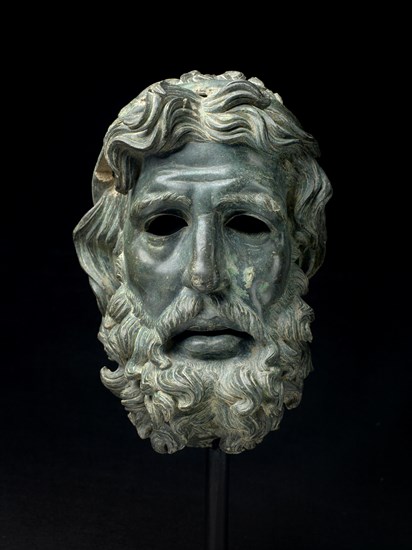
Bronze Hellenistic portrait of Antigonos Doson, one of Alexander the Great's diadochi (successors) at the Museum of Fine Arts Houston, Texas

Image
Bronze Hellenistic portrait of Antigonos Doson, one of Alexander the Great's diadochi (successors) at the Museum of Fine Arts Houston, Texas. Larger-than-life-size Greek bronze statues were focal points of temples and important public places. Unfortunately, few ancient statues have survived in complete form. Distinguishing attributes and characteristics are often missing, so coins of the period are an important source for iden tifying gods, royalty, and important persons. The identity of this Hellenistic bronze portrait head, dated between 227-221 BCE, was unclear until an exceptionally fine tetradrachm--an ancient Greek silver coin worth four drachma--minted during the reign of Macedonian king Antigonos Doson (227–221 BCE), was obtained by the museum. Coins featuring Antigonos Doson portray him as Poseidon, god of the sea--a reference to his reestablishment of Macedonia's supremacy over the sea. The bronze head and silver coin both have fine facial bone structure, deep-set...

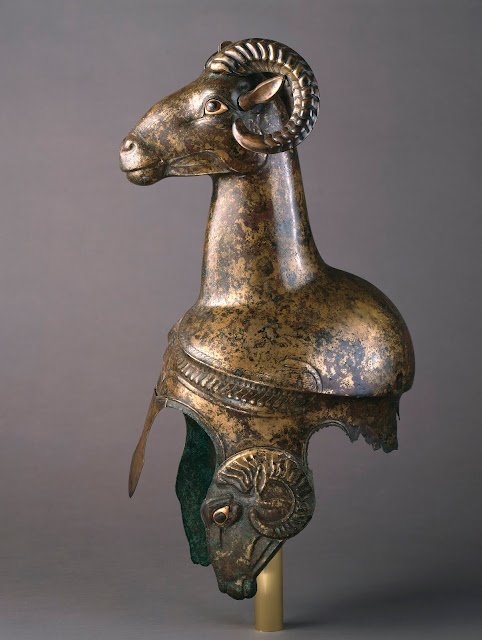
Archaic period Greek helmet with ram's head, 525-500 BCE at the Saint Louis Art Museum in Saint Louis, Missouri

Image
Archaic period Greek helmet with ram's head, 525-500 BCE at the Saint Louis Art Museum in Saint Louis, Missouri. This bronze Archaic Period helmet with a ram's head was excavated in Metaponto (ancient Metapontum) in the southern region of Italy known as Magna Graecia. The size of its decorative element indicates it was probably worn for ceremonial purposes rather than in actual combat. It was made by hammering a single sheet  of bronze, which makes it extremely light and unsuitable as actual armor. Additional decoration was added using a series of common metalworking techniques such as repoussée, punching, tracing, and engraving. The ram’s head on top, whose horns, ears, and eyes have been restored, is mirrored by the attached ram’s head cheek pieces. The selection of the ram to adorn a military-style helmet is fitting since the animals have a double-layered skull which helps protect them from injury. Image courtesy of the museum.

Nuragic bronze figurines at the Art Institute of Chicago in Chicago, Illinois

Image
Nuragic bronze figurines at the Art Institute of Chicago in Chicago, Illinois. Back in June of this year I posted about the collection of Nuragic Art at the national Archaeological Museum of Cagliari on Sardinia. Nuragic civilization lasted on the island of Sardinia from the 18th century BCE to 238 BCE when the Romans colonized the island. The term "Nuragic" is derived from the island's most characteristic monument, the nura ghe, a tower-fortress type of construction the ancient Sardinians built in large numbers. Even today more than 7,000 nuraghes dot the Sardinian landscape. If you can't make a trip to Sardinia, though, you can still see several excellent examples of Nuragic bronze figurines at the Art Institute of Chicago. These warrior people have been associated with the Sherden tribe of the late Bronze Age Sea Peoples. Simonides of Ceos and Plutarch spoke of raids by Sardinians against the island of Crete, in the same period in which the Sea People invaded E...

Kneeling Satyr at the Nelson-Atkins Museum of Art in Kansas City, Missouri.

Image
Kneeling Satyr at the Nelson-Atkins Museum of Art in Kansas City, Missouri.  Said to be from the vicinity of Pergamon, in modern-day Turkey produced during the 2nd or 1st century BCE, this bronze satyr has traces of silver in his eyes. This statuette depicts a follower of the god of wine, Dionysos. A late-night carouser, he probably served here—most appropriately—as a lamp-stand. The tree probably held oil lamps in its branches. Photographed at the Nelson-Atkins Museum of Art in Kansas City, Missouri.

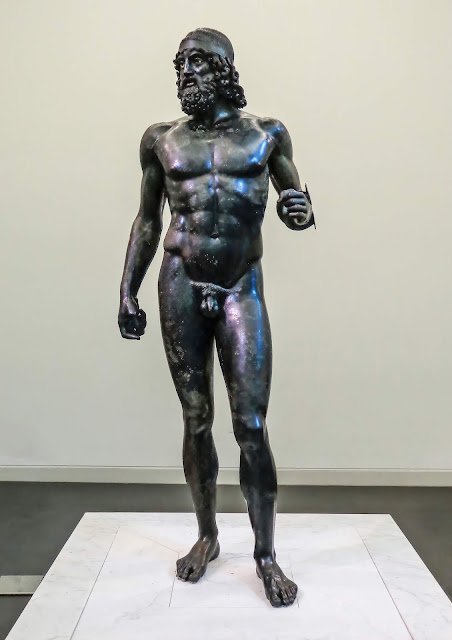
Antiquities from Dodona including the famous Riaci Warriors on exhibit through June 8, 2019 at the Archaeological Museum of Reggio Calabria, Italy

Image
Antiquities from Dodona including the famous Riaci Warriors on exhibit through June 8, 2019 at the Archaeological Museum of Reggio Calabria, Italy. Antiquities from Dodona, the ancient Greek oracle and a panhellenic sanctuary in Epirus, will be exhibited at the National Archaeological Museum of Reggio Calabria, Italy. The exhibition “Ιl Santuario di Dodona e la Magna Grecia” presents artifacts reflecting the importance of relat ions between Dodona and the cities of Magna Graecia, from the founding of the Greek colonies to the later Roman era, as documented by ancient literary sources and archaeological evidence, along with epigraphic and numismatic data. Artifacts will be on display from both the Reggio Calabria museum as well as the Archaeological Museum of Ionnina. Image: One of the Riaci warriors thought to be the work of Myron created between 460 and 450 BCE found by a snorkeling chemist near Monasterace, Italy. Image courtesy of Wikimedia Commons contributor Effems and...

Bronze Age Greek and Roman artifacts at the İzmir Archaeological Museum in İzmir, Turkey

Image
Bronze Age Greek and Roman artifacts at the İzmir Archaeological Museum in İzmir, Turkey. The İzmir Archaeological Museum originally established in 1924 contains remains from ancient Smyrna, claimed to be the birthplace of Homer, as well as Ephesus, Pergamon, Miletus, Aphrodisias, Clazomenae, Teos, and Iasos including busts, statues, statuettes, jewelry, coins, tools, architectural elements and various eating and cooking utensi ls. One of the most impressive is a life-sized late Hellenistic bronze sculpture of a running athlete wearing a victory wreath from the coast of Kyme. Image: Life-sized late Hellenistic bronze sculpture of a running athlete wearing a victory wreath from the coast of Kyme. Image courtesy of Wikimedia Commons contributor Dick Osseman.

Artifacts from ancient Egypt, the Near East, Greece, Rome, the Americas, Asia and Africa. Ongoing at the Michael C. Carlos Museum of Emory University in Atlanta, Georgia.

Image
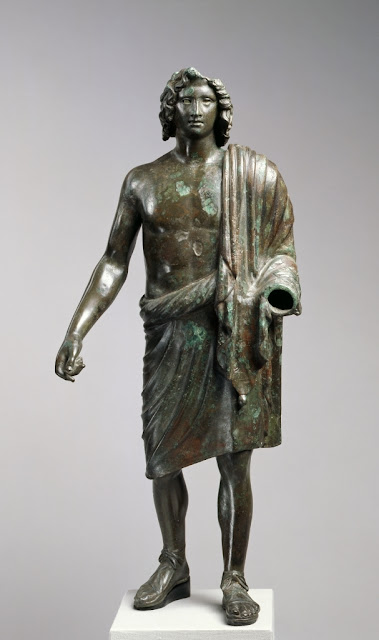
Artifacts from ancient Egypt, the Near East, Greece, Rome, the Americas, Asia and Africa.  Ongoing at the Michael C. Carlos Museum of Emory University in Atlanta, Georgia.  Some 17,000 artifacts from ancient Egypt, the Near East, Greece, Rome, the Americas, Asia, and Africa, as well as works on paper from the Renaissance to the present day, provide visitors with a glimpse into the art and history of world cultures. Image: Clothing and posture identify this 1st to 2nd century CE figure from Alexandria, Egypt as Hermanubis, a Greco-Egyptian deity who combines the essences of the Greek god Hermes with the Egyptian Anubis. The syncretism of Hermes and Anubis arises from the function of both deities to guide souls to the Underworld. Distinctive in the clothing of Hermanubis is a garment that wraps around the waist with a roll of cloth, with one end falling over the left shoulder. In his left hand he may have held a palm branch, while in his right the caduceus (herald's staff...

Ancient Mediterranean and Near Eastern Bronzes, Ongoing, at the Harvard Art Museums, Cambridge, Massachusetts

Image
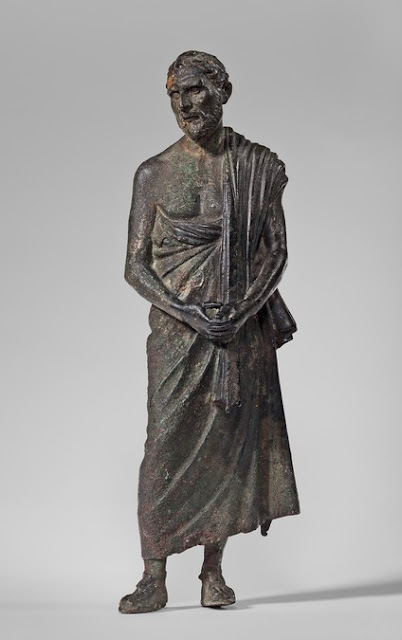
Ancient Mediterranean and Near Eastern Bronzes, Ongoing, at the Harvard Art Museums, Cambridge, Massachusetts Portrait Statuette of the Greek Orator Demosthenes Early Roman copy of a Greek original courtesy of the Harvard Art Museum. For more than 5,000 years, bronze and other copper alloys have been essential materials, used to create everything from life-size sculpture to objects of daily life, such as weapons, jewelry, and tableware. Copper alloy objects were especially prestigious due to the intrinsic value of the metal, which has also been used for coinage for thousands of years. The Harvard Art Museums’ collection of ancient bronze objects ranges from masterpieces, such as the statuette of the philosopher Demosthenes, to utilitarian objects, such as writing tools, clothing fasteners, and lamps. The objects date from the early Bronze Age through the Byzantine period and originate from Europe, the Middle East, Central Asia, and North Africa. The collection contains significa...