Posts

Showing posts with the label Ptolemaic

Ptolemaic dynastic portraits using a combination of marble and stucco: Economy, Practicality, or Distinctive Style?

Image
"Beginning with Ptolemy I Soter, the Ptolemaic dynasty reigned from 305 BCE to 30 BCE, when the last Ptolemaic ruler, Kleopatra VII, committed suicide, and Octavian made Egypt a province of Rome. In their capital at Alexandria and in historically prominent Egyptian cities and sanctuaries, the Ptolemies continued the practices of their pharaonic predecessors in an attempt to integrate themselves into Egyptian society and their images into Egypt’s visual culture," explains Yale University's Susan B. Matheson. "They employed architecture and sculpture to help establish their rightful place as rulers and to present themselves as a dynasty like those that came before. This impressive display of public art featured primarily Egyptian iconography and style. Egyptian dress and traditional royal and divine attributes were typical, and inscriptions were generally in the native hieroglyphic script." Matheson points out that Ptolemaic dynastic portraits ranged from those ap...

The cult of Serapis: Visions and Portents

Image
Serapis, sometimes spelled Sarapis, is a Graeco-Egyptian deity promoted during the 3rd century BCE by Ptolemy I Soter as a means to unify Greeks and Egyptians in his realm.  Alexander the Great had attempted to use Amun for this purpose, but he was more prominent in Upper Egypt, and not as popular in Lower Egypt, where the Greeks had stronger influence. Ptolemy built an immense temple to the god in Alexandria which became known as the Serapeum.   However, there is evidence the cult of Serapis existed before the Ptolemies came to power in Alexandria as a temple of Serapis in Egypt is mentioned in 323 BCE by both Plutarch (Life of Alexander, 76) and Arrian (Anabasis, VII, 26, 2).  In descriptions of Alexander's death, a temple of Serapis is said to have existed in Babylon at the time and Serapis was considered so important,  he alone is named as being consulted on behalf of the dying king.  Some scholars point out, though, that a Babylonian god named Ea (also...

Hellenistic Bronze statuette of a veiled and masked dancer, 3rd–2nd century BCE, Ptolemaic Period, Egypt

Image
A week ago, I illustrated one of my "wisdom" posts with an image of a veiled vestal virgin produced by Italian sculptor Antonio Corradini.  He is famous for his ability to use solid medium like marble to depict illusory veiled women where the contours of their face and body can be discerned beneath the "veil".  Well, this morning while browsing artifacts in the collection of the Metropolitan Museum of Art, I saw an amazing Greek bronze sculpture created in the 3rd - 2nd century BCE in Alexandria, Egypt that possesses the same ethereal quality as those much more modern sculptures of Corradini. The Metropolitan Museum of Art observes: The complex motion of this dancer is conveyed exclusively through the interaction of the body with several layers of dress. Over an undergarment that falls in deep folds and trails heavily, the figure wears a lightweight mantle, drawn tautly over her head and body by the pressure applied to it by her right arm, left hand, and right leg. ...

Egyptian male, probably Ptolemaic to Roman Period, 100 BCE - 100 CE

Image
 Egyptian male, probably Ptolemaic to Roman Period, 100 BCE - 100 CE grey-black basalt.  Once part of a statue placed in a temple as a votive gift,  the sculpture portrays an older man with firmly set facial features.  Signs of age, with hints of bittersweet emotion, appear only in the private sculpture of the Late and Ptolemaic Period, never in royal works.  This is in direct opposition to works of the Middle Kingdom where signs of age, wariness, and care appeared first in royal facial features.  - Walters Art Museum Image: Egyptian male, probably Ptolemaic to Roman Period, 100 BCE - 100 CE,  grey-black basalt, that I photographed at the Walters Art Museum in Baltimore, Maryland.

Ptolemaic Greek funerary traditions in Alexandria, Egypt

Image
During the Ptolemaic period a distinctive type of subterranean tomb for multiple burials proliferated in the cemeteries around the city of Alexandria. Underground chambers cut into the living rock radiated from a central courtyard open to the sky. Most chambers contained a number of loculi, long narrow niches cut into the walls, which served as burial slots. Some loculi were sealed with painted limestone slabs in the form of small shrines. Here, a lively depiction of a man trying to bridle a horse, while a boy stands behind him, commemorates a man from Thessaly in Northern Greece, who must have been one of the many foreigners who congregated in the wealthy, cosmopolitan Ptolemaic capital. - Metropolitan Museum of Art Image: Painted limestone funerary slab with a man controlling a rearing horse 2nd half of 3rd century B.C.E. at the Metropolitan Museum of Art

Arts of Africa and the Americas. Ongoing. At the Minneapolis Institute of Art. Minneapolis, Minnesota

Image
Arts of Africa and the Americas. Ongoing. At the Minneapolis Institute of Art. Minneapolis, Minnesota Bronze Graeco-Egyptian sculpture of a Ptolemaic ruler in the guise of Herakles 2nd century BCE. Image courtesy of the Minneapolis Institute of Art in Minneapolis, Minnesota. The Arts of Africa and the Americas Department is dedicated to the immense creativity of Native peoples across the world, from prehistory to the present. The collection has grown significantly since the department was founded more than 30 years ago, and now numbers more than 5,500 objects, including masterworks of sculpture, ceram ics, textiles, metalsmithing, painting, basketry, and bead, shell, and quillwork, reflecting the diversity of these regions and cultures.

Egypt: The Time of Pharaohs. Through December 31, 2018 at the Royal BC Museum in Victoria, British Columbia, Canada

Image
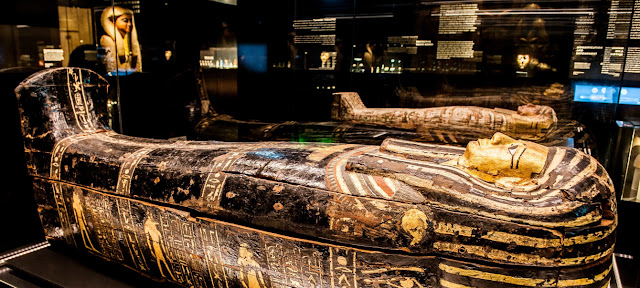
Egypt: The Time of Pharaohs. Through December 31, 2018 at the Royal BC Museum in Victoria, British Columbia, Canada . Experience a time when civilization grew along the Nile, pyramids dotted the skyline and people believed gods walked among us. With more than 300 original artifacts, some an astounding 4,500 years old, this exhibition covers all aspects of ancient Egyptian life, from the emergence of ancient Egyptian civilization along the Nile to the Ptolemaic and Roman eras. Be among the first in North America to see this exhibition’s priceless ancient artifacts, such as the coffin of Nakht, an exceptional bust of Hatshepsut and an ornate gold and garnet necklace from the Ptolemaic period. Images courtesy of the Royal BC Museum