Posts

Ancient Nubia Now from October 13, 2019 to January 20, 2020 at the Boston Museum of Fine Arts
Image
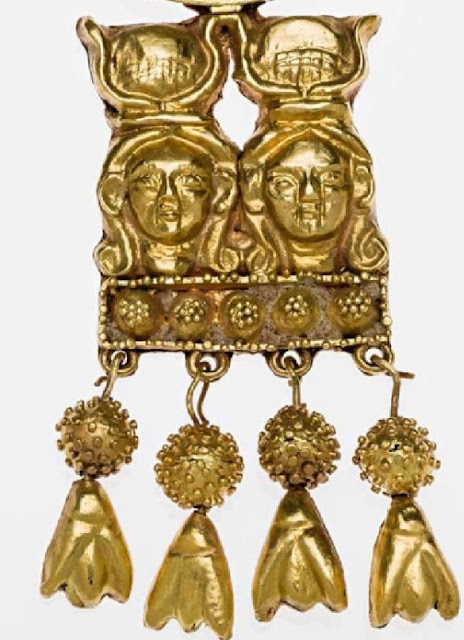
Ancient Nubia Now from October 13, 2019 to January 20, 2020 at the Boston Museum of Fine Arts. Between 2400 BCE and 300 CE, a series of kingdoms flourished in what is today the Sudanese Nile Valley, a region known in antiquity as Kush and by modern scholars as Nubia. Ruling from the capitals of Kerma (2400–1550 BCE), Napata (800–300 BCE), and Meroe (300 BCE–300 CE), Nubian kings and queens controlled vast empires and trade netwo rks, rivalling—and even for a brief time conquering—their more famous neighbors, the Egyptians. The Nubians left behind the remains of cities, temples, palaces, and pyramids, and their artists and craftspeople produced magnificent jewelry, pottery, metalwork, furniture, and sculpture. “Ancient Nubia Now” features more than 400 highlights from the collection, many never before exhibited. Among the highlights are the exquisite jewels of Nubia’s queens, the nearly lifesize statue of Senkamanisken from the sacred mountain of Gebel Barkal, the army of funerary f...

In the Round: Ancient Art from All Sides through October 2019 at the Bowdoin College Museum of Art, in Brunswick, Maine

Image
In the Round: Ancient Art from All Sides through October 2019 at the Bowdoin College Museum of Art, in Brunswick, Maine. This exhibition examines the geometry and design of ancient art and the efforts by artists to represent depth and movement by influencing the vantage point of the viewer. By simply flipping a coin, rotating a vase, or walking around a sculpture, the composition changes and new perspectives emerge. Using artifac ts from the ancient Mediterranean, In the Round explores early innovations in representational art. Image: Mummy Portrait of a Lady, Egypt, Roman Period 100-150 CE Stucco and glass courtesy of the Bowdoin College Museum of Art.

Course of Empire painting series by Thomas Cole

Image
While looking for an illustration for today's quote, I found this series of images painted by American artist Thomas Cole in 1836 eerily preceding the American Civil War. The series is called "The Course of Empire" with "Consumation", "Destruction", and "Desolation" of an imaginary Greco-Roman city depicted here. There are two other paintings entitled "Savage State" and "Pastoral State" but I think we're way past those stages. All images are courtesy of Wikimedia Commons. The series was commissioned by New York merchant Luman Reed and is now in the collections of the New York Historical Society. "Course of Empire: Consummation" by Thomas Cole, 1836 "Course of Empire: Destruction" by Thomas Cole, 1836 "Course of Empire: Desolation" by Thomas Cole, 1836

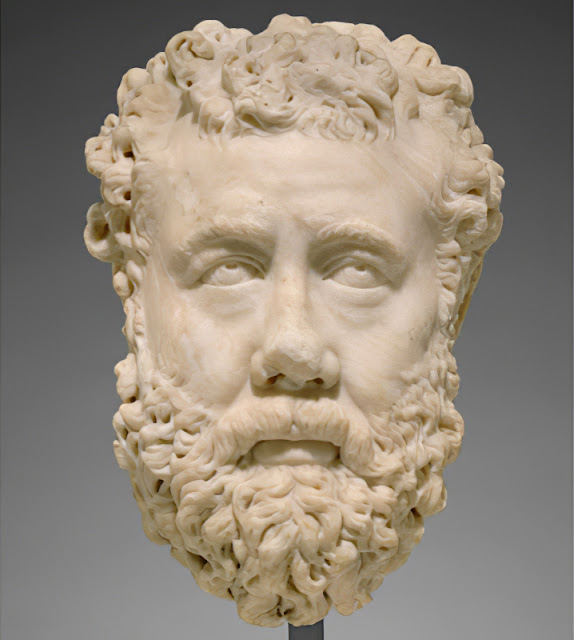
Style and Status: Power Beards of the Ancient World October 26-27, 2019 11 a.m. - 3 p.m. at the Getty Villa in Pacific Palisades, California

Image
Style and Status: Power Beards of the Ancient World October 26-27, 2019 11 a.m. - 3 p.m. at the Getty Villa in Pacific Palisades, California. In antiquity, facial hair and beards were not just for looks - they also helped identify men as leaders, thinkers, and warriors. Watch a stylist recreate beards from ancient Assyria, Greece, and Rome. Then make your own beard or body oil evoking ancient scents, and attend the same-da y free lecture The Meaning of Beards: From Antiquity to Today to learn more about the role of beards through time. While at the Getty Villa be sure to allow enough time to view the exhibit "Buried by Vesuvius, Treasures from the Villa dei Papiri" ending October 28, 2019. Image: Portrait of a Bearded Man, 200-225 CE, marble, courtesy of the J. Paul Getty Museum.

Peter and Pan – From Ancient Greece to Neverland through December 11, 2019 at the Israel Museum in Jerusalem.

Image
Peter and Pan – From Ancient Greece to Neverland through December 11, 2019 at the Israel Museum in Jerusalem. This exhibition will present the detailed metamorphosis and transitions made by Greek god Pan into the modern character of Peter Pan. The exhibit examines both social contexts of this transformation and investigates the changes of life from all vantage points, culturally, economically, socially and more. The exhibit in cludes a collection of archeological artifacts including those on loan from the Louvre in Paris, as well as first and second edition books by J.M Barrie including original illustrations. Images (my own, not from the exhibition): Pan closeup from Pan and Daphnis at the National Archaeological Museum in Naples 2nd century CE Pan from the Theater of Pompey in Rome, Italy 1st century BCE Pan mosaic from villa in Genazzano thought to have belonged to Marcus Aurelius 138-192 CE Pan on 2nd century CE Roman sarcophagus depicting Dionysus preparin...

The Road to Palmyra through March 1, 2020 at the Ny Carlsberg Glyptotek in Copenhagen

Image
The Road to Palmyra through March 1, 2020 at the Ny Carlsberg Glyptotek in Copenhagen. Harald Ingholt, a Danish archaeologist, was on his third campaign of excavations at Palmyra, in present-day Syria, in 1928, when his team unearthed a half-length portrait of an unknown woman made between 190 and 210 CE in a tomb dubbed Qasr Abjad. The following year Ingholt presented The Beauty of Palmyra and around a dozen other sculptures  to Copenhagen’s Ny Carlsberg Glyptotek. Today, the Glyptotek’s collection of Palmyrene tomb sculptures is the largest outside Syria. For the past 18 months, Cecilie Brøns, an archaeologist and director of the Glyptotek’s Tracking Colour project, which examines the use of pigments in antiquity, has led a team reconstructing how the tomb sculpture may originally have looked. Using X-ray fluorescence, the team identified paint patches, mostly red and yellow ochre, which were well ­preserved due to the sculpture having been ­underground for nearly two millenn...

Ancient Iran: a glimpse of Persian art and architecture under the Sassanids

Image
Ancient Iran: a glimpse of Persian art and architecture under the Sassanids.  The Sassanid dynasty of ancient Persia was established in 224 CE when Ardashir I overthrew the Parthian empire.  Sassanid monuments in such cities as Ardashir Khurreh and Bishapur incorporate domes and squinches, or arched openings, in four sides of a square structure.  This architectural form, used extensively in religious architecture after the adoption of Zoroastrianism as the state religion, was continued during the subsequent Islamic era. It was also used in the grandiose palaces at Ctesiphon, Firuzabd, and Sarvestan.  It was during this period that the bas-reliefs on limestone cliffs, including  Bishapur, Naqsh-e Rostam and Naqsh-e Rajab in southern Iran were created.  In 2018, UNESCO added an ensemble of Sassanian historical cities in southern Iran, entitled “Sassanid Archaeological Landscape of Fars Region”, to its World Heritage list.  The Sassanids also practiced h...