Posts

Greek, Roman, Egyptian, and Nabatean Art at the Cincinnati Art Museum in Cincinnati, Ohio.
Image
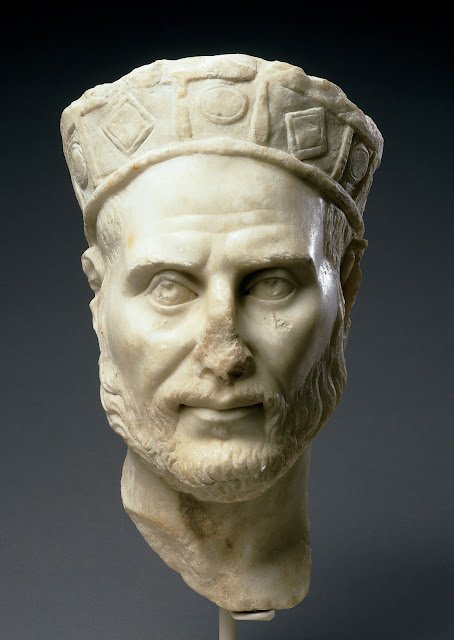
Greek, Roman, Egyptian, and Nabatean Art at the Cincinnati Art Museum in Cincinnati, Ohio.  Portrait head of a priest or magistrate from Greece or Asia Minor, 3rd century CE. Image courtesy of the Cincinnati Art Museum. The Cincinnati Art Museum possesses a distinguished collection of ancient art from the Mediterranean region and the Near East. Spanning some four thousand years from the fourth millennium B.C.E. to the early centuries C.E. This notable collection features major examples of stone sculpture, decorated metalwork, painted wall carvings  and ceramic vessels from ancient Egypt, Greece and Rome as well as an exceptional collection of Nabataean sculpture and decorated architecture—the largest collection of material of its kind outside of Jordan.
Ancient Mediterranean and Near Eastern Bronzes, Ongoing, at the Harvard Art Museums, Cambridge, Massachusetts

Image
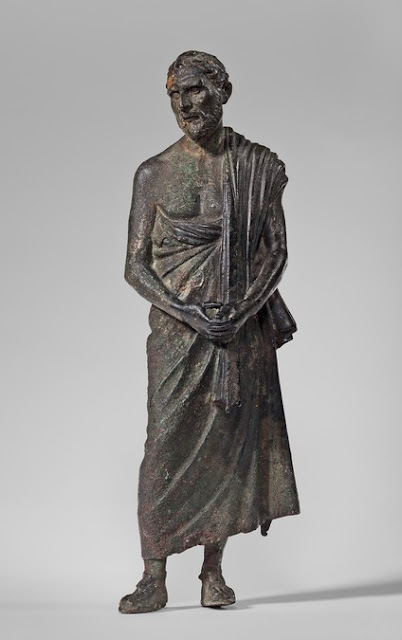
Ancient Mediterranean and Near Eastern Bronzes, Ongoing, at the Harvard Art Museums, Cambridge, Massachusetts Portrait Statuette of the Greek Orator Demosthenes Early Roman copy of a Greek original courtesy of the Harvard Art Museum. For more than 5,000 years, bronze and other copper alloys have been essential materials, used to create everything from life-size sculpture to objects of daily life, such as weapons, jewelry, and tableware. Copper alloy objects were especially prestigious due to the intrinsic value of the metal, which has also been used for coinage for thousands of years. The Harvard Art Museums’ collection of ancient bronze objects ranges from masterpieces, such as the statuette of the philosopher Demosthenes, to utilitarian objects, such as writing tools, clothing fasteners, and lamps. The objects date from the early Bronze Age through the Byzantine period and originate from Europe, the Middle East, Central Asia, and North Africa. The collection contains significa...

Antinous: Boy Made God Through February 24, 2019 at the Ashmolean Museum in Oxford, England.

Image
Antinous: Boy Made God - September 25, 2018 - February 24, 2019 at the Ashmolean Museum in Oxford, England. Antinous as Dionysos Roman 2nd century CE at the Archaeological Museum in Naples, Italy. Antinous was a boy-favorite of the Emperor Hadrian. He drowned in the Nile in A.D. 130, and the emperor founded a city in middle Egypt in his honor called Antinoopolis or ‘Antinous City’. A striking portrait of the boy was created by a great court sculptor, and this image was widely reproduced around the empire. More than eighty busts and statues survive. This exhibition explores the spread of Antinous’ image and his empire-wide cult as a hero and god.

Classical art of ancient Greece and Rome at the North Carolina Museum of Art in Raleigh, North Carolina.

Image
Classical art of ancient Greece and Rome. Ongoing. At the North Carolina Museum of Art in Raleigh, North Carolina.  Head of a Woman in the Guise of a Goddess 1st century CE copper alloy and silver.  Image courtesy of the North Carolina Museum of Art in Raleigh, North Carolina The influence of other Mediterranean civilizations—such as ancient Egypt—is often visible in Greek, Roman or Cypriot art, attesting not only to the cultural and commercial exchanges throughout the region, but also to the Greek colonization of North Africa and Western Asia during the Hellenistic period and the vastness of the Roman Empire. In this exhibit, visitors can compare the Figure of a Youth from Cyprus with the Egyptian Figure of a Man, and note the Greek Hydria (probably from Egypt) as well as the Egypto-Roman statuette of Aphrodite-Isis. Many works of classical art also bring to life ancient personalities, such as Marcus Aurelius in this museum's portrait of the emperor and the playwrights...

Iron Age burials of Keltenmuseum. Ongoing. At the Keltenmuseum in Hallein, Austria near Salzburg

Image
Iron Age burials of Keltenmuseum.  Ongoing.  At the Keltenmuseum in Hallein, Austria near Salzburg,  Reconstructed chariot found in Grave 44 of the excavations around the salt min at Dürrnberg, Austria. Image courtesy of Wolfgang Sauber, Wikimedia Commons . Collections include the grave goods of a  'princely' warrior buried with a wooden jug that had bronze mounts, one of which is the stylised Celtic head which is used as the logo of the Keltenmuseum, a spouted bronze pilgrim flask, and a bucket shaped vessel which contained an Athenian pottery kylix dated to around 470BCE. At the feet of this warrior was his pointed bronze helmet, of typical La Tène type, an Iron sword, a bow and arrow and three lances as well as a small gold model of a boat with two oars symbolic of the journey to the afterlife.  Other items on display from other La Tène type burials include amber jewelry, Celtic bronze vessels, and reconstructed chariots.

Armenia. Through January 13, 2019 at the Metropolitan Museum of Art in New York City.

Image
Armenia. Through January 13, 2019 at the Metropolitan Museum of Art in New York City. Bronze censor with engraved and chased details. 7th-8th century CE.  Image courtesy of the History Museum of Armenia, Yerevan (1265) This is the first major exhibition to explore the remarkable artistic and cultural achievements of the Armenian people in a global context over fourteen centuries—from the fourth century, when the Armenians converted to Christianity in their homeland at the base of Mount Ararat, to the seventeenth century, when Armenian control of global trade routes first brought books printed in Armenian into the region. Through some 140 objects - including opulent gilded reliquaries, richly illuminated manuscripts, rare textiles, cross stones (khachkars), precious liturgical furnishings, church models, and printed books.

Devotion and Decadence: The Berthouville Treasure and Roman Luxury

Image
Devotion and Decadence: The Berthouville Treasure and Roman Luxury is back in the US for its last appearance at New York University's Institute for the Study of the Ancient World from October 17, 2018 Silver cup with centaurs, Roman, middle of the 1st century CE. From the Treasure of Berthouville, recovered in 1830. Image courtesy of Wikimedia Commons user Jastrow. Devotion and Decadence: The Berthouville Treasure and Roman Luxury is back in the US for its last appearance at New York University's Institute for the Study of the Ancient World from October 17, 2018 – January 6, 2019. Recognized today as one of the finest surviving hoards of ancient Roman silver, the Berthouville Treasure was discovered by a French farmer while plowing his field near the village of Berthouville, in Normandy. The cache—comprising approximately ninety silver and gilt-silver objects dating from the first to third centuries CE—had been buried in a brick-lined pit in antiquity. The exhibit i...