Posts

Showing posts with the label statue

Rome's integration of Isis

Image
In the first millennium BCE, Osiris and Isis became the most widely worshipped Egyptian deities, and Isis absorbed traits from many other goddesses. Rulers in Egypt and its neighbor to the south, Nubia, built temples dedicated primarily to Isis, and her temple at Philae was a religious center for Egyptians and Nubians alike. Her reputed magical power was greater than that of all other gods, and she was said to protect the kingdom from its enemies, govern the skies and the natural world, and have power over fate itself. In the Hellenistic period (323–30 BCE), when Egypt was ruled and settled by Greeks, Isis was worshipped by Greeks and Egyptians, along with a new god, Serapis. Their worship diffused into the wider Mediterranean world. Isis's Greek devotees ascribed to her traits taken from Greek deities, such as the invention of marriage and the protection of ships at sea, and she retained strong links with Egypt and other Egyptian deities who were popular in the Hellenistic world, ...

Mars, The Roman God of War

Image
Statue of the Roman emperor Hadrian as Mars, God of War, 117–125 CE, that I photographed at the Capitoline Museums, Rome, Italy In ancient Roman religion and myth, Mars was the god of war and also an agricultural guardian, a combination characteristic of early Rome. He was the son of Jupiter and Juno, and he was the most prominent of the military gods in the religion of the Roman army.  Under the influence of Greek culture, Mars was identified with the Greek god Ares, whose myths were reinterpreted in Roman literature and art under the name of Mars. But the character and dignity of Mars differed in fundamental ways from that of his Greek counterpart, who is often treated with contempt and revulsion in Greek literature. Mars' altar in the Campus Martius, the area of Rome that took its name from him, was supposed to have been dedicated by Numa, the peace-loving semi-legendary second king of Rome. Although the center of Mars's worship was originally located outside the sacred boun...

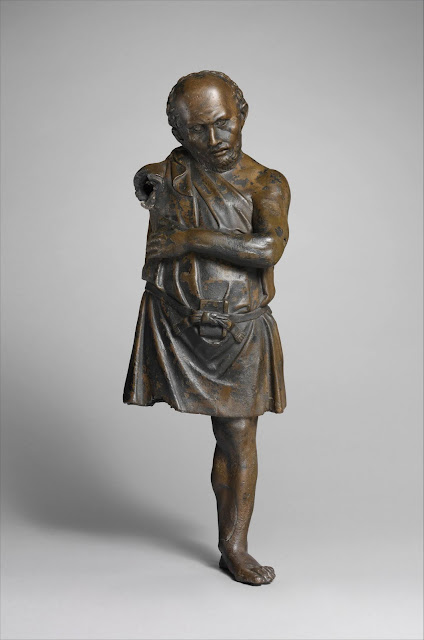
Bronze statuette of an artisan with silver eyes, mid-1st century BCE, Greek

Image
This statuette is remarkable for its synthesis of Hellenistic immediacy and Classical composure. The figure can be identified as an artisan by his dress and muscular build. Particularly telling is the pair of wax tablets tucked in his belt—the equivalent of a note pad—on which he would have written or drawn with a pointed stylus. The portrait is imbued with great psychological power and may represent a famous, even mythological, figure. For example, he may portray the Homeric hero Epeios, who with Athena's help carved the Trojan horse. It has also been proposed that he is the legendary master craftsman Daidalos, who built the labyrinth at Knossos, or even the famous fifth century B.C. Athenian sculptor Phidias, creator of the chryselephantine cult statue of Zeus at Olympia and master craftsman of the sculptures of the Parthenon on the Athenian Akropolis. - Metropolitan Museum of Art Bronze statuette of an artisan with silver eyes, mid-1st century BCE, Greek, courtesy of the Metropo...

Small Etruscan Bronzes

Image
The Etruscans had a strong tradition of working in bronze from very early times, and their small bronzes were widely exported. Ancient sources reveal accounts of large numbers of statues sent to Rome after their conquest.  According to Pliny, the Romans looted 2,000 bronze statues from the city of Volsinii alone after capturing it. The Etruscans excelled in portraying humans. In the 7th century BCE they started depicting human heads on canopic urns and when they started burying their dead in the late 6th century BCE they began portraying full figures on terracotta sarcophagi and funerary urns, often reclining as if at the funeral banquet. Apart from cast bronze, the Etruscans were also skilled at the engraving of cast pieces with complex linear images, whose lines were filled with a white material to highlight them.  This technique was used primarily on mirrors and cistae. Sadly, few pieces survive with the defining filling still intact. Image: Bronze statuette of a youth, lat...

Artifacts from archaeological expeditions to the ancient city of Ephesus on display at the Ephesos Museum in Vienna, Austria

Image
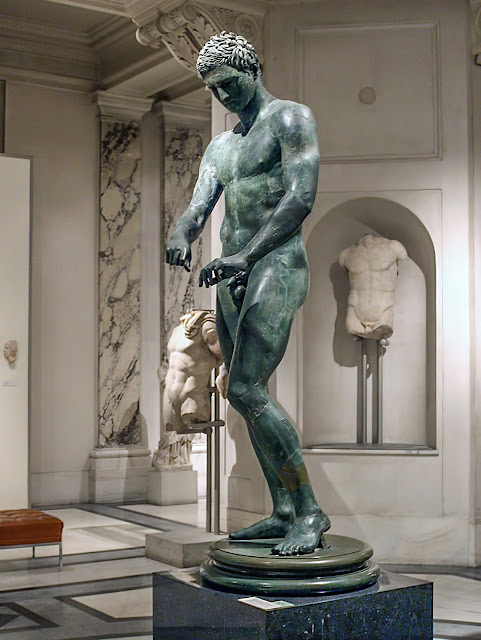
Artifacts from archaeological expeditions to the ancient city of Ephesus on display at the Ephesos Museum in Vienna, Austria. The Ephesos Museum in Vienna displays antiquities from the city of Ephesus, in modern-day Turkey. Begun in the late 19th century, the collection includes original works of sculpture and architecture from seven expeditions between 1896 and 1906. Works include remnants from the late-Classical Altar of Art emis, including a 4th century BCE sculpture of an Amazon, the Parthian Monument commemorating the campaigns of the Roman Emperor Lucius Verus, a model of ancient Ephesus, architectural and sculptural cult relics from the Sanctuary of the Great Gods, on the Greek island of Samothrace, and numerous sculptures including a Roman bronze of an athlete cleaning his strigil from the 1st century CE copied from a 4th century BCE Greek original. Image: Roman bronze of an athlete cleaning his strigil 1st century CE copy of 4th century BCE Greek original courtesy...

Henry Blundell Collection of Roman Sculpture, ongoing, at the World Museum in Liverpool, United Kingdom

Image
Henry Blundell Collection of Roman Sculpture, ongoing, at the World Museum in Liverpool, United Kingdom. Henry Blundell ( 1724-1810 ) was educated in the Classics in France and when the market for Italian antiquities dried up at the close of 18th century, Blundell purchased a variety of statues, busts and ash chests at auctions of important British collections of Roman sculpture. His collection is one of the few such collection s that remained together over the years and not scattered across different institutiions or individuals. Many of the statues and busts represent deities, heroes, and other mythological beings as well as a few well-known Roman emperors. The collection is said to be the largest collection of Roman sculpture outside of the British Museum. Image: Hermaphrodite struggling with old saytr found in the remains of a villa at Prato Bagnato on the Via Prenestina in 1776. Image courtesy of the World Museum, Liverpool then digitally enhanced.