Posts

Showing posts with the label satyr

Pan: Purveyor of Music and Panic

Image
In Greek mythology, Syrinx was a forest Nymph. In her attempt to escape the affection of the god Pan (god of the wild, shephers, and flocks with the hindquarters, legs and horns of a goat), she was transformed into a water-reed or calamos (cane-reed). Then, Pan cut several reeds, placed them in parallel one next to the other, and bound them together to make a melodic musical instrument. Ancient Greeks called this instrument Syrinx, in honour of the Muse, and Pandean, or Pan-pipes or Pan-flute, after Pan. The Syrinx, a predominantly pastoral instrument for the Greeks, was adopted by the Etruscans who played it at their festivals and banquets called it a fistula. The Romans adopted both Pan, whose Roman counterpart was Faunus, father or Bona Dea, and the Syrinx from the Greeks and the Etruscans, and they too played it at their banquets, festivals, as well as in religious and funeral processions. Despite Homer's account of the chaste nature of Odysseus' wife Penelope in "The ...

Horse Trappings in the time of Alexander the Great

Image
The power of mobility  given by mounted units in warfare was recognized early on, but was offset by the difficulty of raising large forces and by the inability of horses (then mostly small) to carry heavy armor. Nonetheless, there are indications that, from the 15th century BCE onwards, horseback riding was practiced amongst the military elites of the great states of the ancient Near East, most notably those in Egypt, Assyria, the Hittite Empire, and Mycenaean Greece. Cavalry techniques, and the rise of true cavalry, were an innovation of equestrian nomads of the Central Asian and Iranian steppe and pastoralist tribes such as the Iranic Parthians and Sarmatians.  Initially, riders had no spurs, saddles, saddle cloths, or stirrups. Fighting from the back of a horse was much more difficult than mere riding. The cavalry acted in pairs. The reins of the mounted archer were controlled by his neighbor's hand. Even so, at this early time, cavalry used swords, shields, spears, and bo...

Satyrs: The Mischief-Makers of Antiquity

Image
Satyrs in early mythology. In Greek mythology, a satyr, also known as a silenos is a male nature spirit with ears and a tail resembling those of a horse. Early artistic representations sometimes include horse-like legs, but, by the sixth century BCE, they were more often represented with human legs. Satyrs were characterized by their ribaldry and were known as lovers of wine, music, dancing, and women. They were companions of the god Dionysus and were believed to inhabit remote locales, such as woodlands, mountains, and pastures. Satyrs and silenoi in Greek mythology are thought to be derived from earlier human-equine hybrids in other Indo-European mythologies including Kimpurusas described in the Indian epic Rāmāyaṇa and the Celtic dusii, hairy demons believed to occasionally take human form and seduce mortal women. The Illyrians believed in satyr-like creatures called Deuadai. The Slavic lešiy is described as being covered in hair and having a goat's h...

Kneeling Satyr at the Nelson-Atkins Museum of Art in Kansas City, Missouri.

Image
Kneeling Satyr at the Nelson-Atkins Museum of Art in Kansas City, Missouri.  Said to be from the vicinity of Pergamon, in modern-day Turkey produced during the 2nd or 1st century BCE, this bronze satyr has traces of silver in his eyes. This statuette depicts a follower of the god of wine, Dionysos. A late-night carouser, he probably served here—most appropriately—as a lamp-stand. The tree probably held oil lamps in its branches. Photographed at the Nelson-Atkins Museum of Art in Kansas City, Missouri.

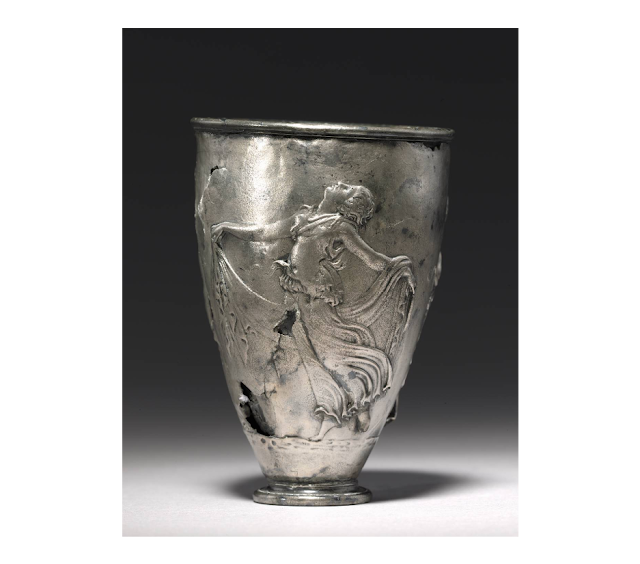
The Vicarello Goblet late 1st century BCE to early 1st century CE at the Cleveland Museum of Art

Image
The Vicarello Goblet late 1st century BCE to early 1st century CE at the Cleveland Museum of Art. This masterpiece of the Roman silversmith’s art was found north of Rome at Vicarello, the ancient Aquae Apollinares (the Springs of Apollo). Exquisitely worked in relief is a multifigure scene centered on a rustic shrine of the god Priapus. He is in the form of a stylized boundary marker placed atop a column. A woman approaching fr om the right seems to have brought him to life by touching him. To the left are votive offerings to the god arranged on top of and around a table. A satyr at the far left and a maenad at the far right dance ecstatically. - Cleveland Art Museum Image: Three views of the Vicarello Goblet from ancient Aquae Apollinares (Vicarello, Italy) courtesy of the museum.

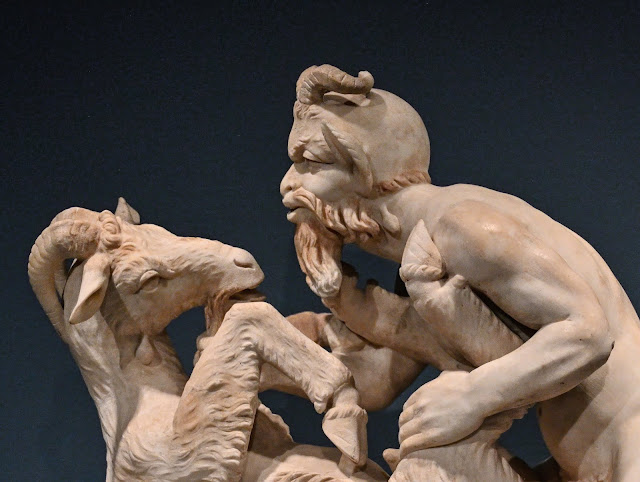
A goat and satyr "Buried by Vesuvius" at the Getty Villa until October 28, 2019

Image
A goat and satyr "Buried by Vesuvius" at the Getty Villa until October 28, 2019. The marble sculpture of the woodland god Pan having intercourse with a she-goat was discovered in the Villa dei Papiri in 1752. It immediately became notorious and was long off-limits, viewable only in the vaults of the royal palace at Portici by special permission of the king. Explicit imagery was common in antiquity. S ome modern commentators have interpreted this sculpture as evidence of the Romans’ reverence for the generative power of sex. Others have seen it as a satire on the bestial nature of all men. As many of the sculptures in the villa seem to have been grouped thematically, it is tempting to link this work with busts found nearby such as the Macedonian king Demetrios Poliorketes, often depicted with horns, like Pan, and famously dissolute. The satyr and goat were found on the south side of the rectangular peristyle on March 1, 1752. Image: Closeup of Satyr and goat found...

Two versions of Silenus "Buried by Vesuvius" at the Getty Villa through October 28, 2019

Image
Two versions of Silenus "Buried by Vesuvius" at the Getty Villa through October 28, 2019. These two silens, aged companions of the wine god Bacchus, were part of a group of four displayed around the central pool of the Villa dei Papiri’s atrium. Water issued from the wineskin and the mouth of the panther. For the erudite owners of the villa and their cultured  visitors, these statuettes may have brought to mind Greek poems describing fountain figures in the form of satyrs. One poem, attributed to Plato, reads: “A cunning master wrought me, the satyr, son of Bacchus, divinely inspiring the monolith with breath . . . Instead of purple wine I now pour forth pleasant water.” - J. Paul Getty Museum Images: Silenus with a Wineskin found near the impluvium in the atrium of the Villa dei Papiri on December 18, 1754. Silenus with a Panther also found near the impluvium in the atrium on the same date. Both figurines are Roman bronze 1st century BCE - 1st century CE. Photo...

Selected Sculptures from the exhibit Buried by Vesuvius, Treasures from the Villa dei Papiri through October 28, 2019 at the Getty Villa In Pacific Palisades, California

Image
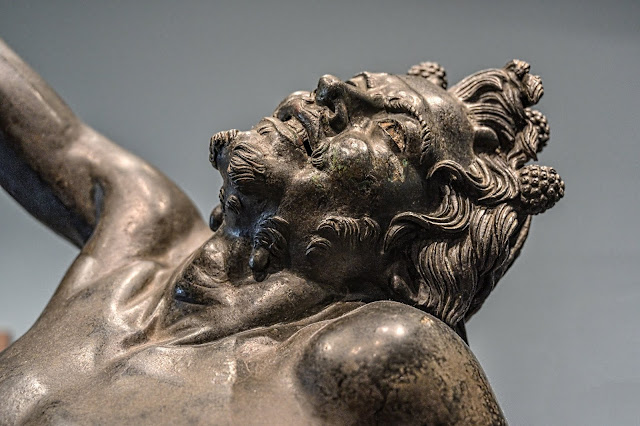
Selected Sculptures from the exhibit Buried by Vesuvius, Treasures from the Villa dei Papiri through October 28, 2019 at the Getty Villa In Pacific Palisades, California. A large collection of bronze and marble statuary as well as a thousand papyrus scrolls were rediscovered in the 1750s and 1760s when the ancient villa on the cliffs adjacent to the town of Herculaneum was excavated from the volcanic debris of the eruption of Mount Vesuvius in 79 CE.  For the next few days, we will examine some of these art objects that are featured in the current exhibit.  First of the objects is the famous drunken satyr, a replica of which basks in the sun in the Getty's large reflection pool in the outer peristyle.  Of the 65 statues and busts found at the archaeological site, the Drunken Satyr is considered the most impressive.  The statue did not emerge from the 80 feet of volcanic rock and debris  intact, however.  The right arm and left hand had become detached, a...

Henry Blundell Collection of Roman Sculpture, ongoing, at the World Museum in Liverpool, United Kingdom

Image
Henry Blundell Collection of Roman Sculpture, ongoing, at the World Museum in Liverpool, United Kingdom. Henry Blundell ( 1724-1810 ) was educated in the Classics in France and when the market for Italian antiquities dried up at the close of 18th century, Blundell purchased a variety of statues, busts and ash chests at auctions of important British collections of Roman sculpture. His collection is one of the few such collection s that remained together over the years and not scattered across different institutiions or individuals. Many of the statues and busts represent deities, heroes, and other mythological beings as well as a few well-known Roman emperors. The collection is said to be the largest collection of Roman sculpture outside of the British Museum. Image: Hermaphrodite struggling with old saytr found in the remains of a villa at Prato Bagnato on the Via Prenestina in 1776. Image courtesy of the World Museum, Liverpool then digitally enhanced.

Buried by Vesuvius: Treasures from the Villa dei Papiri June 26 to October 28, 2019 at the Getty Villa in Pacific Palisades, California.

Image
Buried by Vesuvius: Treasures from the Villa dei Papiri June 26 to October 28, 2019 at the Getty Villa in Pacific Palisades, California.  Although the Getty Villa is a reproduction of the Villa dei Papiri in Herculaneum that was swallowed by the 79 CE eruption of Vesuvius, this exhibit is the first time objects from the Villa will be featured in a special display within its California counterpart.  The original Villa yielded a private residence with spectacular colored marble and mosaic floors, gloriously frescoed walls, important bronze and marble statuary, plus a unique library of more than a thousand papyrus scrolls (from which it gets its name). The treasures, originally discovered in the 1750s will be accompanied by objects recovered recently in ongoing excavations at the site.  The newly conserved bronze sculpture known as the Drunken Satyr will be among the artwork on display.  It's modern replica graces the reflecting pool at the Getty Villa's Outer Perist...

Reopening March 1, 2019. An exploration of the ancient city of Aregenua at the Vieux la Romaine Archaeological Museum near Caen, France

Image
Reopening March 1, 2019. An exploration of the ancient city of Aregenua at the Vieux la Romaine Archaeological Museum near Caen, France. This museum's permanent collections include 4,000 objects recovered from the ancient town of Aregenua, the capital of the Viducasse tribe. Excavations beginning in 1702 under the direction of King Louis XIV uncovered a bath house and a theater. Recent excavations in 1988 revealed a large town  house with paved central courtyard and a large number of artifacts used in daily life there. In 2002, a museum was built to showcase the artifacts and provide visitor information. Image: Relief of a satyr recovered from the House of the Grand Peristyle in Aregenua. Image courtesy of the Vieux la Romaine Archaeological Museum with digital enhancements.