Posts

Showing posts with the label portrait

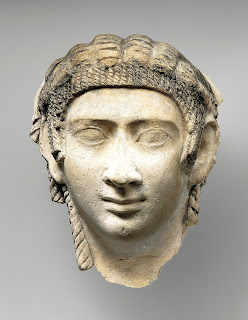
Ptolemaic dynastic portraits using a combination of marble and stucco: Economy, Practicality, or Distinctive Style?

Image
"Beginning with Ptolemy I Soter, the Ptolemaic dynasty reigned from 305 BCE to 30 BCE, when the last Ptolemaic ruler, Kleopatra VII, committed suicide, and Octavian made Egypt a province of Rome. In their capital at Alexandria and in historically prominent Egyptian cities and sanctuaries, the Ptolemies continued the practices of their pharaonic predecessors in an attempt to integrate themselves into Egyptian society and their images into Egypt’s visual culture," explains Yale University's Susan B. Matheson. "They employed architecture and sculpture to help establish their rightful place as rulers and to present themselves as a dynasty like those that came before. This impressive display of public art featured primarily Egyptian iconography and style. Egyptian dress and traditional royal and divine attributes were typical, and inscriptions were generally in the native hieroglyphic script." Matheson points out that Ptolemaic dynastic portraits ranged from those ap...

A Trajanic period Roman in Egypt

Image
This morning while I was researching a Fayum portrait of a priest of Serapis in the collections of the British Museum, I came across this encaustic portrait of what appears to be just a common Romano-Egyptian.  Although his face is painted with skill, he wears no adornments or displays even a hint of status from his clothing.  Because of the quality of the portrait, he must have been somewhat successful in whatever occupation he practiced, whether it was that of a tradesman or even a legionary.   The British Museum points out that his mummy, found in the necropolis of Hawara, was simply wrapped in coarse linen.  His closely cropped hair is similar to Roman court portraiture of the Trajanic period and he is said to confront the viewer directly in the Roman manner. The portrait appears to be an example of what became known during Trajan's rule as the portrait of the decennial, an image seemingly devoid of emotion with firm, calm features emanating authority and di...

The tragic boy emperor Philip II

Image
Philip II (Latin: Marcus Julius Severus Philippus; 237 – 249CE), also known as Philip the Younger, was the son and heir of the Roman Emperor Philip the Arab by his wife Marcia Otacilia Severa. When his father became emperor in 244, young Philip was appointed caesar at the age of only seven-years-old. In 247, he became consul, and was later elevated by his father to the rank of augustus and co-ruler.  Although ancient historians claim both Philip the Arab and his son were killed in battle by Decius.   Decius was a distinguished senator who had served as suffect consul in 232, had been governor of Moesia and Germania Inferior soon afterwards, served as governor of Hispania Tarraconensis between 235 and 238, and was urban prefect of Rome during the early reign of Emperor Philip the Arab. In 248 or 249 Decius was sent to quell the revolt of Pacatianus and his troops in Moesia and Pannonia, a rebellion seen by some modern historians as emerging Balkan separatism.  After t...

The challenge of ancient portrait identification

Image
This portrait of a well-fed 3rd century CE Roman empress caught my attention because the woman appears to be rather plump, obviously not suffering deprivation during the most tumultuous period of the crisis of the Third Century.  The Getty does not speculate on which empress this woman is so I compared it to known sculptures and coin portraits of powerful women surrounding Alexander Severus.  The longer looped hair behind the ears appears in portraits of both the emperor's mother, Julia Avita Mamaea and his first young wife, Orbiana Sallustius but neither are portrayed as plump or with the bun on the top of the head.  I could find no images of his second wife, Sulpicia Memmia, however, and his third wife's name is unknown. When Alexander was assassinated in 235 CE, he was succeeded by Maximinus Thrax.  The coin portrait of his wife, Caecilia Paulina, depict a rather hawkish woman with none of the distinctive characteristics of this portrait either. After Maximinus Th...

Greco-Roman female portraiture

Image
Head of a woman, Greek, 200-100 BCE Marble at the Yale University Art Gallery. "In Greek and Roman female portraits, private women often imitated goddesses or queens in order to gain status and influence. This head, perhaps, echoes features of the goddess Aphrodite or the Egyptian ruler Cleopatra VII (reigned 69–30 BCE).  Although extensive damage and repairs, including a damaged nose and a missing section of hair, have made examinations of the head difficult, one can still see the resemblance to the two iconic figures." "The figure’s melon hairstyle and the beginnings of what was probably a slightly aquiline nose relate the head to portraits of Cleopatra VII who is shown with these features in her more ‘masculinized’ portraits, as in her portrait on a silver denarius in the British Museum.  At the same time, the portrait of a woman also has the classic turn of the head and soft facial features one finds in portraits of typical Greek women and of Aphrodite.  Cleopatra VI...

Painted portrait shroud from a Romano-Egyptian female

Image
 Linen Shroud of a Woman Wearing a Fringed Tunic, 170–200 CE, said to be from Fayum at the Metropolitan Museum of Art in New York. This round-faced Romano-Egyptian woman wears a fine tunic with narrow clavi (stripes) and a mantle draped over her arms.  She must have been extremely wealthy as she wears a great deal of jewelry including earrings, three necklaces, six twisted gold bracelets, and three rings.  Curators are surprised by what appears to be red socks on her feet as there has been no recovery of socks in the archaeological record from this period. She apparently still practices Egyptian religion as she is flanked on either side by Egyptian deities including Anubis.  The Met curators point out that she seems to step forward from a light gray rectangle. This form could be interpreted as a doorway, a late reminiscence of the so-called False Doors of pharaonic Egypt, elaborate niches through which the dead were believed to communicate with the living.  Imag...

Mummy mask of a woman with corkscrew locks and bang, 50–150 CE, Roman Period Egypt

Image
Plaster Romano-Egyptian mummy masks of the 1st - 2nd century CE appear to be individualized, much like the famous mummy portraits of the Faiyum region. But, in fact, most were made in a mold.  Distinguishing details were added while the plaster was still moist with a spatula or knife. Ears were added separately and, sometimes, eyes were inlaid then the mask painted or gilded. "This woman's waved hairstyle is based on Roman court fashion, but three hanging corkscrew curls behind the ears and a short fringe of curls over the forehead and in front of the ears seem to reflect a local style. Toward the back of her head, above her ears, are traces of a smooth area that once represented a pillow. In general earlier Roman-period masks such as this one show the deceased as if reclining on a bier with the head on a pillow, while later masks have the head raised as if the deceased is rising from the bier. The underneath edge of this example is flat where it is meant to be attached to a b...

Elite Roman portraiture of the Republican Period

Image
Roman portrait sculpture from the Republican era tends to be somewhat more modest, realistic, and natural compared to early Imperial works  Republican Rome embraced imperfection in portraiture because, though there were different levels of power each class of society had, everybody had physical blemishes, so this type of untouched physical representation fostered a sense of community by implying that, while there were existing inequalities, that did not change the fact that they were Romans. Veristic portraits, including arguably ugly features, was also a way of showing confidence and of placing a value on strength and leadership above superficial beauty. This type of portraiture sought to show what mattered to the Romans - powerful character valued above appearances. This hyper-realism was often achieved through the production of a wax cast from the family member while they were still living, Image: Sensitively modeled bronze portrait bust of a Roman male with inlaid ivory eyes, 5...

Egyptian male, probably Ptolemaic to Roman Period, 100 BCE - 100 CE

Image
 Egyptian male, probably Ptolemaic to Roman Period, 100 BCE - 100 CE grey-black basalt.  Once part of a statue placed in a temple as a votive gift,  the sculpture portrays an older man with firmly set facial features.  Signs of age, with hints of bittersweet emotion, appear only in the private sculpture of the Late and Ptolemaic Period, never in royal works.  This is in direct opposition to works of the Middle Kingdom where signs of age, wariness, and care appeared first in royal facial features.  - Walters Art Museum Image: Egyptian male, probably Ptolemaic to Roman Period, 100 BCE - 100 CE,  grey-black basalt, that I photographed at the Walters Art Museum in Baltimore, Maryland.

Sarcophagus portrait of an Egyptian woman, ca. 1000 BCE, Third Intermediate Period, Egypt at The Field Museum

Image
 Looking through images I took of artifacts in Chicago's Field Museum way back in 2005, I saw this sensitive sarcophagus portrait of an Egyptian woman.  I had just begun photographing museum collections back then and had not yet developed my method of sequential identification information so I didn't have the full reference I like to provide whenever I feature a particular artifact.  The Field Museum also does not provide a convenient database of their collections on their website either so I had to do a bit more digging.  I used Google Images to try to locate similar images that might have more description and discovered that this portrait caused quite a stir back in 2009 after Michael Jackson's death because people thought it looked like a portrait of him.  An article referred to the piece as 3,000 years old which would place it in the early part of the Third Intermediate Period so I hope that is correct.  I found other sarcophagus images at the Field Mus...

Figure of a woman Roman 2nd century CE at the Dallas Museum of Art in Dallas, Texas

Image
This nobly restrained composite statue depicts a virtuous Roman matron of a distinguished family. She is commemorated as both a chaste wife and mother of children, and her portrait celebrates marriage as an enduring value and symbol of Roman life. This figure provides a notable contrast with the DMA's luxuriant Roman portrait head of a youth (1984.163) in both style and character. Whereas the boy exudes exuberant youth with his active gaze and foppish curls, the Roman matron embodies the discreetly refined dignity of an aristocratic lady.  She holds her mantle like a veil over her shoulder and stands in modest dignity, as though she were a priestess of the home. Often found in imperial female portrait statues, the body type is based on Greek draped figures from the 4th century BCE. Associated with the work of Late Classical sculptors such as Praxiteles or Lysippus, figures like this of the so-called Small Herculaneum type were frequently adapted in Roman art. Here the heavily drape...

Portrait of the noblewoman Lady Tjepu

Image
One of the most remarkable paintings to survive from ancient Egypt, this depiction of the noblewoman Tjepu came from a tomb built for her son Nebamun and a man named lpuky.  Egyptian artists usually did not depict individuals as they truly looked, but rather as eternally youthful, lavishly dressed, and in an attitude of repose.  Tjepu was about forty years old when this painting was executed, but she is shown in what was the height of youthful fashion during the reign of Amunhotep III: a perfumed cone on her heavy wig, a delicate side tress, and a semitransparent, fringed linen dress. - Brooklyn Museum  Image: Portrait of the noblewoman Lady Tjepu, painted gesso on limestone, New Kingdom, Dynasty 18, reign of Amunhotep III (1390-1352 BCE) from tomb no. 181 at Thebes that I photographed at the Brooklyn Museum.

Antiquities at the Toledo Museum of Art in Toledo, Ohio.

Image
Antiquities at the Toledo Museum of Art in Toledo, Ohio. The Toledo Museum of Art holds small but distinguished collections of Renaissance, Greek, Roman, Egyptian and Japanese art including a portrait bust of Gaius Julius Caesar believed to have been produced in the 1st century CE after his assassination. Its Egyptian objects include a beautifully preserved cartonnage mummy case from the Third Intermediate Period (943-716 BCE)  and a portrait head of Pharaoh Ahmose II from the Late Period, Dynasty 26, about 550 BCE. Portrait head of Gaius Julius Caesar believed to have been produced in 1 CE. Image courtesy of the Toledo Museum of Art.

Greek, Roman, Egyptian, and Nabatean Art at the Cincinnati Art Museum in Cincinnati, Ohio.

Image
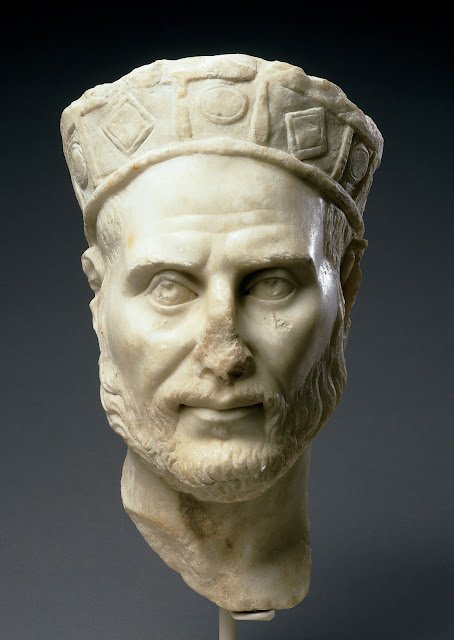
Greek, Roman, Egyptian, and Nabatean Art at the Cincinnati Art Museum in Cincinnati, Ohio.  Portrait head of a priest or magistrate from Greece or Asia Minor, 3rd century CE. Image courtesy of the Cincinnati Art Museum. The Cincinnati Art Museum possesses a distinguished collection of ancient art from the Mediterranean region and the Near East. Spanning some four thousand years from the fourth millennium B.C.E. to the early centuries C.E. This notable collection features major examples of stone sculpture, decorated metalwork, painted wall carvings  and ceramic vessels from ancient Egypt, Greece and Rome as well as an exceptional collection of Nabataean sculpture and decorated architecture—the largest collection of material of its kind outside of Jordan.