Posts

Showing posts with the label ntiquities

Bound for Disaster - Pompeii and Herculaneum through September 13, 2020 at the Moesgaard Museum

Image
Bound for Disaster - Pompeii and Herculaneum through September 13, 2020 at the Moesgaard Museum in Højbjerg, Denmark.  This exhibition presents more than 250 objects on loan from seven Italian museums and cultural institutions. Visitors will be able to view reliefs and gravestones bearing inscriptions that provide vivid descriptions of and information about family relations, frescoes featuring maritime motifs, landscapes and everyday situations, military and maritime equipment and cargoes of commodities from distant destinations and the commercial harbour at Naples. There are also mosaics and marble statues, fountains and figures related to mythology and cult, together with jewellery and other luxury goods from the Romans’ high life before the cataclysm. The exhibition also includes exhibits demonstrating the terrible consequences of the volcanic eruption, including casts of corpses from Pompeii and skeletons of the dead from Herculaneum. This museum's permanent collections totalli...

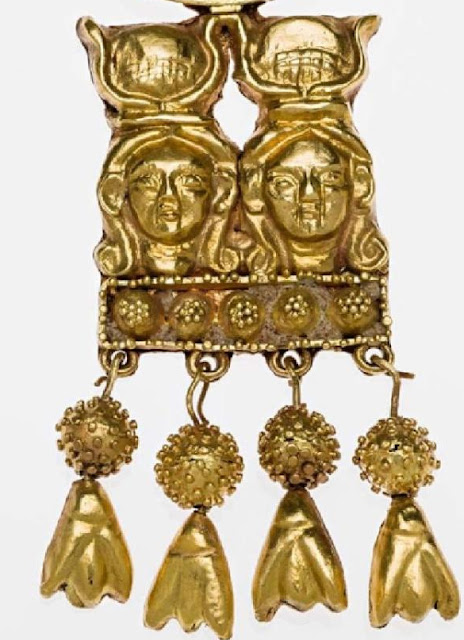
Objects recovered from the harbor of Alexandria and the underwater remains of the city of Thonis-Heracleion on display at the Egypt's Lost Cities exhibit in the Ronald Reagan Presidental Library and Museum

Image
Objects recovered from the harbor of Alexandria and the underwater remains of the city of Thonis-Heracleion on display at the Egypt's Lost Cities exhibit in the Ronald Reagan Presidental Library and Museum. Thonis-Heracleion, was an ancient Egyptian city located near the Canopic Mouth of the Nile, about 32 km (20 miles) northeast of Alexandria. Its ruins are located in Abu Qir Bay, currently 2.5 km off the coast, under 10 m (3 0 ft) of water. Heracleion is mentioned by many chroniclers in antiquity, including Herodotus, Strabo and Diodorus. The city was said by Herodotus to have been visited by Paris and Helen of Troy who sought refuge there on their flight from the jealous Menelaus before the Trojan War. In the Late Period of ancient Egypt it was the country's main port for international trade and collection of taxes. During the time when the city especially flourished between the 6th and 4th centuries B.C.E., a large temple of Amun-Gereb, the supreme god of the Egyptians ...

Beautifully detailed Greek funerary banquet relief at the Michael C. Carlos Museum, Emory University, in Atlanta, Georgia

Image
Beautifully detailed Greek funerary banquet relief at the Michael C. Carlos Museum, Emory University, in Atlanta, Georgia. The afterlife as a banquet, as depicted here, was a popular image in fourth-third century grave-reliefs. The iconography, borrowed in archaic times from the ancient Near East, was based on everyday symposia. Generic elements in this relief include the deceased, represented as a banqueter (symposiast), who holds out a libation bowl (phiale). His wife sits at the foot of his couch. In front of the couch is a table on which food (perhaps fruit or cakes) has been placed. At left, a serving boy stands beside a volute-krater holding a jug and drinking vessel with long conical body and ram's head end (rhyton). The krater is depicted on a stand, indicating that the artist intended it to be understood as metal. The startling horse's head above the serving boy may have aristocratic associations (horse-breeding and racing was the preserve only of the wealthy); ...

Woman Wearing a Peplos, possibly Demeter or Hera, "Buried by Vesuvius" at the Getty Villa until October 28, 2019.

Image
Woman Wearing a Peplos, possibly Demeter or Hera, "Buried by Vesuvius" at the Getty Villa until October 28, 2019. Exploration of the Villa dei Papiri was abandoned in 1764. Its tunnels were backfilled and its precise location underground was forgotten despite the ever-growing fame of its contents. Renewed interest in the site in the 1980s led to limited excavations in the 1990s and 2000s, which brought to light a portion of the bu ilding’s atrium as well as lower levels that were unknown in the eighteenth century. Among the new discoveries were rooms with colorful mosaic floors and spectacular frescoed walls and stuccoed ceilings. Finds also included a seaside pavilion and swimming pool, where archaeologists recovered two marble sculptures and luxurious wood and ivory furniture components. These recent excavations helped clarify the chronology of the villa, which is now thought to have been built around 40 BCE, with the seaside pavilion added around 20 CE. Reconstructe...

A contemplative Priapus, son of Dionysus and Aphrodite at the Getty Villa exhibit "Buried by Vesuvius" through October 28, 2019

Image
A contemplative Priapus, son of Dionysus and Aphrodite at the Getty Villa exhibit "Buried by Vesuvius" through October 28, 2019. In Greek mythology, Priapus was a minor rustic fertility god, protector of livestock, fruit plants, gardens and male genitalia as well as the patron of merchant sailing. Although Priapus is usually depicted in erotic imagery, the bust of the god found in the Villa dei Papiri portrays a much different  aspect of the deity and was displayed alongside busts of poets and philosophers. Originally worshiped by Greek colonists in Lampsacus in Asia Minor, the cult of Priapus spread to mainland Greece and eventually to Italy during the 3rd century BCE. Lucian tells us that in Bithynia, Priapus was accounted as a warlike god, a rustic tutor to the infant Ares. Pausanius says this god is worshiped where goats and sheep pasture or there are swarms of bees - but by the people of Lampsacus he is more revered than any other god, being called by them a son of D...

Ancient Nubia Now from October 13, 2019 to January 20, 2020 at the Boston Museum of Fine Arts

Image
Ancient Nubia Now from October 13, 2019 to January 20, 2020 at the Boston Museum of Fine Arts. Between 2400 BCE and 300 CE, a series of kingdoms flourished in what is today the Sudanese Nile Valley, a region known in antiquity as Kush and by modern scholars as Nubia. Ruling from the capitals of Kerma (2400–1550 BCE), Napata (800–300 BCE), and Meroe (300 BCE–300 CE), Nubian kings and queens controlled vast empires and trade netwo rks, rivalling—and even for a brief time conquering—their more famous neighbors, the Egyptians. The Nubians left behind the remains of cities, temples, palaces, and pyramids, and their artists and craftspeople produced magnificent jewelry, pottery, metalwork, furniture, and sculpture. “Ancient Nubia Now” features more than 400 highlights from the collection, many never before exhibited. Among the highlights are the exquisite jewels of Nubia’s queens, the nearly lifesize statue of Senkamanisken from the sacred mountain of Gebel Barkal, the army of funerary f...

Style and Status: Power Beards of the Ancient World October 26-27, 2019 11 a.m. - 3 p.m. at the Getty Villa in Pacific Palisades, California

Image
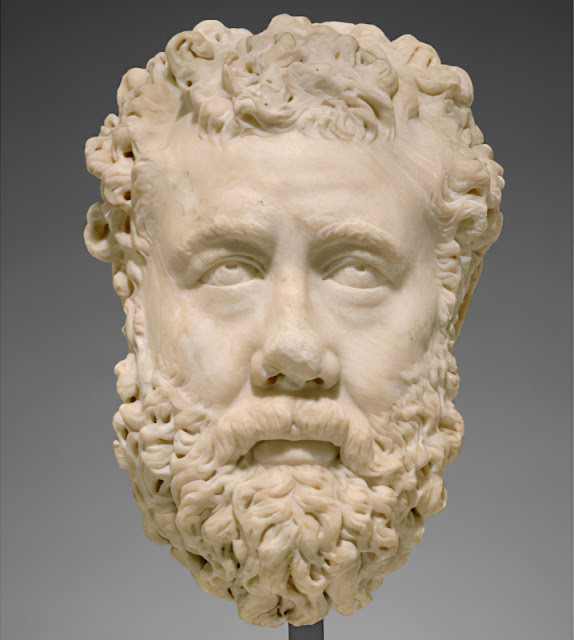
Style and Status: Power Beards of the Ancient World October 26-27, 2019 11 a.m. - 3 p.m. at the Getty Villa in Pacific Palisades, California. In antiquity, facial hair and beards were not just for looks - they also helped identify men as leaders, thinkers, and warriors. Watch a stylist recreate beards from ancient Assyria, Greece, and Rome. Then make your own beard or body oil evoking ancient scents, and attend the same-da y free lecture The Meaning of Beards: From Antiquity to Today to learn more about the role of beards through time. While at the Getty Villa be sure to allow enough time to view the exhibit "Buried by Vesuvius, Treasures from the Villa dei Papiri" ending October 28, 2019. Image: Portrait of a Bearded Man, 200-225 CE, marble, courtesy of the J. Paul Getty Museum.

Remains from the archaeological site of Piana di San Martino at the Archaeological Museum in Pianello Val Tidone, Italy

Image
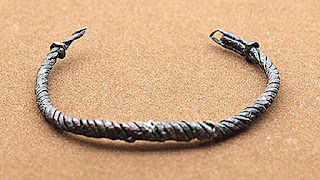
Remains from the archaeological site of Piana di San Martino at the Archaeological Museum in Pianello Val Tidone, Italy. The archaeological museum displays historically important remains found in the Tidone Valley basin that offer a picture of the history and the dynamics of the ancient populations of the area, from prehistory to the Roman age. Located in the basement of the municipal fortress of Pianello Val Tidone, the museum includes finds from the necropolis of Pianello, the Roman tomb in Ganaghello, the Roman villa near Arcello, a late antique housing structure in Trevozzo and the pre to protohistoric settlement of the 2nd and 1st millennium BCE. Images: An arm ring and vessel on display at the Archeological Museum of Val Tidone courtesy of the museum.

King Tut: Treasures of the Golden Pharaoh through September 15, 2019 at the Grande Halle de la Villette in Paris, France

Image
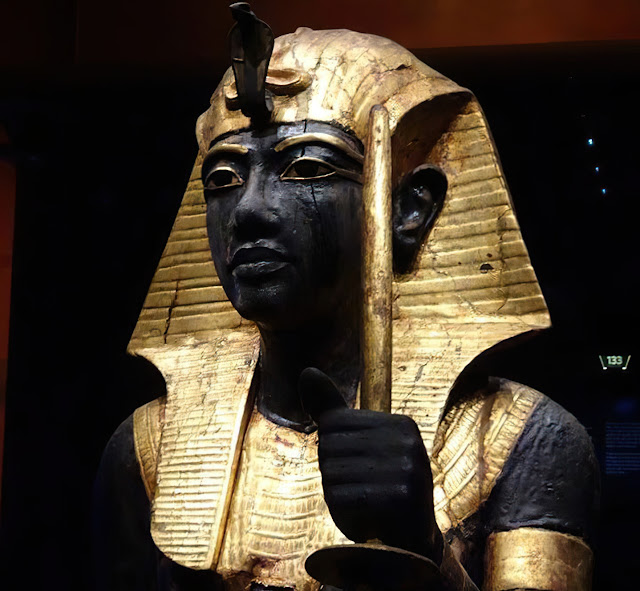
King Tut: Treasures of the Golden Pharaoh through September 15, 2019 at the Grande Halle de la Villette in Paris, France.  An exhibit said to be the last touring exhibit of actual King Tut artifacts, is now on display in Paris, France.  Although King Tut: Treasures of the Golden Pharaoh does not include the famous golden death mask, but it does include gold jewelry, sculptures, and ceremonial objects the king personally used such as gilded ushabti figurines, inlaid storage chests, Canopic utensils, the statue of Tutankhamun's ka, and vessels crafted of alabaster.  Sixty of the 150 objects have never left Egypt before.   The Louvre in Paris has loaned one of its top Egyptian pieces to the show, a statue of Amon, the king of the gods, to protect the pharaoh. Image: Guardian statue from the tomb of King Tutankhamun.  Image courtesy of "King Tut: Treasures of the Golden Pharaoh" media relations.

Museum of Ancient Cultures at McQuarie University in New South Wales, Australia

Image
Museum of Ancient Cultures at McQuarie University in New South Wales, Australia. This Museum celebrates the diversity and cultural achievements of ancient societies, including Egypt, the Ancient Near East, Greece and Rome. More than 4000 ancient objects are the core of a research-driven exhibition narrative that explores ancient daily life, afterlife beliefs, religion, technology and popular culture as well as the largest collection of ancient coins and papyrus manuscripts in the Southern Hemisphere. Roman objects date from the Villanovan and Etruscan periods to the 5th century CE. The Greek collection includes Minoan and Mycenaean material as well as objects from the Hellenistic Period. Exhibits from ancient Egypt span the periods from the Pre-dynastic to the Graeco-Roman Period. Objects from the early 3rd millenium BCE to the Late Iron Age are showcased in the galleries of the ancient Near East and Cyprus. There is even a small collection of artifacts from the Bronze Age Indus Va...

Gold of Mapungubwe at the Museum of Anthropology and Archaeology at the University of South Africa in Pretoria, South Africa

Image
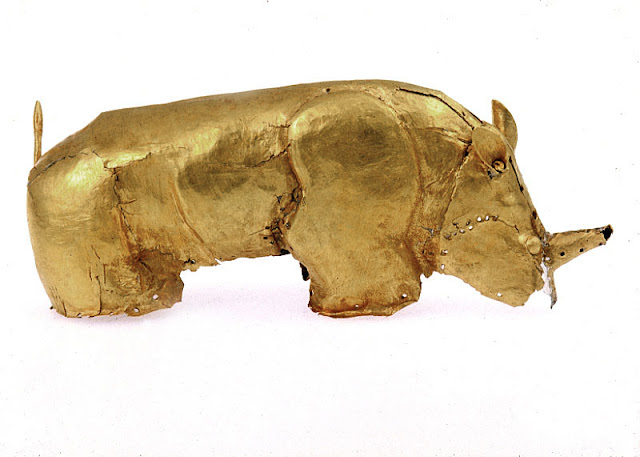
Gold of Mapungubwe at the Museum of Anthropology and Archaeology at the University of South Africa in Pretoria, South Africa.  Artifacts including objects known collectively as the Mapungubwe Gold from the Mapungubwe archaeological site discovered in 1933  are on display at this museum on the campus of the University of South Africa in Pretoria.  Mapungubwe originated as a complex Iron Age society on the borders of Zimbabwe and Botswana and evolved into the first South African state, now recognized as a World Heritage Site. This museum is home to 27,000 objects dating from prehistory to the Iron Age and beyond including pottery, beadwork, musical instruments and utensils.  Not to be missed is the paleo-anthropology collection of casts taken from original hominid fossils. Two exceptional specimens are Taung Child and Mrs Ples (both belonging to Australopithecus africanus).  Image: Golden rhinoceros found at the Mapungubwe World Heritage Site. Image courtes...

Antiquities from the Arabian Peninsula. Ongoing. At the Sharjah Archaeological Museum in Sharjah, United Arab Emirates

Image
Antiquities from the Arabian Peninsula. Ongoing. At the Sharjah Archaeological Museum in Sharjah, United Arab Emirates.  This museum's exhibits include artifacts of daily life, currencies, jewelry, pottery and ancient weapons created by civilizations in the region from the Stone Age until the rise of Islam, covering 125,000 years of occupation. Visitors can also explore tombs, cemeteries and houses through reconstructed model s and learn about the first forms of writing which appeared in this area more than 2500 years ago. The archaeological findings reveal the connections and relations between Sharjah inhabitants and their neighbors in the Arabian Peninsula, as well as with other civilizations encountered through commercial relationships from the east of the Indus Valley to the west of the Mediterranean islands. Image: Golden Bridle (150 BC - 200 CE) found buried with the remains of a horse and a camel in Mleiha. Image courtesy of the Sharjah Archaeological Museum.

The Celtic Prince of Hochdorf and his burial goods on display at The Hochdorf / Enz Celtic Museum in Eberdingen, Germany

Image
The Celtic Prince of Hochdorf and his burial goods on display at The Hochdorf / Enz Celtic Museum in Eberdingen, Germany. Twenty-five hundred years ago on the heights south of the Enz, a large wooden chamber was constructed for a Celtic prince, whose wealth and validity is reflected in the splendid gifts that followed him to the grave. The prince remained undisturbed until 1978 when his burial mound was excavated. The find promp ted the construction of The Celtic Museum in 1991. Now the prince, his wealth and artifacts from his contemporaries are on display for half a million visitors a year to this museum. Image: A recreation of the original burial chamber and grave goods courtesy of The Hochdorf / Enz Celtic Museum.

Facial Reconstructions Now On Display at the Brighton Museum in Brighton England

Image
The faces of the seven Britons, reconstructed from archaeological remains spanning 40,000 years, are on display at the Brighton Museum & Art Gallery in Brighton, England. Five of the seven individuals are true “locals,” forensically reconstructed from skulls excavated around Brighton in the southeastern county of Sussex. The most ancient natives are a Neanderthal woman and an early modern man. For full story see:   https://www.nationalgeographic.com/culture/2019/01/facial-reconstruction-history-england-uk/