Posts

Showing posts with the label mask

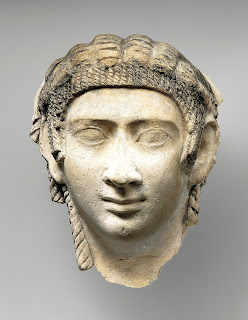
Mummy mask of a woman with corkscrew locks and bang, 50–150 CE, Roman Period Egypt
Image
Plaster Romano-Egyptian mummy masks of the 1st - 2nd century CE appear to be individualized, much like the famous mummy portraits of the Faiyum region. But, in fact, most were made in a mold.  Distinguishing details were added while the plaster was still moist with a spatula or knife. Ears were added separately and, sometimes, eyes were inlaid then the mask painted or gilded. "This woman's waved hairstyle is based on Roman court fashion, but three hanging corkscrew curls behind the ears and a short fringe of curls over the forehead and in front of the ears seem to reflect a local style. Toward the back of her head, above her ears, are traces of a smooth area that once represented a pillow. In general earlier Roman-period masks such as this one show the deceased as if reclining on a bier with the head on a pillow, while later masks have the head raised as if the deceased is rising from the bier. The underneath edge of this example is flat where it is meant to be attached to a b...

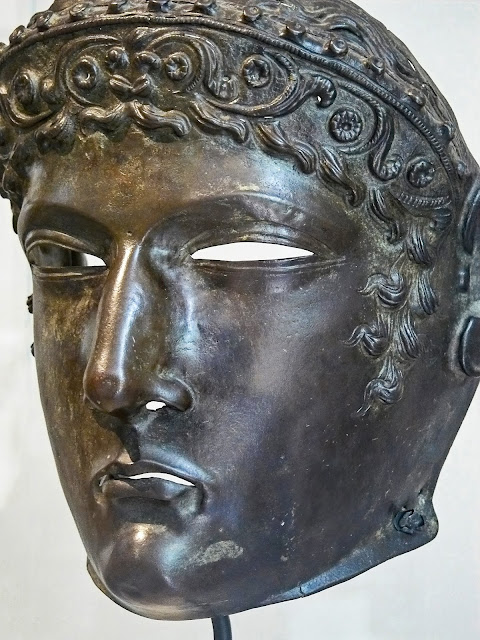
Roman cavalry helmets

Image
According to Arrian of Nicomedia, a Roman provincial governor and a close friend of Hadrian, face mask helmets were used in cavalry parades and sporting mock battles called “hippika gymnasia“.  Both men and horses wore elaborate suites of equipment on these occasions, often in the guise of Greeks and Amazons. Parades or tournaments played an important part in maintaining unit morale and fighting effectiveness. They took place on a parade ground situated outside a fort and involved the cavalry practising manoeuvring and the handling of weapons such as javelins and spears (Fields, Nic; Hook, Adam. Roman auxiliary cavalryman: AD 14-193). Calvary helmets were made from a variety of metals and alloys, often from gold-coloured alloys or iron covered with tin. They were decorated with embossed reliefs and engravings depicting the war god Mars and other divine and semi-divine figures associated with the military. To see a fascinating selection of these masks and read more about them check ...

Cartonnage mummy mask from Balansura (Upper Egypt) 1st quarter of 2nd century CE, Roman Period at the Kunsthistorisches Museum Wien in Vienna, Austria

Image
Cartonnage mummy mask from Balansura (Upper Egypt) 1st quarter of 2nd century CE, Roman Period at the Kunsthistorisches Museum Wien in Vienna, Austria. Cartonnage is a type of material used in Ancient Egyptian funerary masks from the First Intermediate Period to the Roman era. In a technique similar to papier-mâché, scraps of linen or papyrus were stuck together with plaster or resin and used to make mummy cases and masks. It c ould be molded to the shape of the body, forming a type of shell. After the material dried it was often painted or gilded. and decorated with geometric shapes, deities, and inscriptions. During the Ptolemaic era, the single shell method was altered to include four to six pieces of cartonnage. There would generally be a mask, pectoral, apron, and foot casing. In certain instances there were two additional pieces used to cover the ribcage and stomach. The materials used to produce cartonnage changed over time. In the Middle Kingdom it was common to use plaster...

Ancient Roman military masks on Wikimedia Commons

Image
Ancient Roman military masks on Wikimedia Commons. If any of you have visited the museum at Kalkriese, you have probably seen one of its most important artifacts, a once-silvered mask worn by either a Roman cavalryman or possibly a standard bearer. I found a discussion thread up on Reddit in which noted historian Adrian Goldsworthy pointed out, "For a long time, these helmets were designated as "parade helmets" by histo rians and archaeologists, and it was assumed that they would not be used in battle. They seemed too ostentatious and impractical. Then we found the battlefield at the Teutoburger Wald and discovered a masked helmet among the debris. A Roman tombstone in Germany even seems to depict an infantry signifer (standard bearer) wearing such a helmet. Add in the fact that we've found almost as many of these "parade" helmets as we have "normal" helmets, and it seems quite possible to me that these masked helmets would ...

Roman hoard and militaria at The Weißenburger Roman Museum in Weißenburger, Bavaria

Image
Roman hoard and militaria at The Weißenburger Roman Museum in Weißenburger, Bavaria.  The Weißenburger Roman Museum in Weißenburger, Bavaria was founded in 1983 to house one of the most important hoard finds in the whole of Germany consisting of 114 objects, including 17 bronze statues, statuettes, votive tablets, vessels, tools, and militaria. The hoard was probably hidden, like so many other treasures in Raetia, during the Alamanni invasions in the middle of the 3rd century CE. The museum underwent a 2.65 million euro rennovation in 2017 so the artifacts are now displayed with modern lighting in a contemporary environment. Images: Roman cavalry mask front and back, in the Weißenburg Roman Museum courtesy of Wikimedia Contributor, Wolfgang Sauber.

Our Dark Materials: Rediscovering an Egyptian Collection. Through May 16, 2019 at the Stanford Archaeology Center in Stanford, California.

Image
Our Dark Materials: Rediscovering an Egyptian Collection.  Through May 16, 2019 at the Stanford Archaeology Center in Stanford, California.   Although some museums like the Neues in Berlin have superb intact examples, many more are assembled from such fragments as you can see in this picture I took at the Petrie Museum in London a couple of years ago. The exhibit presents new examination of a forgotten collection. Artifacts from ancient Egypt provide insight into experiences of ordinary Egyptians in daily life and death. The exhibit features original artifacts, stone tools, such as a ceremonial knife, as well as ceramic containers and figurines, collected by the Stanford family and others around the turn of the 20th century including those damaged in the 1906 earthquake.