Posts

Showing posts with the label maenad

Spurned Women: The violent death of Orpheus

Image
Orpheus is best known as a musician that could play so beautifully he charmed even the most violent animals.  As such he is portrayed in numerous mosaics, paintings, and on ceramics.  So I was surprised to see a red-figure calyx krater attributed to the Villa Giulia Painter and dated to 460-450 BCE depicting Orpheus being violently attacked by Thracian women, one with a spear and one with an axe. I realize taste in music is quite personal but this extreme response is so antithetical to all of those peaceful images I have seen of Orpheus surrounded by mesmerized animals that I had to research this event further. According to a Late Antique summary of Aeschylus' lost play Bassarids , Orpheus, towards the end of his life, disdained the worship of all gods except the sun, whom he called Apollo. One early morning he went to the oracle of Dionysus at Mount Pangaion to salute his god at dawn, but, like Pentheus, was ripped to shreds by Thracian maenads for not honoring his previous p...

Etruscan Candelabrum Stand of a Dancing Maenad 525-500 BCE at the Cleveland Art Museum

Image
Conceived primarily in two dimensions—front and rear silhouette—this small bronze dancer probably once belonged to an elaborate candelabra or incense burner. The exaggeratedly long fingers and pointed shoes characterize the work as Etruscan, as do the stylized folds of the figure’s dress, which add visual interest but not verisimilitude. While her right hand holds above her head a cylindrical support, her left squeezes a small object, perhaps a fruit or clapper. - Cleveland Art Museum Etruscan fashion reflected the influence of Ionia and the Near East especially in pointed footwear, soft conical hats, and generally highly decorative patterns. Increased trade with Greece and Magna Graecia resulted in the adoption of long dresses secured at the shoulder by a brooch, light shawls, a long, simple white cloak (himation) with a red or black border, and a short-sleeved tunic (chiton) made from linen.  However, the Etruscans' flamboyant taste was expressed in much more vibrant colors than ...

Dancing Maenad 27 BCE - 14 CE Roman copy of a Greek original attributed to Kallimachos circa 425-400 BCE at the Metropolitan Museum of Art in New York City

Image
Dancing Maenad 27 BCE - 14 CE Roman copy of a Greek original attributed to Kallimachos circa 425-400 BCE at the Metropolitan Museum of Art in New York City. Maenads were mythical women inspired by the god of wine, Dionysos, to abandon their homes and families and roam the mountains and forests, singing and dancing in a state of ecstatic frenzy. This figure, wearing an ivy wreath and carrying a thyrsos (fennel stalk) bedecked wi th ivy leaves and berries, moves forward, trancelike, her drapery swirling about her. Maenads became popular as art subjects in the late fifth century B.C.E. with Euripides portrayal of the manic devotées of Dionysos in his play the Bacchae. In the play, King Pentheus bans the worship of Dionysus then the king's cousin lures him into the woods where he is torn apart by maenads including his own mother, Agave, who, in a trance tears off his head believing it to be that of a lion. The rites associated with the worship of Dionysus (Roman Bacchus) were chara...

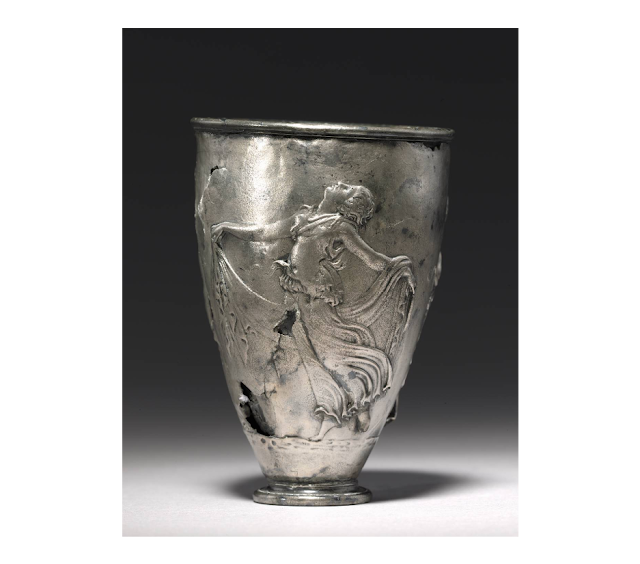
The Vicarello Goblet late 1st century BCE to early 1st century CE at the Cleveland Museum of Art

Image
The Vicarello Goblet late 1st century BCE to early 1st century CE at the Cleveland Museum of Art. This masterpiece of the Roman silversmith’s art was found north of Rome at Vicarello, the ancient Aquae Apollinares (the Springs of Apollo). Exquisitely worked in relief is a multifigure scene centered on a rustic shrine of the god Priapus. He is in the form of a stylized boundary marker placed atop a column. A woman approaching fr om the right seems to have brought him to life by touching him. To the left are votive offerings to the god arranged on top of and around a table. A satyr at the far left and a maenad at the far right dance ecstatically. - Cleveland Art Museum Image: Three views of the Vicarello Goblet from ancient Aquae Apollinares (Vicarello, Italy) courtesy of the museum.