Posts

Showing posts with the label applique

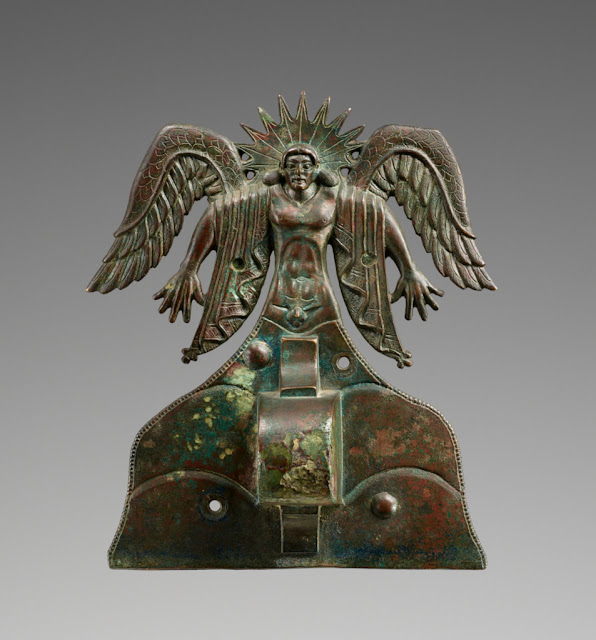
Usil: Etruscan God of the Sun
Image
Usil, the Etruscan god of the sun, is equated with the Greek and Roman Helios/Sol Invictus. Appliques depicting the god usually depict the deity with spread wings and a nimbus of rays surrounding his head which is also adorned with a diadem.  On such a plaque obtained by the J. Paul Getty Museum, the figure merges into a broad plate decorated with undulating lines, suggesting the sea from which the sun emerges at daybreak and sinks at dusk.  "Ornamental reliefs such as this functioned as fittings on funeral carts and chariots, which often accompanied the burials of Etruria’s equestrian elite. Probably affixed to the sides of the vehicle, the winged god reflects the imagery of a celestial divinity driving the chariot of the sun across the sky, which was common in Greek and later Etruscan art. The earliest Usil plaque, in the Vatican Museums, was reportedly found at Roma Vecchia between 1760 and 1775 and was illustrated by Francesco Piranesi in 1778. In 1845, four similar plaque...

Furniture applique in the Greco-Roman world

Image
Little wood survives from ancient Greek and Roman furniture, although ancient texts tell us woods used for such purpose were maple, oak, beech, yew, and willow. Pieces were assembled using mortise-and-tenon joinery, held together with lashings, pegs, metal nails, and glue. Wood was shaped by carving, steam treatment, and the lathe, and furniture is known to have been decorated with ivory, tortoise shell, glass, gold, or bronze attachments similar to this example.  Furniture was also veneered with expensive types of wood in order to make the object appear more costly, although not as elaborate as palatial furnishings in the Near East. The sella, or stool or chair, was the most common type of seating in the Roman period, probably because of its easy portability. Although those of the poor were surely plain, the wealthy had access to precious woods, ornamented with inlay, metal fittings, ivory, and silver and gold leaf. Bronze sellae from Herculaneum were square in form and had straig...

Jupiter Applique Roman 1st-2nd century CE at the Kunsthistorisches Museum Wien in Vienna, Austria

Image
Jupiter Applique Roman 1st-2nd century CE at the Kunsthistorisches Museum Wien in Vienna, Austria. "The Zeus of the Greeks, whom Homer already describes as the "father of men and gods", was also the highest imperial god among the Romans as Jupiter Optimus Maximus (best and greatest). The mighty head of the god, who was always bearded in Greco-Roman antiquity, bears an oak wreath. The oak was sacred to Zeus, and the rustling of i ts leaves was used to prophesy in the oracle sanctuary of Dodona. The hair streaks up over the furrowed forehead in the manner of the portrait of Alexander the Great and frames the broad face with moving, softly modeled curls. A cloth is placed over the back of the head, which falls down on the left side of the body and lies on the right shoulder. The veiling of the head is sacral, but also a reference to the cosmic sphere of clouds and sky. The winged bolt of lightning on its right side should not only be understood as a weapon of God, but a...