Posts

Showing posts with the label Zeus

The myth of Kallisto and lesbianism in the Classical World
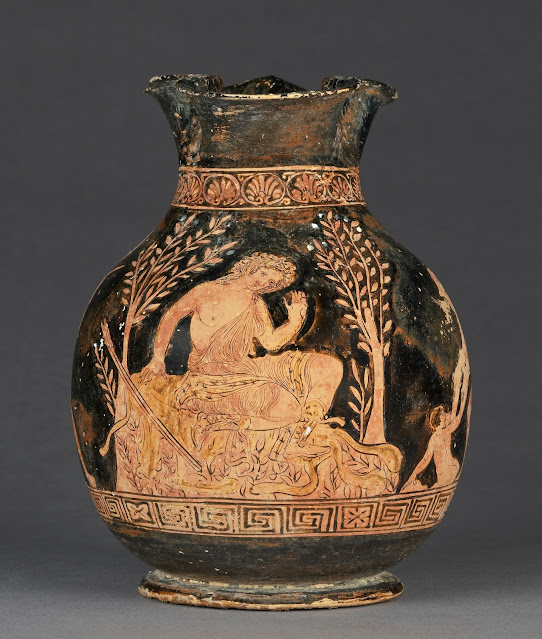
Image
According to Greco-Roman myth, the mortal virgin Kallisto (also spelled Callisto), according to Hesiod the daughter of King Lycaon of Arcadia, spent her time in the Arcadian Mountains of Greece as a favorite hunting companion of Artemis, goddess of the hunt and childbirth. Like all of Artemis' nymph companions, Kallisto had vowed to remain chaste. The king of the Greek gods, Zeus, was attracted to Kallisto (when was Zeus never attracted to all of the voluptuous females cavorting around him?) and seduced her by disguising himself as Artemis, which resulted in the birth of a son, Arkas, who gave his name to the area of Greece known as Arcadia. Artemis, angered at Kallisto's betrayal, (or, according to another version, Zeus's wife Hera, enraged with jealousy) changed Kallisto into a bear. (Yes, it's another example of the rape victim being punished for male misbehavior!) Sixteen years later, her now almost grown son, Arcas, encountered the transformed Kallisto while huntin...

The widespread myth of winged horses

Image
According to Greek myth, the immortal winged horse Pegasus and his brother Chrysaor were born from the blood issuing from Medusa's neck as Perseus was beheading her.  In another version, when Perseus beheaded Medusa, the winged horses were born of the Earth, fed by the Gorgon's blood. A variation of this story holds that they were formed from the mingling of Medusa's blood, pain and sea foam, implying that Poseidon was involved in their creation. The last version bears resemblance to Hesiod's account of the birth of Aphrodite from the foam created when Uranus's severed genitals were cast into the sea by Cronus. Pegasus was captured and raised by the hero Bellerophon who engaged in fighting off monsters. The hero competed with the gods and this angered Zeus, who struck down the horse, turning Pegasus into the beast of burden who carried lightning bolts at Zeus's palace.  Everywhere the winged horse struck his hoof to the earth, an inspiring water spring burst for...

The Zeugma Mosaic Museum

Image
The Zeugma Mosaic Museum  in the town of Gaziantep, Turkey, the biggest mosaic museum in the world, containing 1700m2 of mosaics opened to the public on 9 September 2011,  Named for its pontoon bridge of boats that crossed the Euphrates River at that location, Zeugma was founded as Seleucia by Seleucus I Nicator, one of the general successors of Alexander the Great, in the early 3rd century BCE.  By 64 BCE, the Romans controlled the city and Zeugma became a military base and thriving commercial center with a population of about 70,000 people. In 253 CE, it was destroyed by the Sassanids, but was later rebuilt.  However, continuing raids by the Persians and Arabs led to its abandonment in the 7th century CE. The mosaics, remained relatively unknown until 2000 when plans for new dams on the Euphrates meant that much of Zeugma would be flooded. Many of the mosaics remain covered and teams of researchers continue to work on the project to rescue them. In addition to the ...

Jupiter Applique Roman 1st-2nd century CE at the Kunsthistorisches Museum Wien in Vienna, Austria

Image
Jupiter Applique Roman 1st-2nd century CE at the Kunsthistorisches Museum Wien in Vienna, Austria. "The Zeus of the Greeks, whom Homer already describes as the "father of men and gods", was also the highest imperial god among the Romans as Jupiter Optimus Maximus (best and greatest). The mighty head of the god, who was always bearded in Greco-Roman antiquity, bears an oak wreath. The oak was sacred to Zeus, and the rustling of i ts leaves was used to prophesy in the oracle sanctuary of Dodona. The hair streaks up over the furrowed forehead in the manner of the portrait of Alexander the Great and frames the broad face with moving, softly modeled curls. A cloth is placed over the back of the head, which falls down on the left side of the body and lies on the right shoulder. The veiling of the head is sacral, but also a reference to the cosmic sphere of clouds and sky. The winged bolt of lightning on its right side should not only be understood as a weapon of God, but a...

Samian ware flask from Southern Gaul, 1st century CE, depicting Heracles killing Laomedon, King of Troy, at the Museo Civico Archeologico della Valle Sabbia in Gavardo (Brescia)

Image
Samian ware flask from Southern Gaul, 1st century CE, depicting Heracles killing Laomedon, King of Troy, at the Museo Civico Archeologico della Valle Sabbia in Gavardo (Brescia). In one version of mythology, Laomedon, king of Troy, was the father of Ganymede. Zeus fell in love with the beautiful boy and, disguised as an eagle, kidnapped the child. Laomedon grieved so much for his son Zeus sent Hermes to Laomedon with two magn ificent horses so swift they could run across water. Hermes also assured the king that Ganymede would become immortal and would thereafter be the distinguished cup bearer for the gods. Sometime later, Laomedon began constructing walls around his city of Troy and promised a reward to Apollo and Poseidon for their assistance. But after the walls were completed Laomedon refused to give them the promised payment. So the gods, in their anger, sent a pestilence and a sea monster to ravage the land. An oracle revealed to Laomedon that the only way to save Troy would ...

The Olympian Aegis

Image
The Olympian Aegis. According to the Iliad, both Zeus and Athena carried an aegis thought to be either a shield or animal skin adorned with the head of Medusa. The aegis was thought to have magical properies and when shook by an Olympian, would wrap clouds around Mount Ida, create claps of thunder and strike men down with fear. In the Iliad when Zeus sends Apollo to revive the wounded Hector, Apollo, holding the aegis, char ges the Achaeans, pushing them back to their ships drawn up on the shore. Roman poet Virgil described the aegis as a fearsome thing with a surface of gold like scaly snakeskin, edged with golden tassels and bearing the Gorgoneion in the central boss. But Augustus' freedman, Gaius Julius Hyginus, who became superintendent of the Palatine library, claimed it was the skin of a pet goat owned by Zeus' nurse, Amalthea, that he used as a shield when he went forth to do battle against the Titans. Images: Early Roman Imperial Zeus with Aegis and Gor...