Posts

Showing posts with the label Rome

"Colors of the Romans: Mosaics from the Capitoline Collections" opens at the Centrale Montemartini in Rome

Image
The “Colors of the Romans” exhibition at Centrale Montemartini, one of Rome’s great museums, hopes to attract tourists to the Italian capital through this lesser-known but varied selection of mosaics. The exhibition is divided into four sections.  The first showcases the history and mosaic techniques. The works chosen represent all types of mosaic floors and wall decorations, allowing to illustrate through the techniques, materials, colors, decorative motifs, the stylistic evolution and the transformation of mosaic art over time.  The second explores living and dwelling in Rome between the end of the Republican age and the late ancient age: luxury residences and domestic contexts.  The route follows a chronological criterion, passing from the oldest examples - such as the large polychrome mosaic with coffered, discovered at the Villa Casali al Celio - to the more recent ones, up to the fourth century CE, the period to which the mosaic belongs with a seasonal bust, perhaps...

Camillus: Second Founder of Rome

Image
Marcus Furius Camillus (c. 446 – 365 BCE) was a Roman soldier and statesman of the patrician class. According to Livy and Plutarch, Camillus triumphed four times, was five times dictator, and was honored with the title of Second Founder of Rome.  Camillus belonged to the lineage of the Furii Camilli, whose origin had been in the Latin city of Tusculum. Although this city had been a bitter enemy of the Romans in the 490s BCE, after both the Volsci and Aequi later began to wage war against Rome, Tusculum joined Rome, unlike most Latin cities. Soon, the Furii integrated into Roman society, accumulating a long series of magistrate offices. Thus the Furii had become an important Roman family by the 450s. In 406 BCE, Rome declared war against the rival Etrurian city of Veii. The city of Veii was powerful and was located on a well-fortified and elevated site. This required the Romans to commence a siege lasting several years. In 401 BCE, as the war started to grow increasingly unpopular i...

Remnants of Caligula's Horti Lamiani now on display

Image
During the four years that Caligula occupied the Roman throne, his favorite hideaway was an imperial pleasure garden called Horti Lamiani. The vast residential compound spread out on the Esquiline Hill, one of the seven hills on which the city was originally built, in the area around the current Piazza Vittorio Emanuele II. There, just on the edge of the city, villas, shrines and banquet halls were set in carefully constructed “natural” landscapes. An early version of a wildlife park, the Horti Lamiani featured orchards, fountains, terraces, a bath house adorned with precious colored marble from all over the Mediterranean, and exotic animals, some of which were used, as in the Colosseum, for private circus games.  Now, relics from the Horti Lamiani have been recovered and put on display by archaeologists. The objects and structural remnants on display in the museum paint a vivid picture of wealth, power and opulence including elaborate mosaics and frescoes, a marble staircase, capi...

The emperor Hadrian and the Castel Sant'Angelo

Image
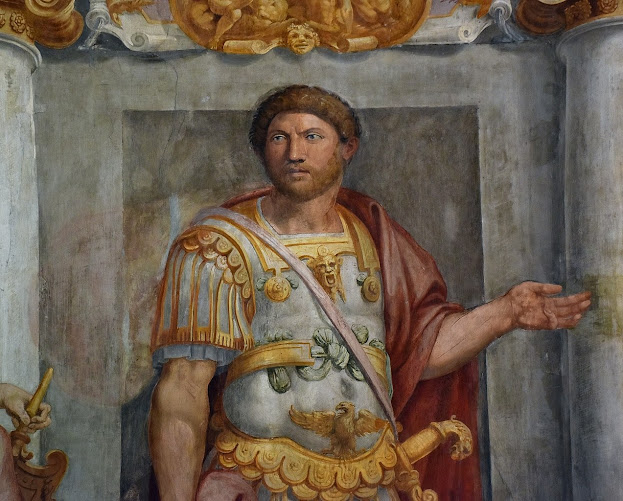
The emperor Hadrian's tomb was erected on the right bank of the Tiber, between AD 134 and 139. Now known as the Castel Sant'Angelo, originally the mausoleum was a decorated cylinder, with a garden top and golden quadriga. Hadrian's ashes were placed here a year after his death in Baiae in 138, together with those of his wife Sabina, and his first adopted son, Lucius Aelius, who died in 138. Following this, the remains of succeeding emperors were also placed here, the last recorded deposition being Caracalla in 217 CE. But much of the tomb  contents and decorations were lost when the building was converted to a military fortress in 401 CE then subsequently included in the Aurelian Walls by Flavius Honorius Augustus. The urns and ashes were scattered by Visigoth looters during Alaric's sack of Rome in 410, and the original decorative bronze and stone statuary were thrown down upon the attacking Goths when they besieged Rome in 537, as recounted by Procopius.  In the 14th ...

Rape of the Sabine Women in Art

Image
The ancient legend of the abduction of the Sabine women by the men of Rome has inspired artists for centuries. Upon finding the city bereft of women, Rome’s founder, Romulus, invited the neighboring peoples to a festival as a pretense to the abduction. Each Roman youth carried off an unmarried woman from the Sabine contingent as his bride. When the Sabines later attacked Rome to reclaim their females, the women ran onto the battlefield and secured peace between their fathers and husbands. Here we see two dramatic treatments of the subject by Italian artists Andrea Andreani and Giambologna.  Andreani, an Italian engraver, revived the technique of the chiaroscuro print, the use of light and shadow to define three-dimensional objects, at the end of the sixteenth century and created a number of ambitious works including a reproduction of Andrea Mantegna's "Triumph of Caesar".  Some evidence exists that ancient Greek and Roman artists used chiaroscuro effects but the techni...

Cypriot Gold at the Metropolitan Museum of Art in New York

Image
The island of Cyprus has been inhabited by humans since at least 10,000 BCE.  During the late Bronze Age the island experienced two waves of Greek settlement, around 1400 BCE, and,  following the Bronze Age collapse of Mycenaean Greece, from 1100 to 1050 BCE.  Literary evidence also suggests an early Phoenician presence at Kition which was under Tyrian rule at the beginning of the 10th century BCE. It is thought Phoenician merchants colonized the area and expanded the political influence of Kition. Then, Cyprus was conquered by Assyria, first during the reign of Tiglath-Pileser III (744-7242 BCE), then by Sargon II (722-705 BCE). Assyrian hegemony ended with the fall of the Neo Assyrian Empire in 609 BCE.  The city-kingdoms of Cyprus gained their independence for a short time before domination by Egypt in the sixth century BCE, followed by Persia in 545 BCE.  In 499 BCE, the Cypriots, led by Onesilus, king of Salamis, joined the Greeks in the unsuccessful I...

East Meets West: Rome and the Han Dynasty of China

Image
Ancient Rome and the Han Dynasty of China exchanged goods, not only over the famous Silk Road but by sea as well. Unfortunately, intermediate empires such as the Parthians and Kushans, seeking to maintain lucrative control over the silk trade, initially inhibited direct contact between Rome and China. Although ancient Chinese geographers demonstrated a general knowledg e of West Asia and Rome's eastern provinces, Roman histories of the 1st century BCE offer only vague accounts of China and the silk-producing Seres people of the Far East. In classical sources, the problem of identifying references to ancient China is exacerbated by the interpretation of the Latin term Seres, whose meaning fluctuated and could refer to several Asian peoples in a wide arc from India over Central Asia to China. But, by the 1st-century CE, geographer Pomponius Mela asserted that the lands of the Seres formed the centre of the coast of an eastern ocean, flanked to the south by India and to the ...