Posts

Showing posts with the label Near East

Aphrodite of the East - A warrior love goddess

Image
The cult of Aphrodite in Greece was imported from, or at least influenced by, the cult of Astarte in Phoenicia, which, in turn, was influenced by the cult of the Mesopotamian goddess known as "Ishtar" to the East Semitic peoples and as "Inanna" to the Sumerians. Pausanias states that the first to establish a cult of Aphrodite were the Assyrians, followed by the Paphians of Cyprus and then the Phoenicians at Ascalon. The Phoenicians, in turn, taught her worship to the people of Cythera. Aphrodite took on Inanna-Ishtar's associations with sexuality and procreation. Furthermore, she was known as Ourania, which means "heavenly", a title corresponding to Inanna's role as the Queen of Heaven. Early artistic and literary portrayals of Aphrodite are extremely similar on Inanna-Ishtar. Like Inanna-Ishtar, Aphrodite was also a warrior goddess. The second-century CE Greek geographer Pausanias records that, in Sparta, Aphrodite was worshipped as Aphrodite Arei...

Kohl box in the shape of an elongated figure wearing a helmet (?) and cape (?), Hasanlu Period IV Bronze (ca. 800 BCE)

Image
The site of Hasanlu was extensively excavated from 1957–77 as part of a general investigation into the archaeology of the Ushnu-Solduz Valley in northwestern Iran, a joint venture of the Penn Museum, the Metropolitan Museum of Art of New York City, and the Archaeological Service of Iran. The site has deposits dating back some 8,000 years to Neolithic times, however, the Iron Age levels, beginning around 1250 BCE, are the best understood. The settlement portion of Hasanlu was dramatically destroyed (ca. 800 BCE) leaving a burned and body-strewn destruction level. The conflagration is thought to have happened in late summer based on plant remains. The people who remained in the buildings on the High Mound, including women and children, were completely wiped out by violence and fire. Most seem to have been left where they were killed in the streets and in buildings, which then collapsed on their bodies because of the fire. The people who remained at Hasanlu did have weapons and horses at ...

Greco-Roman, African, and Asian antiquities at the Ackland Art Museum of the University of North Carolina at Chapel Hill

Image
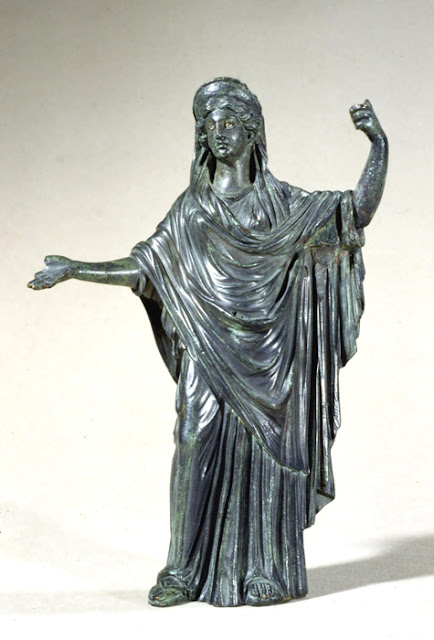
Greco-Roman, African, and Asian antiquities at the Ackland Art Museum of the University of North Carolina at Chapel Hill. The collection of the Ackland Art Museum includes over 19,000 works of art. It's ancient works of art include sculpture, glassware, coins, jewelry and ceramics dating as far back as the second millennium. Among some of the more unusual pieces, is a sculpture of a man carrying a fish identified as possibly 4 th century CE Anglo Roman. The African collection includes a sculpture created by the Nok culture of ancient Nigeria dated from 100 BCE - 200 CE. Also, don't miss a painting of a peasant offering Cleopatra VII a basket of figs with an asp by French artist EugĆØne Delacroix painted in 1838. Images: The goddess Juno, Roman, bronze, 150-200 CE, Man carrying a fish, 4th century CE, Anglo-Roman, and a Nok figural sculpture from ancient Nigeria 100 BCE - 200 CE. All images courtesy of the museum.

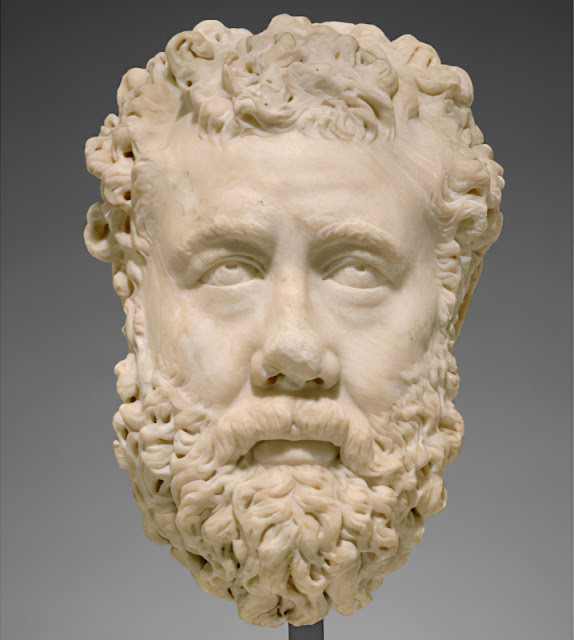
Style and Status: Power Beards of the Ancient World October 26-27, 2019 11 a.m. - 3 p.m. at the Getty Villa in Pacific Palisades, California

Image
Style and Status: Power Beards of the Ancient World October 26-27, 2019 11 a.m. - 3 p.m. at the Getty Villa in Pacific Palisades, California. In antiquity, facial hair and beards were not just for looks - they also helped identify men as leaders, thinkers, and warriors. Watch a stylist recreate beards from ancient Assyria, Greece, and Rome. Then make your own beard or body oil evoking ancient scents, and attend the same-da y free lecture The Meaning of Beards: From Antiquity to Today to learn more about the role of beards through time. While at the Getty Villa be sure to allow enough time to view the exhibit "Buried by Vesuvius, Treasures from the Villa dei Papiri" ending October 28, 2019. Image: Portrait of a Bearded Man, 200-225 CE, marble, courtesy of the J. Paul Getty Museum.

Artifacts from ancient civilization at The Allard Pierson Museum in Amsterdam, The Netherlands

Image
Artifacts from ancient civilization at The Allard Pierson Museum in Amsterdam, The Netherlands. The Allard Pierson Museum is the archaeological museum of the University of Amsterdam. Artifacts from the ancient civilizations of ancient Egypt, the Near East, the Greek World, Etruria, and the Roman Empire are curated and exhibited in this museum. The collections include art objects and utensils dating from 4000 BCE to 500 CE. Ther e are also scale models of ancient temples and buildings. In the Ancient Egypt exhibition there is a room dedicated to death, with mummies, sarcophagi, and a film showing the process of mummification. The plaster-cast attic, to be visited only with a guided tour, shows copies of Roman and Greek statues. A collection of Roman sarcophagi is also on display, including a rare wooden anthropomorphic coffin from around 150 CE. Image: Pottery depicting girls playing from Corinth, circa 300 BCE. Courtesy of the Wikimedia Commons contributor 23 dingen voor m...

Ancient art from Egypt, the Near East, Scythia, Rome, Persia, China, Korea, and the Americas ongoing at the Saint Louis Art Museum in Saint Louis, Missouri

Image
Ancient art from Egypt, the Near East, Scythia, Rome, Persia, China, Korea, and the Americas ongoing at the Saint Louis Art Museum in Saint Louis, Missouri. Objects include ceramics, glassware, sculptures, masks, artitectural elements, weapons, funerary art and artifacts used in daily life. Image: A Bull's Head cast of solid copper from ancient Sumeria Early Dynastic III period, 2600-2450 BCE. The bull's massive head is emphasi zed by a stocky muzzle and shortened horns. The addition of a curled, wide beard looks curiously natural on an animal that symbolized the sky god An. As the embodiment of fertility and power, the bearded bull served as an ever-present symbol of divine protection and royal might through centuries of ancient Near Eastern art. Image courtesy of the Saint Louis Art Museum.

Art of the Ancient World. Ongoing. At the Boston Museum of Fine Arts in Boston, Massachusetts.

Image
Art of the Ancient World.  Ongoing.  At the Boston Museum of Fine Arts in Boston, Massachusetts. This idealized female head, said to have been found at Memphis in Egypt, leaves it unclear who is represented. The flawless features and loosely fastened, undulating hair, are appropriate for a goddess such as Artemis or Aphrodite; the style may show the influence of Skopas, one of the leading Greek sculptors of the fourth century. Yet the head also bears a marked resemblance-especially the long, delicate nose-to portraits of ArsinoĆ« II, queen of Egypt in the 270s B.C.; the ribbon in her hair could be a diadem, signature headgear of later Greek royalty. Image courtesy of the Boston Museum of Fine Arts. The Boston Museum of Fine Arts is home to one of the world’s premiere encyclopedic collections of antiquities, featuring more than 85,000 works of art from Egypt, Nubia, the Near East, Greece, Italy, Cyprus, and Anatolia. These works range in date from about 6500 BCE to 600...

South Asian Art, Islamic Art and Antiquities. Ongoing. At the Cincinnati Art Museum in Cincinnati, Ohio.

Image
South Asian Art, Islamic Art and Antiquities. Ongoing. At the Cincinnati Art Museum in Cincinnati, Ohio. Mithraic Relief with Bull 150-200 CE. Courtesy of the Cincinnati Art Museum The Cincinnati Art Museum possesses a distinguished collection of ancient art from the Mediterranean region and the Near East. Spanning some four thousand years from the fourth millennium B.C.E. to the early centuries C.E. this notable collection features major examples of stone sculpture, decorated metalwork, painted wall c arvings and ceramic vessels from ancient Egypt, Greece and Rome.

Newly reinstalled! Art of the ancient Mediterranean. Ongoing. At the Newark Museum in Newark, New Jersey.

Image
Newly reinstalled! Art of the ancient Mediterranean. Ongoing. At the Newark Museum in Newark, New Jersey. The mummy case of Henet-Mer 21st dynasty 1075-945 BCE.  Image courtesy of the Newark Museum in Newark, New Jersey. The Newark Museum's art of the ancient Mediterranean cultures—Egypt, the Near East, Greece and Rome—includes one of the finest collections of ancient glass in the nation as well as classical antiquities that illustrate glassmaking over a 2,500 year period. The Egyptian Collection features the mummy case of Henet-Mer (pictured above), as well as sculpture, writing and funerary objects that provide a view of life in ancient Egypt, from Neolithic times through the Roman period. Unusual holdings of the Coptic art of Christian Egypt include rare textiles, pottery, sculpture and paintings. Sculpture from Greece, Rome, Cyprus and Etruria are also important pieces in the collections.