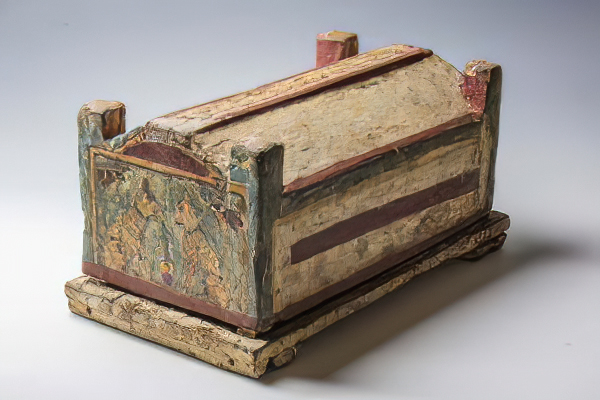
Reassertion of political power reflected in Late Period Egyptian art

A scene of two girls in a wheat field quarreling and pulling each other's hair, found in Luxor in a Late Period tomb of a man named Mentuemhet closely resembles a scene used in the tomb of man named Menna who lived 1200 years before. It dates from Dynasty 26 circa 664 BCE. The Late Period is considered by scholars to be the last flowering of native Egyptian culture before the Persian conquests, followed by the victories of Alexander the Great and the establishment of the Ptolemaic Kingdom. Its first pharaoh, Psamtik I, threw off ties to the Assyrians about 665 BCE by forming alliances with King Gyges of Lydia and mercenaries from Caria and Greece. In the ninth year of his 54-year reign, Psamtik reunified Egypt by destroying the last vestiges of the Nubian 25th Dynasty's control over Upper Egypt. But Psamtik, in his effort to reassert Egyptian authority in the Near East, was driven back by the Neo-Babylonian forces under Nebuchadnezzar II. However, he succeeded in...