Posts

Showing posts with the label Hellenistic

Cypriot gold spiral earrings: Local fashion or the result of Achaemenid influence?

Image
According to the Metropolitan Museum of Art, spirals with ornate animal-head terminals are frequently found in Cypriot tombs of the Classical period. Terracotta and limestone votive statues illustrate that from the Archaic through the Classical period it was customary for Cypriot men and women to wear such ornaments in large holes pierced through their earlobes. When I saw these earrings, I wondered if this Cypriot practice of making large holes in their earlobes to accommodate these ornaments was a local fashion or adopted as a result of Persian rule beginning in 545 BCE, especially since most examples I have seen  are dated between the late 6th century to the 5th century BCE. I managed to find images of Achaemenid bracelets similarly made of gold tubing but each example of similar earrings I found in my research were all labeled Cypriot. Since the Cypriots were ruled by the Assyrians and even the Egyptians for a short time, I researched the jewelry of those cultures as well but f...

Social Integration in Roman Period Egypt

Image
The social structure in Aegyptus under the Romans was both unique and complicated. On the one hand, the Romans continued to use many of the same organizational tactics that were in place under the leaders of the Ptolemaic period. At the same time, the Romans saw the Greeks in Aegyptus as “Egyptians”, an idea that both the native Egyptians and Greeks would have rejected. To further compound the whole situation, Jews, who themselves were very Hellenized overall, had their own communities, separate from both Greeks and native Egyptians. The Romans began a system of social hierarchy that revolved around ethnicity and place of residence. The Augustan takeover introduced a system of compulsory public service, which was based on poros (property or income qualification), which was wholly based on social status and power. Other than Roman citizens, a Greek citizen of one of the Greek cities had the highest status, and a rural Egyptian would be in the lowest class. In between those classes was t...

Eros Sleeping

Image
Eros, the Greek god of love, was capable of overpowering the minds of all gods and mortals. According to an early myth, Gaia (goddess of the Earth) and Eros were the source of all creation. Literary references of the sixth and fifth centuries BCE. often portray Eros as a cruel, capricious being who causes burning desire. In Classical art he is usually represented as a beautiful winged youth. During the Hellenistic period (323–31 BCE) a new image of the god as a baby took hold. The popularity of that iconography is linked to the myth of Eros being the son of Aphrodite, born of her affair with Ares (god of war). The most innovative and influential representation of Eros during the Hellenistic and the Roman periods was of Eros sleeping.  Variations of the type are known from hundreds of sculptures, which, to judge from the number of extant replicas and adaptations, was one of the most popular ever produced in Roman Imperial times. It was also among the earliest of the ancient statues ...

Hellenistic Bronze statuette of a veiled and masked dancer, 3rd–2nd century BCE, Ptolemaic Period, Egypt

Image
A week ago, I illustrated one of my "wisdom" posts with an image of a veiled vestal virgin produced by Italian sculptor Antonio Corradini.  He is famous for his ability to use solid medium like marble to depict illusory veiled women where the contours of their face and body can be discerned beneath the "veil".  Well, this morning while browsing artifacts in the collection of the Metropolitan Museum of Art, I saw an amazing Greek bronze sculpture created in the 3rd - 2nd century BCE in Alexandria, Egypt that possesses the same ethereal quality as those much more modern sculptures of Corradini. The Metropolitan Museum of Art observes: The complex motion of this dancer is conveyed exclusively through the interaction of the body with several layers of dress. Over an undergarment that falls in deep folds and trails heavily, the figure wears a lightweight mantle, drawn tautly over her head and body by the pressure applied to it by her right arm, left hand, and right leg. ...

Bronze statuette of a girl holding a puppy, Greek or Roman, 1st century BCE – 2nd century CE

Image
 The Romans favored bronze and marble above all else for their finest work and loved miniatures.  By the mid-1st century CE, Roman sculptors began to move away from emulating their Etruscan and Greek predecessors and sought to capture and create optical effects of light and shade for greater realism.  This trend may well have developed from the tradition of keeping realistic wax funeral masks of deceased family members in the ancestral home.  Although few bronze examples have survived due to a high demand for reuse of the alloy, those that did, like this poignant figurine, portrayed a people who were realistically scarred, wrinkled, or plump, like this healthy-appearing little girl. Sadly (from my viewpoint anyway), towards the end of the Empire, the influence of art from the eastern Mediterranean resulted in figural sculpture with enlarged heads, vacantly staring eyes, and out-of-proportion torsos and limbs such as those seen in works portraying the emperor Constant...

Buddhist sculpture of the 4th and 5th centuries CE

Image
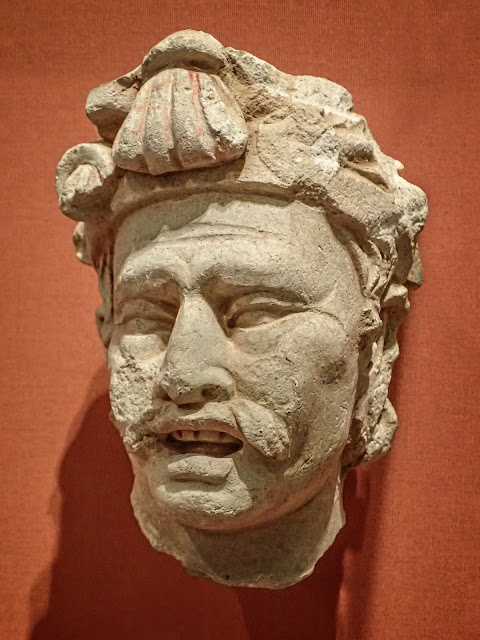
Buddhist monuments of the 4th and 5th century CE were decorated with elaborate scenes in stucco.  The heads were sometimes made separately and pegged in place, so they often became detached. This Head may be Kuvera or possibly a warrior belonging to the army of the evil god Mara, a demonic celestial king who tempted Prince Siddhartha (Gautama Buddha) by trying to seduce him with the vision of beautiful women who, in various legends, are often said to be Mara's daughters.  In Buddhist cosmology, Mara is associated with death, rebirth and desire. Modeled of lime composition, this sculpture reflecting Hellenistic influence introduced into the region by Alexander the Great, was found in Hadda, Afghanistan and is part of the collections of the Victoria and Albert Museum in London that I photographed in 2016.

Ptolemaic Hellenistic mosaic floor from the royal quarter of Alexandria.2nd century BCE

Image
Ptolemaic Hellenistic mosaic floor from the royal quarter of Alexandria.2nd century BCE. Excavated from the grounds of the New Alexandria Library in 1993, this Ptolemaic mosaic from Hellenistic Egypt, dated between 200 - 150 BCE, is now located in the Greco-Roman Museum of Alexandria, Egypt. While it is slightly damaged at the center with cracks and fragmentary along the sides (surrounded by a grey lion-head motif), this mosai c depicts a realistic scene of a male dog with a gilded metal askos vessel (for containing water or wine) with looped handles lying nearby. The rich variety of colored tesserae pieces adds depth, lighting, and shading to the scene similar to Hellenistic Greek paintings of the time period. It could represent a household owner's pet, or perhaps it implies a domestic banquet had occurred and the askos has been emptied for the occasion courtesy of Wikimedia Commons.

Thracian art at the Tekirdağ Museum of Archaeology and Ethnography in Tekirdağ, Turkey

Image
Thracian art at the Tekirdağ Museum of Archaeology and Ethnography in Tekirdağ, Turkey. During excavations in the ancient cities of Heraion-Teichos (City of Hera) in Süleymanpaşa, Çavuşköy in Malkara and Perinthos in Marmaraereğlisi, many Thracian works have been discovered including jewelry, coins, weapons, reliefs and grave goods from the tomb of a Thracian king Kersopleptes. There are also silver vessels, candlesticks and sh ields from the Macedonian era as well as archaeological finds from the Early Bronze Age (3000-2500 BCE), Late Bronze Age (2000-1200 BCE), Early Iron Age (1400-1000 BCE), and the Hellenistic Period, Artifacts from the ancient Roman, Byzantine and Ottoman eras are also on display. Image: Gladiator Relief from Perinthos (ancient Marmara) courtesy of Wikimedia Commons contributor Ollios.

Tritoness Relief Applique, Bronze with copper inlays, Greek, late 2nd century B.C.E. at the Cleveland Museum of Art in Cleveland, Ohio

Image
Tritoness Relief Applique, Bronze with copper inlays, Greek, late 2nd century B.C.E. at the Cleveland Museum of Art in Cleveland, Ohio. Greek pottery depicting a half-human, half-fish being became popular in the 6th century BCE. The original sea god, Triton, was the son of Poseidon and Amphitrite according to Hesiod's Theogony. Triton is usually represented as a merman, with the upper body of a human and the tailed lower bod y of a fish. At some time during the Greek and Roman era, Triton(s) became a generic term for a merman (mermen) in art and literature. A female version (tritoness) was eventually introduced as well. After observing the body of a creature touted as a headless Triton in Rome, Pausanias described it in detail in the 2nd century CE. "The Tritons have the following appearance. On their heads they grow hair like that of marsh frogs not only in color, but also in the impossibility of separating one hair from another. The rest of their body is rough with ...

Bronze Hellenistic portrait of Antigonos Doson, one of Alexander the Great's diadochi (successors) at the Museum of Fine Arts Houston, Texas

Image
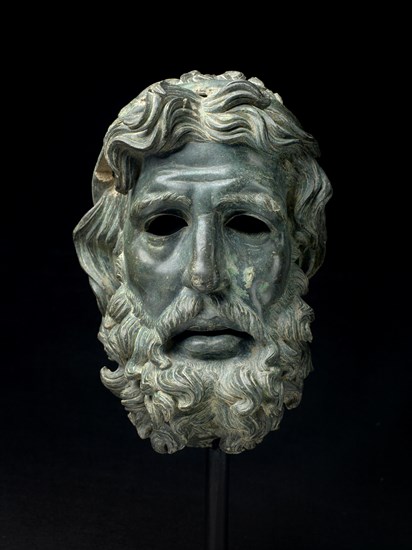
Bronze Hellenistic portrait of Antigonos Doson, one of Alexander the Great's diadochi (successors) at the Museum of Fine Arts Houston, Texas. Larger-than-life-size Greek bronze statues were focal points of temples and important public places. Unfortunately, few ancient statues have survived in complete form. Distinguishing attributes and characteristics are often missing, so coins of the period are an important source for iden tifying gods, royalty, and important persons. The identity of this Hellenistic bronze portrait head, dated between 227-221 BCE, was unclear until an exceptionally fine tetradrachm--an ancient Greek silver coin worth four drachma--minted during the reign of Macedonian king Antigonos Doson (227–221 BCE), was obtained by the museum. Coins featuring Antigonos Doson portray him as Poseidon, god of the sea--a reference to his reestablishment of Macedonia's supremacy over the sea. The bronze head and silver coin both have fine facial bone structure, deep-set...

Archaeological Museum of Olympia in Archaia Olympia, Greece.

Image
Archaeological Museum of Olympia in Archaia Olympia, Greece.  The Archaeological Museum of Olympia, one of the most important of Greece, presents the long historical evolution of one of the brightest sanctuaries of antiquity dedicated to the father of the gods and people, Zeus, and was the cradle of the Olympic Games. It includes the permanent exhibition of findings from excavations in the sacred site of Altea, dating from prehistoric to early Christian times. Of the total, the most important are sculptures, for which the museum is mainly known, as well as the collection of bronze objects, which is the richest in the world and consists of guns, figurines and other objects, the findings of great claymaking are also significant. Image: Late Archaic terracotta statue of Zeus and Ganymede 480-479 BCE courtesy of Wikimedia Commons contributor Joanbanjo, bronze head of a boy from the Hellenistic period courtesy of Wikimedia Commons contributor Zde, and remains of the west ped...

Giovanni Barracco Ancient Sculpture Museum in Rome, Italy

Image
Giovanni Barracco Ancient Sculpture Museum in Rome, Italy What was once known as the Ancient Sculpture Museum and is now known as the Museo Barracco, houses a collection of ancient Egyptian, Near Eastern, Etruscan, Cypriot, Phoenician, Hellenistic, Italic and Roman art once owned by Giovanni Barracco, quaestor of the Senate of the Kingdom who donated them to the city of Rome in 1904.  The first two rooms are dedicated to Egyptian and Near Eastern art.  Highlights include a female sphinx attributed to Queen Hatshepsut, a black granite portrait of Ramses II, and a diorite figure of a bearded priest that Barracco believed to represent Julius Caesar, dated to the third century CE.  There is also a large basalt hourglass attributed to Ptolemy Philadelphus found in fragments at the Campense Serapeum in Rome.  Near eastern art consists primarily of a variety of reliefs from the Assurbanipal's palace in Nineveh depicting Assyrian archers, Elamite warriors, and grooms and ...

A Millennium of ancient Roman culture at the Royal Ontario Museum in Toronto, Onatario, Canada

Image
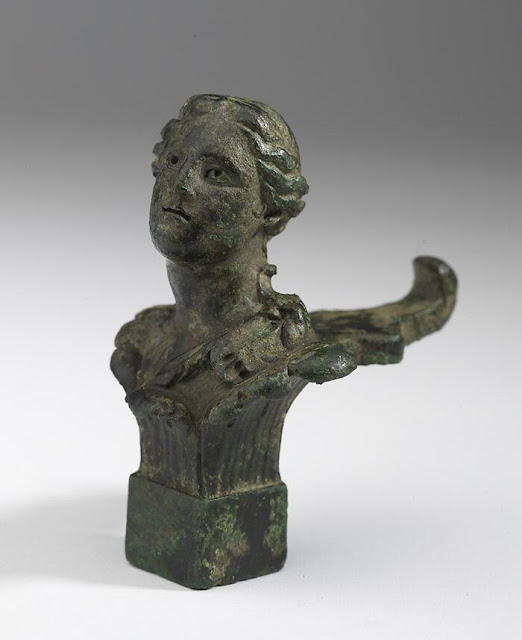
A Millennium of ancient Roman culture at the Royal Ontario Museum in Toronto, Onatario, Canada. The Eaton Gallery of Rome at the Royal Ontario Museum is home to a millennium of ancient Roman culture. It has the largest collection of classical antiquities in Canada, displaying more than 500 objects that range from marble or painted portraits of historical figures to magnificent Roman jewellery. The gallery also features the Bratty  Exhibit of Etruria that sheds some light on the Etruscans, a neighbouring civilization. The Joey and Toby Tanenbaum Gallery of Rome and the Near East depicts the lifestyle and culture of societies under Roman rule and their influence in the Near East and the Byzantine gallery reflects the history of the Byzantine Empire from 330 to 1453 CE. Other ancient cultures represented in the ROM's collections include ancient Cyprus, Egypt, Nubia, Bronze Age Aegean, and the Archaeic, Classical, and Hellenistic Periods of Greece. Image: Finial with the b...

Bronze Age Greek and Roman artifacts at the İzmir Archaeological Museum in İzmir, Turkey

Image
Bronze Age Greek and Roman artifacts at the İzmir Archaeological Museum in İzmir, Turkey. The İzmir Archaeological Museum originally established in 1924 contains remains from ancient Smyrna, claimed to be the birthplace of Homer, as well as Ephesus, Pergamon, Miletus, Aphrodisias, Clazomenae, Teos, and Iasos including busts, statues, statuettes, jewelry, coins, tools, architectural elements and various eating and cooking utensi ls. One of the most impressive is a life-sized late Hellenistic bronze sculpture of a running athlete wearing a victory wreath from the coast of Kyme. Image: Life-sized late Hellenistic bronze sculpture of a running athlete wearing a victory wreath from the coast of Kyme. Image courtesy of Wikimedia Commons contributor Dick Osseman.

Assyrian, Hittite and Phyrgian art. Ongoing. At the Kayseri Archaeological Museum in Kayseri, Turkey.

Image
Assyrian, Hittite and Phyrgian art. Ongoing. At the Kayseri Archaeological Museum in Kayseri, Turkey. Ceremonial jar in the shape of a Bull 1800 BCE Roman sarcophagus depicting the adventures of Heracles 2nd-3rd century CE Neo-Hittite Portal Lions 8th century BCE The archaeological site of Kültepe is just 14 miles southwest of Kayseri and so much of the archaeological museum's space is dedicated to artifacts recovered from the site. Kaneš, the ancient city at the heart of the Kültepe archaeological site, was inhabited continuously from the Chalcolithic to Roman times and flourished as  an important Hattian, Hittite and Hurrian city, containing a large kārum (merchant colony) of the Old Assyrian Empire from the 21st to 18th centuries BCE. Over 20,000 cuneiform tablets were recovered from the site and many of these as well as pitchers, vases, stamps, bowls, metalware and reliefs are displayed in the first hall of the museum. Phrygian ceramics are displayed in the...