Posts

Showing posts with the label Cyprus

Wheeled cauldron stands

Image
I've photographed a number of huge bronze cauldrons, including spectacular examples found in the Midas Mound Tumulus at Gordion in Turkey. But I had never given any thought as to how these huge vessels were transported when full.  I had assumed they were carried manually by servants.  But today, while researching something else, I came across images of wheeled stands that were used to transport large cauldrons in ancient Cyprus.  Somehow I must have overlooked these interesting objects on my visits to both the British Museum and the Neues Museum in Berlin.   Bronze wheeled stand for a cauldron with an animal frieze on the ring and figures in the side panels. The panels depict a seated harp-player approached by a musician and a serving boy, a winged sphinx, a lion gripping a water bird by its neck, and a chariot, Cypriot, 13th or 12th century BCE, at the British Museum courtesy of Wikimedia Commons contributor George Groutas. Wheeled stand for a cauldron, bronze,...

The Hyksos and the Stag

Image
Although the Hellenistic Egyptian historian Manetho portrayed the Hyksos invasion of Egypt during the Second Intermediate Period as violent and brutal, archaeology points to an Asiatic presence at Avaris, which would become the center of Hyksos activity for over 150 years before the beginning of Hyksos rule.  Evidence indicates a gradual Canaanite settlement beginning during the 12th Dynasty around 1800 BCE.  Egyptologist Manfred Bietak points out that Egypt had long depended on the Levant for expertise in areas of shipbuilding and seafaring, with possible depictions of Asiatic shipbuilders being found from reliefs from the Sixth Dynasty ruler Sahure. The Twelfth Dynasty of Egypt is known to have had many Asiatic immigrants serving as soldiers, household or temple serfs, and various other jobs. Avaris in the Nile Delta attracted many Asiatic immigrants in its role as a hub of international trade and seafaring. When the last pharaoh of the Egyptian 13th Dynasty, Sobekhotep IV d...

Persian cavalry before the cataphractarii

Image
The Persians did not use cavalry to a great extent until Cyrus the Great  gave the Persian nobility both horses and the wealth to maintain them from the proceeds of his western conquests. He encouraged them to ride and it became a source of disgrace for a Persian noble to be seen walking.  Cyrus then recruited his cavalry from the nobles, creating a regiment of 15,000 men drawn from the Huvaka or “kinsmen.” These kinsmen adopted brightly-colored trousers and shorter tunics that were more suitable for riding from the Medes.  Cyrus adopted cavalry tactics from the Khorassan horsemen of northeastern Iran, parts of modern Afghanistan and the southern parts of Central Asia. He initially armed his cavalry with the standard weapons of the Persian infantrymen: bows, battle-axes, and oval shields. Later, they were re-equipped with short stabbing swords and throwing javelins instead. Long lances and spears made of wood or entirely of metal were used too. In the mid-5th century Pers...

"Emerging" Aphrodite

Image
This morning while searching for additional information about rare Roman funerary cippi recovered on Cyprus, I stumbled across this little figurine of "emerging" Aphrodite in the collections of the Museum of Cycladic Art. The reason it caught my attention is the pose is strikingly similar to the fresco of Venus in the triclinium of the House of the Prince of Naples that I studied earlier this year.  At the time, I was  wondering why the fresco was identified as Venus (Aphrodite) when the other main fresco in the room was identified as Bacchus (Dionysus), since Ariadne was the consort of Dionysus, not Venus.  Dr. Wallace-Hadrill had patiently explained to me that the goddess in the triclinium was identified as Venus because she is depicted wringing the sea water from her hair as described in Greek mythology (Hesiod's "Theogony" to be exact) but up until now I had never seen other ancient artwork with Venus in that particular pose. According to the museum, the eme...

Egypt and Cyprus in the Late Archaic Period

Image
Cyprus, the third largest island in the Mediterranean, located north of Egypt and west of the Levant, was considered a strategic site  in the ancient world and subsequently occupied by the Assyrians, Egyptians, Persians, Greeks, and Romans.  During the Cypriot Archaic Era (c. 750 BCE to 475 BCE), the island was ruled by Sargon II of Assyria, starting in 709 BCE when the Assyrians extorted taxes from Cyprus in exchange for their independence.  But, by 699 BCE the Assyrians withdrew because of conflicts elsewhere and the Egyptian Pharaoh Amasis II (also known as Ahmose II) claimed the island around 560 BCE. According to Herodotus, Amasis was of common origins and originally an officer in the Egyptian army. He campaigned in Nubia under the Pharaoh Psamtik II in 592 BCE and rose to the rank of general.  Psamtik II was succeeded by his son, Apries (also known as Waphres of Manetho). Apries led an expedition in an attempt to protect Libya from incursions by Dorian Greek in...

Africans in Greek and Roman Art

Image
The Bronze Age Minoans of Crete were probably the first Greeks to come into contact with Ethiopians, a Greek name meaning those with "burnt" faces.  The tomb of Rekhmire, governor of Thebes and vizier during the reigns of the pharaohs Thutmosis III and Amenhotep II, circa 1400 BCE, includes one of the earliest depictions of both African and Aegean peoples, thought to be Nubians and Minoans.  However, the collapse at the end of the Late Bronze Age severed Greek connections with Egypt and even the Near East. Trade between the Greeks and the northern periphery of Africa finally resumed in the 8th and 7th centuries BCE including the establishment of trading centers along the Nile and at Cyrene on the northern coast of Africa. Then depictions of Africans began to appear in Aegean art. All black Africans were known as Ethiopians to the ancient Greeks, as the fifth-century BCE historian Herodotus tells us, with their black skin color being the primary identifying physical characteri...

The contentious relationship between ancient Cyprus and Persia

Image
The early documented history of Cyprus begins with an inscribed stele commemorating a victory by Sargon II (722–705 BCE) of Assyria there in 709 BCE.  Assyrian domination of Cyprus appears to have begun earlier than this, though, during the reign of Tiglath-Pileser III (744–727 BCE), and ended with the fall of the Neo Assyrian Empire in 609 BCE, whereupon the city-kingdoms of Cyprus gained independence once more. Following a brief period of Egyptian domination in the sixth century BCE, Cyprus fell under Persian rule. Royal palaces excavated on Cyprus resemble the architecture of Achaemenid examples like Persepolis, with audience chambers, open courtyards, bathhouses, and stores.  Town fortifications and houses were built of mudbrick walls on stone foundations. Early Greek influence is reflected in Cypriot sculpture, however.  Archaic Greek art with its attractive smile on the face of the statue is found on many ritual pieces dating between 525–475 BCE although portrait sc...

Cypriot Gold at the Metropolitan Museum of Art in New York

Image
The island of Cyprus has been inhabited by humans since at least 10,000 BCE.  During the late Bronze Age the island experienced two waves of Greek settlement, around 1400 BCE, and,  following the Bronze Age collapse of Mycenaean Greece, from 1100 to 1050 BCE.  Literary evidence also suggests an early Phoenician presence at Kition which was under Tyrian rule at the beginning of the 10th century BCE. It is thought Phoenician merchants colonized the area and expanded the political influence of Kition. Then, Cyprus was conquered by Assyria, first during the reign of Tiglath-Pileser III (744-7242 BCE), then by Sargon II (722-705 BCE). Assyrian hegemony ended with the fall of the Neo Assyrian Empire in 609 BCE.  The city-kingdoms of Cyprus gained their independence for a short time before domination by Egypt in the sixth century BCE, followed by Persia in 545 BCE.  In 499 BCE, the Cypriots, led by Onesilus, king of Salamis, joined the Greeks in the unsuccessful I...

Terracotta jug in the shape of an African head, Roman Cyprus, 3rd century CE at the Metropolitan Museum of Art in New York City

Image
Terracotta jug in the shape of an African head, Roman Cyprus, 3rd century CE at the Metropolitan Museum of Art in New York City. The unique geographic location of Cyprus at the crossroads of seafaring trade in the eastern Mediterranean made it an important center for trade and commerce in antiquity. Already in the Early Bronze Age (ca. 2500–1900 B.C.) and Middle Bronze Age (ca. 1900–1600 B.C.), Cyprus had established contacts w ith Minoan Crete and, subsequently, Mycenaean Greece, as well as with the ancient civilizations of the Near East (Syria and Palestine), Egypt, and southern Anatolia. In 570 BCE, Cyprus was conquered by Egypt under Amasis II. This brief period of Egyptian domination left its influence mainly in the arts. Some ceramics recovered on Cyprus feature men wearing Egyptian wigs and Assyrian-style beards. The influence of Egypt would continue during and after the wars of Alexander's successors. The largest city and kingdom of Cyprus, Salamis, strongly supported P...

Cyprus: Island on the Move through March 15, 2020 at the Rijksmuseum Van Oudheden in Leiden, Netherlands

Image
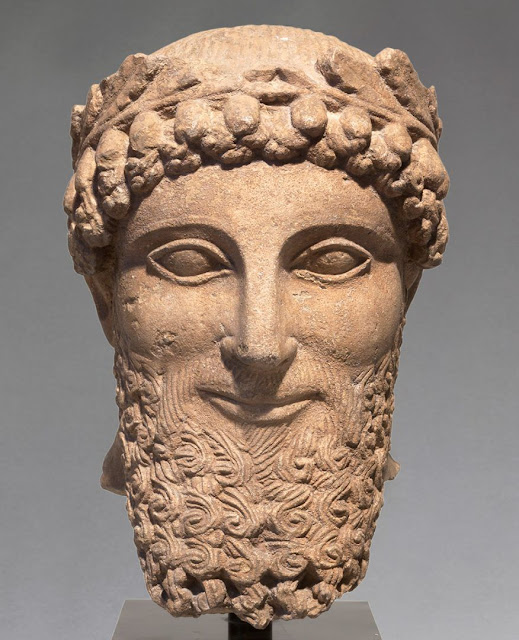
Cyprus: Island on the Move through March 15, 2020 at the Rijksmuseum Van Oudheden in Leiden, Netherlands. More than four hundred objects including three hundred archaeological masterpieces from the national collections of Cyprus are presented in this exploration of the history and cultural diversity of this archaeologically rich island. A story covering more than nine thousand years, visitors will see Aphrodite statues of marb le, luxury goods from the Near East and Egypt, gold jewelry, imaginative pottery with lively animal figures, decorated bronze kettles and weapons, colorful mosaics and a silver-inlaid king throne. Image: Dated between 460-450 BCE, this Cypriot male portrait with almond-shaped eyes and the 'archaic' smile is typical of a Greek image of the period. However, the curled beard reflects the fashion of the Persian court as 5th century BCE Cyprus was ruled by the Persians. Image courtesy of the museum.

Kypriaka Chronika: Tales of Ancient Cypriote Ceramics in West Coast Collections. February 9 - April 28, 2019 at the Hallie Ford Museum of Art, Willamette University, Salem, Oregon.

Image
Kypriaka Chronika: Tales of Ancient Cypriote Ceramics in West Coast Collections. February 9 - April 28, 2019 at the Hallie Ford Museum of Art, Willamette University, Salem, Oregon. The exhibition features 26 ceramic vessels and figurines that date from the Early Bronze Age to Early Iron Age (ca. 2500 to 475 BCE). The exhibits include a bichrome ware horse and rider from the Cypro-Archaic Period from 700-600 BCE as a votive off ering for a tomb. Other animal forms produced during this period include bulls, birds, and fishes. Cypriot Bichrome ware is characterized by black and red lines defining geometric, floral or zoomorphic decorations. Examples of this pottery have been found all over the Levant but neutron activation analysis has shown the composition matched Cyprus-made pottery indicating its export to Palestine and other areas. Cypriot bichrome ware horse and rider 700-600 BCE. Image courtesy of the Hallie Ford Museum of Art in Salem, Oregon.