Posts

Showing posts with the label Alexandria

Cremation or inhumation?

Image
During the Ptolemaic period a distinctive type of subterranean tomb for multiple burials proliferated in the cemeteries around the city of Alexandria. Underground chambers cut into the living rock radiated from a central courtyard open to the sky. Most chambers contained a number of loculi, long narrow niches cut into the walls, which served as burial slots. Some loculi were sealed with painted limestone slabs in the form of small shrines. - Metropolitan Museum of Art Roman columbaria were often built partly or completely underground as well. Most columbaria were managed by funeral societies and used by the lower and middle-classes. Niches could be quite simple or elaborately decorated with inscriptions, paintings, and mosaics depending on each family's economic means.   The Columbarium of Pomponius Hylas is a 1st-century CE Roman columbarium, situated near the Porta Latina on the Via Appia, Rome, Italy. It was discovered and excavated in 1831 by Pietro Campana. Though its nam...

The cult of Serapis: Visions and Portents

Image
Serapis, sometimes spelled Sarapis, is a Graeco-Egyptian deity promoted during the 3rd century BCE by Ptolemy I Soter as a means to unify Greeks and Egyptians in his realm.  Alexander the Great had attempted to use Amun for this purpose, but he was more prominent in Upper Egypt, and not as popular in Lower Egypt, where the Greeks had stronger influence. Ptolemy built an immense temple to the god in Alexandria which became known as the Serapeum.   However, there is evidence the cult of Serapis existed before the Ptolemies came to power in Alexandria as a temple of Serapis in Egypt is mentioned in 323 BCE by both Plutarch (Life of Alexander, 76) and Arrian (Anabasis, VII, 26, 2).  In descriptions of Alexander's death, a temple of Serapis is said to have existed in Babylon at the time and Serapis was considered so important,  he alone is named as being consulted on behalf of the dying king.  Some scholars point out, though, that a Babylonian god named Ea (also...

Hellenistic Bronze statuette of a veiled and masked dancer, 3rd–2nd century BCE, Ptolemaic Period, Egypt

Image
A week ago, I illustrated one of my "wisdom" posts with an image of a veiled vestal virgin produced by Italian sculptor Antonio Corradini.  He is famous for his ability to use solid medium like marble to depict illusory veiled women where the contours of their face and body can be discerned beneath the "veil".  Well, this morning while browsing artifacts in the collection of the Metropolitan Museum of Art, I saw an amazing Greek bronze sculpture created in the 3rd - 2nd century BCE in Alexandria, Egypt that possesses the same ethereal quality as those much more modern sculptures of Corradini. The Metropolitan Museum of Art observes: The complex motion of this dancer is conveyed exclusively through the interaction of the body with several layers of dress. Over an undergarment that falls in deep folds and trails heavily, the figure wears a lightweight mantle, drawn tautly over her head and body by the pressure applied to it by her right arm, left hand, and right leg. ...

Priest holding a vase from the eastern harbor of Alexandria in the "Egypt's Lost Cities" exhibit at the Ronald Reagan Presidential Library and Museum

Image
Priest holding a vase from the eastern harbor of Alexandria in the "Egypt's Lost Cities" exhibit at the Ronald Reagan Presidential Library and Museum through April 12, 2020. This young priest, carved in black granite holds a vase depicting Osiris, whose cult flourished among Romano-Egyptians in the late 1st century CE. The cult of Isis and Osiris continued at Philae until at least the 450s CE, long after Roman imperial decrees o f the late 4th century that ordered the closing of temples to "pagan" gods. Philae was the last major ancient Egyptian temple to be closed. The ritual reenactment of Osiris's funeral rites were held in the last month of the inundation (the annual Nile flood), coinciding with Spring, and held at Abydos which was the traditional place where the body of Osiris drifted ashore after having been drowned in the Nile. Some elements of the ceremony were held in the temple, while others involved public participation in a form of theater. T...

Egypt's Lost Cities through April 12, 2020 at the Ronald Reagan Presidential Library in Simi Valley, California

Image
Egypt's Lost Cities through April 12, 2020 at the Ronald Reagan Presidential Library in Simi Valley, California. The Stele of Ptolemy VIII Euergetes II, an 18-ton monolith, one of the 250 artifacts in the "Egypt's Lost Cities" exhibit excavated from the ancient towns of Thonis-Heracleion and Canopus in Egypt, now greets visitors to the Ronald Reagan Presidential Library, Thonis-Heracleion and Canopus, once bustling cities on E gypt's north coast, sank into the Mediterranean Sea about 1,200 years ago, casualties of rising sea levels, earthquakes and tidal waves. They remained lost until 2000, when they were uncovered by French underwater archaeologist Franck Goddio, founding president of the European Institute for Underwater Archaeology. The exhibition includes gold coins and jewelry, bronze vessels, and a 16-foot tall 8-ton red granite statue of the god Hapi. In addition to artifacts recovered by Goddio, other artifacts from museums in Cairo and Alexandria wil...

Artifacts from ancient Egypt, the Near East, Greece, Rome, the Americas, Asia and Africa. Ongoing at the Michael C. Carlos Museum of Emory University in Atlanta, Georgia.

Image
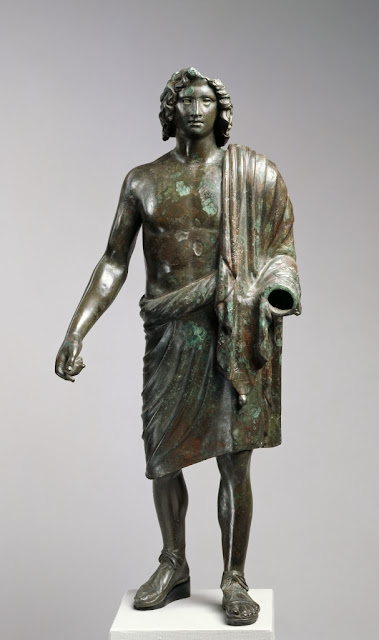
Artifacts from ancient Egypt, the Near East, Greece, Rome, the Americas, Asia and Africa.  Ongoing at the Michael C. Carlos Museum of Emory University in Atlanta, Georgia.  Some 17,000 artifacts from ancient Egypt, the Near East, Greece, Rome, the Americas, Asia, and Africa, as well as works on paper from the Renaissance to the present day, provide visitors with a glimpse into the art and history of world cultures. Image: Clothing and posture identify this 1st to 2nd century CE figure from Alexandria, Egypt as Hermanubis, a Greco-Egyptian deity who combines the essences of the Greek god Hermes with the Egyptian Anubis. The syncretism of Hermes and Anubis arises from the function of both deities to guide souls to the Underworld. Distinctive in the clothing of Hermanubis is a garment that wraps around the waist with a roll of cloth, with one end falling over the left shoulder. In his left hand he may have held a palm branch, while in his right the caduceus (herald's staff...

Egypt's Sunken Cities. Through April 14, 2019 at the Minneapolis Institute of Art in Minneapolis, Minnesota

Image
Egypt's Sunken Cities. Through April 14, 2019 at the Minneapolis Institute of Art in Minneapolis, Minnesota  More than 1200 years ago, two ancient cities were lost to natural disasters and the rising tides of the Mediterranean Sea. Two decades ago, underwater archaeologist Franck Goddio and his team discovered those cities, revealing monumental statues, religious images carved in stone, exquisite jewelry, and delicate ceramics—and a greater understanding of life during the age of the pharaohs.