Posts

Pompeii: The Exhibition to open at Salt Lake City's Leonardo Museum beginning November 23, 2019

Image
Pompeii: The Exhibition to open at Salt Lake City's Leonardo Museum beginning November 23, 2019. More than 150 artifacts from Pompeii, the Roman city covered by the volcanic eruption of Mount Vesuvius in 79 CE, will be displayed at the Leonardo Museum in Salt Lake City, Utah including mosaics and frescoes, gladiator helmets, armor, and weapons, a ship’s anchor, lamps, jugs, cups, plates, pots and pans and other household objects  and furniture, jewelry, medical instruments, and tools. A simulated 4D eruption theater will allow visitors to experience the deathly impact Mount Vesuvius had on this ancient city, culminating in the reveal of full body casts of twisted human forms, asphyxiated by extreme heat and noxious gases and forever frozen in time. Image: Closeup of the lion skin of Hercules and a stork fighting a snake on gladiator shin guards recovered from the gladiator barracks in Pompeii Roman 1st century CE photographed at "Pompeii: The Exhibit" when disp...

Ninety-six ancient Roman sculptures from the private Torlonia Collection to be displayed at the Capitoline Museums in Rome from March 25, 2020 to January 10, 2021

Image
Ninety-six ancient Roman sculptures from the private Torlonia Collection to be displayed at the Capitoline Museums in Rome from March 25, 2020 to January 10, 2021. Ninety-six from a total of 620 ancient sculptures will be featured in the exhibition "The Torlonia Marbles: Collecting Masterpieces" next year in the Palazzo Caffarelli venue of the Capitoline Museums in Rome. The collection of marble, bronze and alabaster statues, b usts, bas reliefs, and sarcophagi were amassed between the 15th and 19th centuries. Originally showcased in the Museo Torlonia which opened to the public in 1875 in Rome's Trastevere quarter, the museum was shuttered after World War II with access granted only to experts or visiting dignitaries. When the museum was finally closed in 1976 to make way for luxury apartments. The collection ended up stored in a basement in another palace owned by the Torlonia family and has remained there for more than four decades. Finally, after years of negotiat...

Egypt's Lost Cities through April 12, 2020 at the Ronald Reagan Presidential Library in Simi Valley, California

Image
Egypt's Lost Cities through April 12, 2020 at the Ronald Reagan Presidential Library in Simi Valley, California. The Stele of Ptolemy VIII Euergetes II, an 18-ton monolith, one of the 250 artifacts in the "Egypt's Lost Cities" exhibit excavated from the ancient towns of Thonis-Heracleion and Canopus in Egypt, now greets visitors to the Ronald Reagan Presidential Library, Thonis-Heracleion and Canopus, once bustling cities on E gypt's north coast, sank into the Mediterranean Sea about 1,200 years ago, casualties of rising sea levels, earthquakes and tidal waves. They remained lost until 2000, when they were uncovered by French underwater archaeologist Franck Goddio, founding president of the European Institute for Underwater Archaeology. The exhibition includes gold coins and jewelry, bronze vessels, and a 16-foot tall 8-ton red granite statue of the god Hapi. In addition to artifacts recovered by Goddio, other artifacts from museums in Cairo and Alexandria wil...

Assyria to America at the Bowdoin College Museum of Art in Brunswick, Maine through December 13, 2020

Image
Assyria to America at the Bowdoin College Museum of Art in Brunswick, Maine through December 13, 2020. "Assyria to America" examines the ancient and modern histories of six reliefs from ancient Nimrud now in the collections of the Bowdoin College Museum of Art.   For the first time in their 150-year history at Bowdoin, ivory furniture inlays, cuneiform tablets, cylinder seals, and palace vessels are used to explore the sumptuous sensory experiences and vibrant court life of the Neo-Assyrian empire. Image: Head of Ashurnasirpal II from Kalhu (Nimrud), ca. 875–860 B.C.E. gypsum. Courtesy of Bowdoin College Museum of Art.

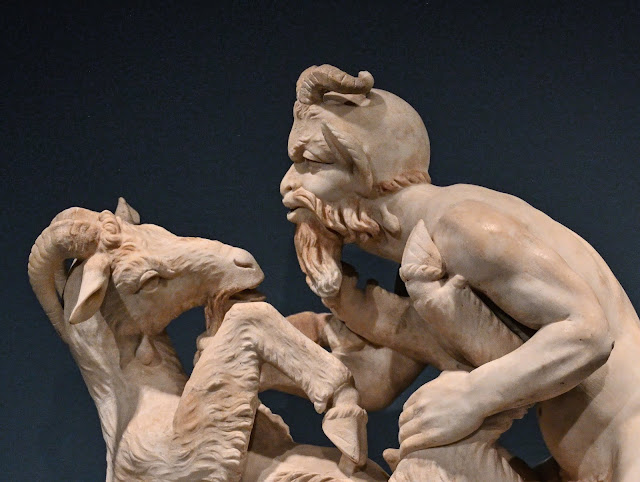
A goat and satyr "Buried by Vesuvius" at the Getty Villa until October 28, 2019

Image
A goat and satyr "Buried by Vesuvius" at the Getty Villa until October 28, 2019. The marble sculpture of the woodland god Pan having intercourse with a she-goat was discovered in the Villa dei Papiri in 1752. It immediately became notorious and was long off-limits, viewable only in the vaults of the royal palace at Portici by special permission of the king. Explicit imagery was common in antiquity. S ome modern commentators have interpreted this sculpture as evidence of the Romans’ reverence for the generative power of sex. Others have seen it as a satire on the bestial nature of all men. As many of the sculptures in the villa seem to have been grouped thematically, it is tempting to link this work with busts found nearby such as the Macedonian king Demetrios Poliorketes, often depicted with horns, like Pan, and famously dissolute. The satyr and goat were found on the south side of the rectangular peristyle on March 1, 1752. Image: Closeup of Satyr and goat found...

Philetairos of Pergamon "Buried by Vesuvius" at the Getty Villa until October 28, 2019

Image
Philetairos of Pergamon "Buried by Vesuvius" at the Getty Villa until October 28, 2019. Philetairos, 343 –263 BCE, was the founder of the Attalid dynasty of Pergamon in Anatolia. After the death of Alexander the Great in 323 BCE, Philetairos became embroiled in the struggle for supremacy, called the Wars of the Diadochi, between Alexander's generals. Philetairos served first under Antigonus then shifted his allegiance to Lysim achus who, after Antigonus was killed at the Battle of Ipsus in 301 BCE, made Philetairos commander of Pergamon, where Lysimachus kept a treasury of nine thousand talents of silver. Philetairos served Lysimachus until 282 BCE when court intrigues prompted him to desert Lysimachus and offer himself and the important fortress of Pergamon, along with its treasury to Seleucus. Seleucus subsequently defeated and killed Lysimachus at the Battle of Corupedium in 281 BCE. But, Seleucus himself was subsequently killed by Ptolemy Ceraunus, the brother-in-...

Woman Wearing a Peplos, possibly Demeter or Hera, "Buried by Vesuvius" at the Getty Villa until October 28, 2019.

Image
Woman Wearing a Peplos, possibly Demeter or Hera, "Buried by Vesuvius" at the Getty Villa until October 28, 2019. Exploration of the Villa dei Papiri was abandoned in 1764. Its tunnels were backfilled and its precise location underground was forgotten despite the ever-growing fame of its contents. Renewed interest in the site in the 1980s led to limited excavations in the 1990s and 2000s, which brought to light a portion of the bu ilding’s atrium as well as lower levels that were unknown in the eighteenth century. Among the new discoveries were rooms with colorful mosaic floors and spectacular frescoed walls and stuccoed ceilings. Finds also included a seaside pavilion and swimming pool, where archaeologists recovered two marble sculptures and luxurious wood and ivory furniture components. These recent excavations helped clarify the chronology of the villa, which is now thought to have been built around 40 BCE, with the seaside pavilion added around 20 CE. Reconstructe...