Posts

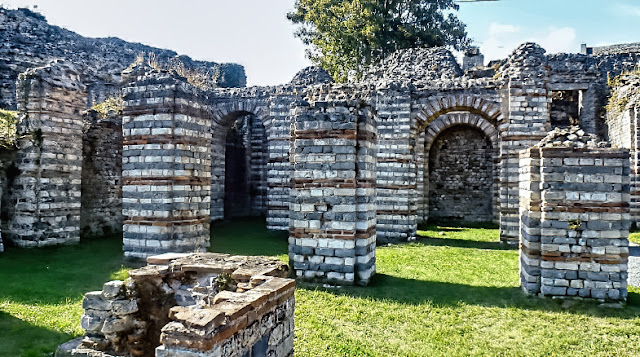
Remains of ancient Aventicum at the Musée Romain d'Avenches, Avenches, Switzerland

Image
Remains of ancient Aventicum at the Musée Romain d'Avenches, Avenches, Switzerland. Aventicum was the largest town and capital of Roman Switzerland (Helvetia or Civitas Helvetiorum). The city was founded after the Helvetii were conquered by Julius Caesar in the early 1st century CE. Aventicum and the Helvetii land was incorporated into the Roman province of Gallia Belgica. Tacitus, writing about 69 CE, speaks of the Helvetians  as originally a Gallic people, renowned for their valor and exploits in war, and he designates Aventicum as their Caput gentis. During the Year of the Four Emperors which followed Nero’s death, the civitas Helvetiorum supported Galba. Unaware of his death, they refused to accept the authority of his rival, Vitellius. The Legio XXI Rapax, stationed in Vindonissa and favoring Vitellius, stole the pay of a Helvetian garrison, which prompted the Helvetians to intercept the messengers and detain a Roman detachment. Aulus Caecina Alienus, a former supporter...

Ancient Art from the Palace of Ramesses III at the Boston Museum of Fine Arts in Boston, Massachusetts

Image
Ancient Art from the Palace of Ramesses III at the Boston Museum of Fine Arts in Boston, Massachusetts. Ramesses III was the last great military pharaoh of the New Kingdom. In his fifth year on the throne he defeated the Libyans and brought them back to Egypt as slaves. In his eighth year he faced an even greater threat: a confederation of displaced eastern Mediterranean tribes on the move, including Greeks and Philistines, known  collectively as the Sea Peoples. Fresh from their victory over the Hittites, the Sea Peoples attempted to invade Egypt with the intention of settling there. Ramesses roundly defeated them both by sea and by land, recording his victories on the walls of his mortuary temple at Medinet Habu, "United with Eternity," which remains the best-preserved royal mortuary temple on the west bank of Thebes. Images: Tiles depicting a Hittite chief, a Nubian Chief, and a Syrian Chief recovered from the Palace of Ramesses III at Medinet Habu, Egyp...

First to Third century CE Treveri and Roman remains at the Gallo-Roman Museum in Arlon, Belgium

Image
First to Third century CE Treveri and Roman remains at the Gallo-Roman Museum in Arlon, Belgium. Before the Roman conquests of Gaul, the territory of Arlon and a vast area to the southeast were settled by the Celtic Treveri tribe. The settlement was located at what would become crossroads of two important Roman roads (Reims-Trier and Metz-Tongres) after the Roman conquest of Gaul. This allowed ancient Orolaunum to prosper and  become a vibrant commercial and administrative center during the first three centuries of the common era. Then much of the city was destroyed during the Germanic invasions of the 3rd century CE despite the defensive walls that had been built on the Knipchen hill. The first archaeological discoveries made in Arlon go back to the 17th century, when remains of the defensive wall were dismantled and its foundations revealed the reuse of fragments of funerary monuments. During the 19th century a necropolis was unearthed along the a wealth of grave goods. Then ...

Gallo-Roman remains of ancient Bavacum, once the capital for the Nervii tribe in Bavay, France

Image
Gallo-Roman remains of ancient Bavacum, once the capital for the Nervii tribe in Bavay, France. Local legends point to the city of Bavay's founding by a cousin of Priam fleeing the destruction of Troy in the 12th century BCE. But archaeologists have been unable to find remains dating that far into antiquity. However, the site served as a capital of the Nervii tribe, connecting their city to the capital cities of neighbouring  Amiens via Arras, Tongeren, Cassel, Trier in the east and Reims in the south, until their defeat by Julius Caesar during the Gallic Wars. The location then became known as Bavacum (or Bagacum) when it was designated a Roman civitas as the result of a reorganization by Augustus between 16 and 13 BCE. The town became an important commercial junction of seven roads on the trade routes between Germania and the naval port of Boulogne-sur-Mer. During the Claudian period through the dynasty of the Flavians, a forum, thermal baths fed by an aqueduct bringing water...

The Neo-Pompeiian art of Eduardo Ettore Forti now online on Wikipedia

Image
The Neo-Pompeiian art of Eduardo Ettore Forti now online on Wikipedia. Like many neo-classical painters of the late 19th century, Ettore Forti, became enthralled by ancient Roman life after the rediscovery of Pompeii in 1748 and the subsequent excavations. Although many of his extant paintings feature scenes of merchants selling carpets, jewelry, or antiquities to well-to-do Roman ladies, he also painted scenes of chariot  racing, musicians, city folk gossiping around a fountain, and even coaches bearing emperors careening down the roads leading back to Rome. These images can now be viewed online in a gallery on Ettore Forti's Wikipedia page. I searched the internet for over a week to collect as many images of his work as I could find and upload them to Wikimedia Commons (since they are now in the public domain). I strongly believe images bring history to life so I've been working hard to identify images in the public domain that portray ancient life and uploading them to W...

Pre-Achaemenid, Greek, Roman, Egyptian and ancient Asian art at the Miho Museum in Sigaraki, Japan.

Image
Pre-Achaemenid, Greek, Roman, Egyptian and ancient Asian art at the Miho Museum in Sigaraki, Japan. The Miho Museum is located southeast of Kyoto, Japan, near the town of Shigaraki. Among the objects in its 2,000-piece permanent collection are more than 1,200 objects that appear to have been produced in Achaemenid Central Asia. Some scholars have claimed these objects are part of the famous Oxus Treasure, lost shortly after its  discovery in 1877 and rediscovered in Afghanistan in 1993, although both the Miho and British Museum's material from this period point to unique findspots. In addition to the Persian objects, the museum houses Roman, Greek, and Egyptian antiquties as well as art from ancient China, Japan, and southeast Asia. Image: 1 ) Vessel with Bull Attacked by a Lion Pre-Achaemenid Period 8th-6th centuries BCE. The wounded bull is extremely serene, looking more as though the lion was embracing him. This vessel symbolizes the order of the cosmos, as the t...

Carthago: The Immortal Myth September 27, 2019 through March 29, 2020 at the Colosseum and Forum Romanum in Rome, Italy.

Image
Carthago: The Immortal Myth September 27, 2019 through March 29, 2020 at the Colosseum and Forum Romanum in Rome, Italy. The history and culture of one of the most powerful and fascinating cities of the ancient Mediterranean will be celebrated in the Colosseum, the Temple of Romulus, and the Imperial Ramp at the Forum Romanum beginning September 27, 2019. The exhibition will feature reconstructions and multimedia installations  alongside artefacts displayed in public for the first time, highlighting a series of historical events uniting the two great powers of the ancient world: Carthage and Rome. Objects on display include items from the collections of archaeological museums in Italy as well as the Carthage National Museum and the Bardo in Tunisia, and the national museums of Beirut in Lebanon, and Madrid and Cartagena in Spain. Visitors will be greeted by a reconstruction of the terrible deity Moloch, featured in the 1914 film Cabiria, stationed at the entrance to the Colosse...