Posts

Maya: The Great Jaguar Rises through December 31, 2019 at the Royal British Columbia Museum in Victoria, British Columbia, Canada

Image
Maya: The Great Jaguar Rises through December 31, 2019 at the Royal British Columbia Museum in Victoria, British Columbia, Canada.  Discover a powerful culture that rose in the tropical rainforests of Guatemala thousands of years ago, and learn how science and belief shaped the Maya identity from ancient times to present day.  The exhibition boasts the world’s largest and most impressive display of Maya objects from Guatemala, and features more than 300 precious jade, ceramic, gold, stone and textile artifacts reflecting classic and contemporary Maya culture. Image:  An exhibit visitor studies a Mayan relief at "The Great Jaguar Rises" in the Royal BC Museum.  Image courtesy of the Royal British Columbia Museum.
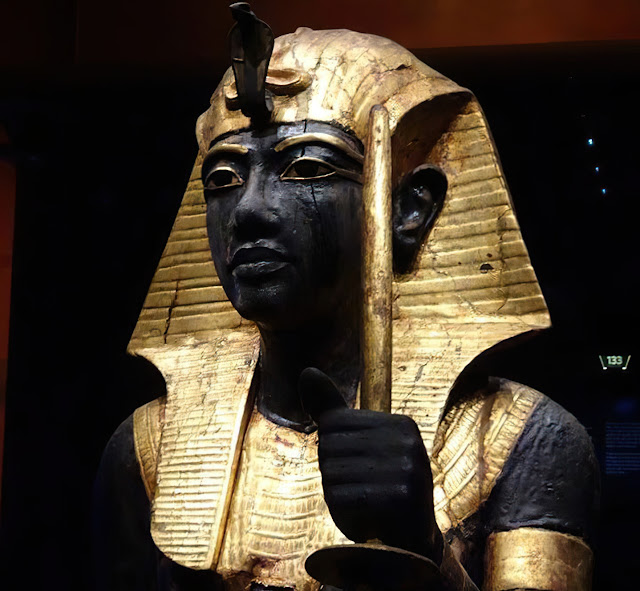
King Tut: Treasures of the Golden Pharaoh through September 15, 2019 at the Grande Halle de la Villette in Paris, France

Image
King Tut: Treasures of the Golden Pharaoh through September 15, 2019 at the Grande Halle de la Villette in Paris, France.  An exhibit said to be the last touring exhibit of actual King Tut artifacts, is now on display in Paris, France.  Although King Tut: Treasures of the Golden Pharaoh does not include the famous golden death mask, but it does include gold jewelry, sculptures, and ceremonial objects the king personally used such as gilded ushabti figurines, inlaid storage chests, Canopic utensils, the statue of Tutankhamun's ka, and vessels crafted of alabaster.  Sixty of the 150 objects have never left Egypt before.   The Louvre in Paris has loaned one of its top Egyptian pieces to the show, a statue of Amon, the king of the gods, to protect the pharaoh. Image: Guardian statue from the tomb of King Tutankhamun.  Image courtesy of "King Tut: Treasures of the Golden Pharaoh" media relations.

Buried by Vesuvius: Treasures from the Villa dei Papiri June 26 to October 28, 2019 at the Getty Villa in Pacific Palisades, California.

Image
Buried by Vesuvius: Treasures from the Villa dei Papiri June 26 to October 28, 2019 at the Getty Villa in Pacific Palisades, California.  Although the Getty Villa is a reproduction of the Villa dei Papiri in Herculaneum that was swallowed by the 79 CE eruption of Vesuvius, this exhibit is the first time objects from the Villa will be featured in a special display within its California counterpart.  The original Villa yielded a private residence with spectacular colored marble and mosaic floors, gloriously frescoed walls, important bronze and marble statuary, plus a unique library of more than a thousand papyrus scrolls (from which it gets its name). The treasures, originally discovered in the 1750s will be accompanied by objects recovered recently in ongoing excavations at the site.  The newly conserved bronze sculpture known as the Drunken Satyr will be among the artwork on display.  It's modern replica graces the reflecting pool at the Getty Villa's Outer Perist...

The Golden Splendor of the Royal Tombs of Ur ongoing at the Penn Museum in Philadelphia, Pennsylvania

Image
The Golden Splendor of the Royal Tombs of Ur ongoing at the Penn Museum in Philadelphia, Pennsylvania.  The Penn Museum joined with the British Museum to support excavations at Tell al-Muqayyar (ancient Ur), directed by Sir Leonard Woolley, from 1922-1934.   The best known artifacts are from the Royal Cemetery of Ur, a burial ground with more than 2000 internments, including those of the kings and queens who ruled the city-state ca. 2500 BCE. They include the personal jewelry of Puabi, the queen, and the “ram-in-the thicket,” a statuette of a goat rampant in a tree. The “ram-in-the-thicket” is made of shell, lapis lazuli, gold, and copper and typifies early Mesopotamian composite art. Other objects on display include a gilded bull-headed lyre, the remains of a young attendant wearing a gold headdress and jewelry of gold, lapis lazuli, carnelian, and shell, and electrotype reproductions of a bull-headed harp ornament and soldier's helmet. Soldiers were among the human s...

Roman-era mosaics in the Adana Archaeology Museum in Adana, Turkey

Image
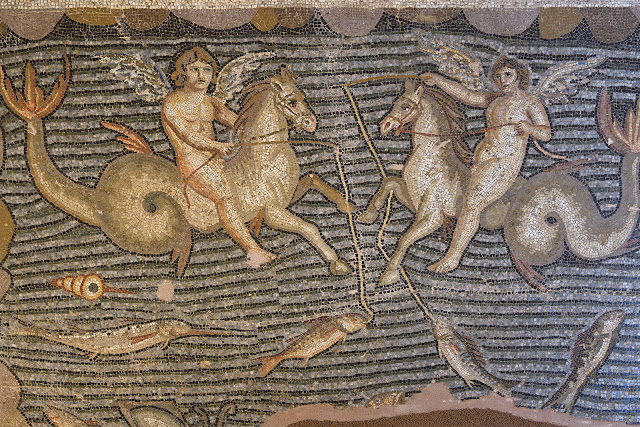
Roman-era mosaics in the Adana Archaeology Museum in Adana, Turkey.  Newly opened galleries at the Adana Museum now house an astonishing collection of Roman-era mosaics.  The mosaics depict an array of themes from classical mythology including Orpheus, Thetys, Artemis, and Erotes, as well as early Christian portrayals of the "Peaceful Kingdom" and Noah's Ark.  The museum has constructed elevated walkways in the new gallery space so visitors can view the expansive mosaics, many that once adorned church floors, more easily. The museum also has many objects from the Hittite period as well as artifacts from the Neolithic, Bronze Age, Iron Age, Archaic, Roman, Byzantine, and Ottoman eras.  Roman objects include sarcophagi, jugs, catapult shots, inscriptions, architectural elements, glassware, ceramics and jewellery. All images cc by courtesy of Dick Osseman:

Art of the ancient world at The Pushkin State Museum of Fine Arts in Moscow, Russia

Image
Art of the ancient world at The Pushkin State Museum of Fine Arts in Moscow, Russia. The ancient collection of the Pushkin State Museum currently includes more than 37,000 pieces. Antique art is dedicated to 8 rooms on the first and second floors of the Main building with a special hall dedicated to Heinrich Schliemann's "Gold of Troy". Works include not only original pieces from Cyprus, Greece, Etruria, Rome, Egypt, and Mesopot amia, but casts from major objects held in other museums including the Museo Archeologico in Naples, the Louvre, the Vatican Museums, the British Museum, the Cairo Museum, and the Antik Sammlung in Berlin. The art of ancient Greece and Rome was a particular interest of the museum's founder, Ivan Tsvetaev, and initially 12 out of 20 rooms were dedicated to it. Galleries containing objects from ancient Egypt and the Near East were updated in 2012 as part of the museum's 100th anniversary. A new hall was also added to house the museum...

Artifacts of the Kingdom of Baekje ongoing at the Buyeo National Museum in Buyeo, Chungcheongnam-do, South Korea

Image
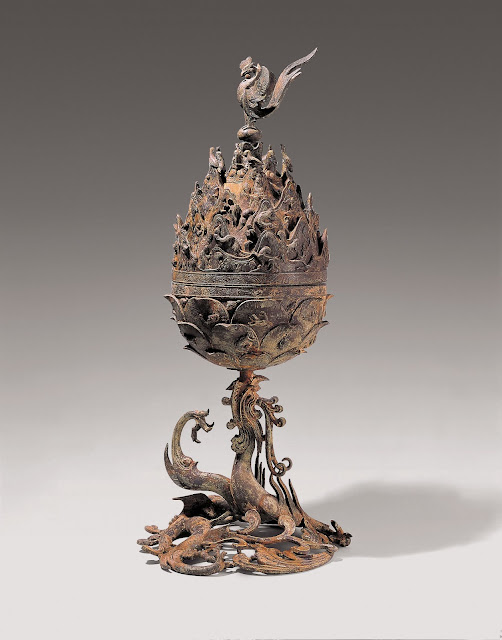
Artifacts of the Kingdom of Baekje ongoing at the Buyeo National Museum in Buyeo, Chungcheongnam-do, South Korea. Since Buyeo was once the capital of the Baekje kingdom during the Sabi period (538-660 CE), the Museum is fully devoted to the Baekje culture.  Baekje was a kingdom located in southwest Korea from 18 BCE to 660 CE.   It was one of the Three Kingdoms of Korea, together with Goguryeo and Silla.  Baekje alternately battled and allied with Goguryeo and Silla as the three kingdoms expanded control over the peninsula. At its peak in the 4th century, Baekje controlled most of the western Korean peninsula, as far north as Pyongyang, and may have even held territories in China, such as in Liaoxi, though this view is controversial. It became a significant regional sea power, with political and trade relations with China and Japan.  Its nautical skill, which made it the Phoenicia of East Asia, was instrumental in the dissemination of Buddhism throughout East...