Posts

Archaeological collections from Egypt and Sudan - Ongoing at The Petrie Museum in London, United Kingdom

Image
Archaeological collections from Egypt and Sudan - Ongoing at The Petrie Museum in London, United Kingdom. The Petrie Museum houses one of the largest archaeological collections in the world, some 80,000 objects, for Egypt and Sudan. It is named after William Matthew Flinders Petrie (1853-1942), appointed in 1892 as first University College London Edwards Professor of Egyptian Archaeology and Philology. Over three-quarters of the material comes from excavations directed or funded by Petrie, or from purchases he made for university teaching. Here you can see the Tarkhan Dress, the world's oldest surviving woven garmet, a v-neck linen shirt  radiocarbon dated to the late fourth-millennium BC. Gilded cartonnage mummy mask from the Roman Period. 5th Dynasty bead-net dress Roman period mummy portrait from the Fayum region

Roman, Etruscan, and Egyptian antiquities at the National Archaeological Museum of Parma, Italy

Image
Roman, Etruscan, and Egyptian antiquities at the National Archaeological Museum of Parma, Italy. This museum was established in 1760 to house artifacts recovered from the excavations of the Roman city of Veleia. It's collections now include Egyptian, Etruscan and Roman materials spanning a period from the Palaeolithic to the Early Middle Ages. From Veleia, the museum displays fragments of the Tabula Alimentaria Traianea and of the Le x de Gallia Cisalpina , figurative bronzes, ornaments and coins, as well as twelve marble statues of members of the Julio-Claudian dynasty. Through donations in the 18th and 19th centuries the museum also acquired ancient sculptures once belonging to the Gonzaga of Guastalla and the Farnese collections as well as numismatic collections of Greek currency, Greek and Etruscan ceramics and Egyptian objects. Sculptures of Julio-Claudians recovered from excavations in Veleia. Image courtesy of the National Archaeological Museum of Parma.

Antiquities and Pre-Columbian Art at the New Orleans Museum of Art in New Orleans, Louisiana

Image
Antiquities and Pre-Columbian Art at the New Orleans Museum of Art in New Orleans, Louisiana. Paintings, drawings and prints, and decorative arts including Greek ceramics survey the development of Western Civilization from the pre-Christian era to the present. A unique Arts of the Americas collection showcases the cultural heritage of North, Central and South America from the pre-Columbian period through the Spanish Colonial era. This collection is especially rich in objects from the great Mayan culture of Mexico and Central America, and in painting and sculpture from Cuzco, the fabulous Spanish capital of Peru. Image: Articulated terracotta figure from the Vera Cruz culture of Vera Cruz, Mexico 700-900 CE. Image courtesy of the New Orleans Museum of Art.

Reopening March 1, 2019. An exploration of the ancient city of Aregenua at the Vieux la Romaine Archaeological Museum near Caen, France

Image
Reopening March 1, 2019. An exploration of the ancient city of Aregenua at the Vieux la Romaine Archaeological Museum near Caen, France. This museum's permanent collections include 4,000 objects recovered from the ancient town of Aregenua, the capital of the Viducasse tribe. Excavations beginning in 1702 under the direction of King Louis XIV uncovered a bath house and a theater. Recent excavations in 1988 revealed a large town  house with paved central courtyard and a large number of artifacts used in daily life there. In 2002, a museum was built to showcase the artifacts and provide visitor information. Image: Relief of a satyr recovered from the House of the Grand Peristyle in Aregenua. Image courtesy of the Vieux la Romaine Archaeological Museum with digital enhancements.

Iberian art from Prehistory to early Modern Age. Ongoing at the National Archaeological Museum of Madrid in Madrid, Spain

Image
Iberian art from Prehistory to early Modern Age. Ongoing at the National Archaeological Museum of Madrid in Madrid, Spain. This museum beside the Plaza de Colón in Madrid was founded in 1867 by a royal decree from Isabella II. Its collections include not only works from the Iberian peninsula but artifacts from ancient Greece, Magna Graecia, ancient Egypt and the Near East. Image: Lady of Elche, Iberian, 4th century BCE, with Greek influence at the National Archaeological Museum of Madrid courtesy of Wikimedia Commons contributor Luis Garcia.

Loupian Roman villa n the village of Loupian in the Hérault départment of France, between Montpellier and Béziers, the heart of Gallia Narbonensis

Image
Loupian Roman villa n the village of Loupian in the Hérault départment of France, between Montpellier and Béziers, the heart of Gallia Narbonensis. Excavations on a three-hectare site south of the village have revealed remains of a Roman farm villa with extensive 2nd-century CE Gallo-Roman mosaics. The site was occupied for more than 600 years. Originally a modest farmstead built a few kilometres south of the Via Domitia, on the hillside overlooking the Bassin de Thau, it rapidly prospered and grew. During the early Empire, in the 1st and 2nd centuries, the villa was a large patrician residence with thermal springs. The main agricultural activity was viticulture, for which a storehouse capable of holding 1,500 hl of wine was constructed. This period also saw the building of a small port on the northern shore of the Bassin de Thau, as well as pottery workshops producing amphorae for the transportation of wine.  In the 5th century, the villa was completely rebuilt and the owner's ...

Antiquities from the excavations at Empúries onsite and in the Archaeological Museum of Catalonia in Barcelona, Spain

Image
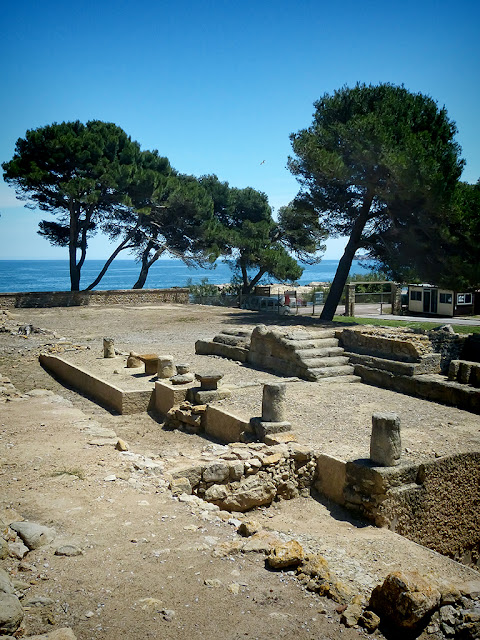
Antiquities from the excavations at Empúries onsite and in the Archaeological Museum of Catalonia in Barcelona, Spain. Empúries was founded in 575 BCE by Greek colonists from Phocaea. After the invasion of Gaul from Iberia by Hannibal the Carthaginian general in 218 BCE, the city was occupied by the Romans (Latin: Emporiæ). After the conquest of Hispania by the Romans, Empúries remained an independent city-state. However, in t he civil war between Pompey and Julius Caesar, it opted for Pompey, and after his defeat it was stripped of its autonomy. A colonia of Roman veterans, named Emporiae, was established near Indika to control the region and a Roman mint operated there. A number of Roman mosaics have been preserved and sculptures of Asclepius, Demeter, Dionysos and possibly the Empress Livia have been recovered, too, as well as red-figured ceramics, oil lamps, articulated dolls, and coin hoards. Note: I had the wonderful opportunity to explore Empúries in 2013 taking the photogr...