Posts

Showing posts with the label warrior

The Romanization of northwest Iberia (modern Portugal)

Image
During the last two centuries of the second millennium BCE a series of settlements were established along the coastal areas of northern Portugal. Their noble elite celebrated ritual banquets and participated in an extensive network of interchange of prestige items such as  cauldrons, knives, bronze vases, roasting spits, flesh-hooks, swords, axes and jewelry, from the Mediterranean up to the British Isles. But this network appears to collapse at the beginning of the first millennium and their open settlements were gradually replaced by fortified hill-forts constructed of earthen walls, battlements and ditches, which enclosed an inner habitable space. Trade dwindled to just the production of various axes and tools. Then, beginning in the 6th century BCE, the "Castro" culture once again began to expand and widespread trade returned driven by Carthaginian merchants who brought imports of wine glass, pottery, and other goods.  The Carthaginians constructed emporia that sometimes ...

Archaic Period Horse Sculptures

Image
Horses, with or without riders, were favorite subjects for Boeotian artisans. The figurines were frequently left as burial offerings in graves. Horses were a sign of wealth for the Greeks of this period, and the terracotta horses were probably left to symbolize and to reinforce the high status of the deceased. Thousands of clay figurines like this one survive from the Archaic period (600 to 480 BCE). "Horses played a central role in the great civic festivals in the ancient world, such as the Panathenaic Games in Athens and the Olympic games at Olympos, where they took part in chariot races and single horse races. The horse’s long affiliation with gods and heroes in Greek mythology no doubt also fostered a special respect and admiration for this remarkable creature in the minds of “ordinary” Greeks. In Homer’s Iliad, horses drive the chariots of the heroes and are praised for their swiftness and beautiful coats. They are often depicted as having special relationships with their own...

The aspis and rise of the Argives

Image
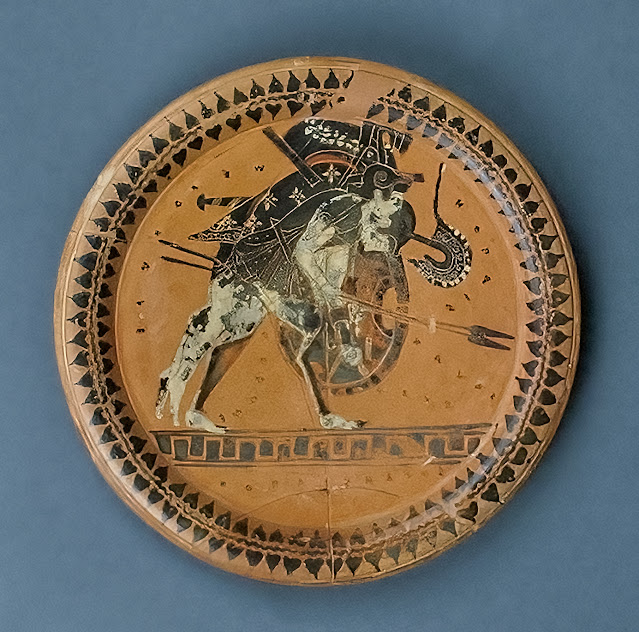
The ancient city of Argos was inhabited as far back as 7,000 years ago.   Argos experienced its greatest period of expansion and power, though, under the energetic 7th century BCE ruler, King Pheidon.  Pheidon was said to have been a descendant of Heracles through Temenus. Pheidon seized the throne from the reigning aristocracy with the support of the lower classes.  He was a vigorous and energetic ruler and greatly increased the power of Argos. Under Pheidon, Argos regained sway over the cities of the Argolid and challenged Sparta’s dominance of the Peloponnese. Spartan dominance is thought to have been interrupted following the Battle of Hyssiae in 669-668 BCE, in which Argive troops defeated the Spartans in a hoplite battle. The Argive army was already equipped at the time with a deeply dished wooden shield called the aspis which is thought to have given the Argives an advantage over the Spartans.  The revolutionary part of the shield was, in fact, the grip. ...

Spotted cats: Mythological beasts of both the Old World and the New

Image
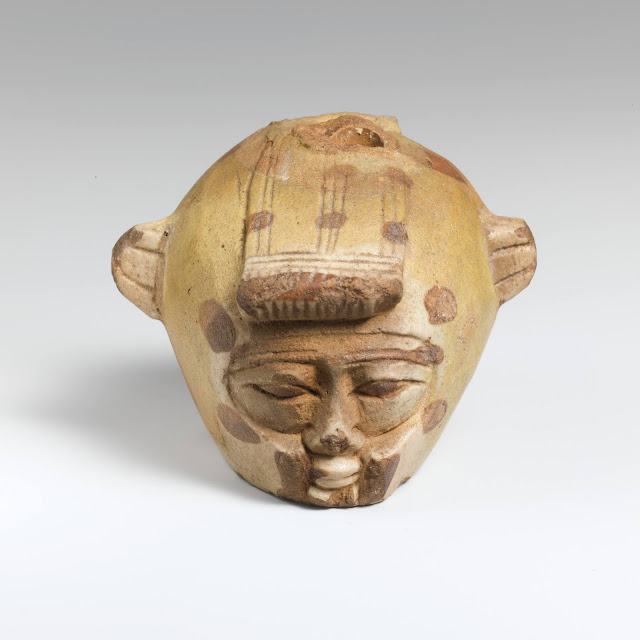
This unusual vase shows a human head of which all but the area of the eyes, nose, and mouth is enclosed in the head of an animal. The softness of the pelt is indicated by the way in which it tightly fits the human head. The small ears and spots are further animal attributes. It is difficult to identify the figure. It may possibly be a very Egyptianized interpretation of Herakles wearing the lion skin. - Metropolitan Museum of Art This vessel caught my attention because it reminded me very much of ancient pre-Columbian American art.  All major Mesoamerican civilizations prominently featured a jaguar god, and for many, such as the Olmec, the jaguar was an important part of shamanism. The jaguar's formidable size, reputation as a predator, and its evolved capacities to survive in the jungle made it an animal to be revered. The Olmec and the Maya witnessed this animal's habits, adopting the jaguar as an authoritative and martial symbol, and incorporated the animal into their mythol...

The psychological cost of warfare in the ancient world

Image
Then said Achilles, "Son of Atreus, king of men Agamemnon, see to these matters at some other season, when there is breathing time and when I am calmer. Would you have men eat while the bodies of those whom Hector son of Priam slew are still lying mangled upon the plain? Let the sons of the Achaeans, say I, fight fasting and without food, till we have avenged them; afterwards at the going down of the sun let them eat their fill. As for me, Patroclus is lying dead in my tent, all hacked and hewn, with his feet to the door, and his comrades are mourning round him. Therefore I can think of nothing but slaughter and blood and the rattle in the throat of the dying." - Iliad 19.226 As some of you know, I am the spouse of a veteran who has suffered from PTSD since service in Vietnam back in 1967-68. Although the psychological trauma suffered by those who have experienced a traumatic event now has a very modern-sounding diagnosis, it is not a recent phenomenon but has been a plague u...

A Celtic chieftain's grave

Image
The Hochdorf Chieftain's Grave is a richly-furnished Celtic burial chamber dating from 540 BCE near Hochdorf an der Enz (municipality of Eberdingen) in Baden-Württemberg, Germany. Beginning in 1968, a volunteer at the State Antiquities and Monuments Office in Baden-Württemberg, Renate Leibfried, kept coming across stone fragments plowed up in the field. She reported her observations and the Archaeological Preservation Office identified what had been a large burial mound.  Dr. Jörg Biel led a complete excavation of the site between 1978 to 1979. The grave contained a Celtic prince, roughly 40 years of age and 6 ft 2 in tall, who was laid out on a bronze recliner with eight wheels.  He wore a gold-plated torc on his neck, a bracelet on his right arm, a hat made of birch bark, a gold-plated dagger made of bronze and iron, rich clothing, amber jewelry and the remains of thin embossed gold plaques which once decorated his now-disintegrated shoes. Other grave goods included a razor ...

The Mycenaean Dendra Panoply

Image
In May 1960 Swedish archaeologists discovered the earliest example of a beaten bronze cuirass at Dendra, dated to the end of the fifteenth century BCE (Late Helladic IIIA - about 1400 BCE). It forms part of the Late Helladic Dendra Panoply, which consists of fifteen separate pieces of bronze sheet, held together with leather thongs, that encased the wearer from neck to knees.  The panoply was found in tomb 12 of the Dendra necropolis and had been partially plundered at some point.  But in addition to the squashed armor, archaeologists were able to recover pottery fragments, a silver toggle pin (probably used to fasten an item of clothing), a bronze oinochoe (jug), as well as various other objects of bronze, including at least one knife and a dagger, a bronze mirror, a gold-plated ring, fragments of a silver cup, fragments of boar's tusk and a pair of swords inlaid with gold and ivory. The panoply, when restored, was found to include a back and breast plate and six bronze plate...