Posts

Showing posts with the label war

Minerva or Bellona?

Image
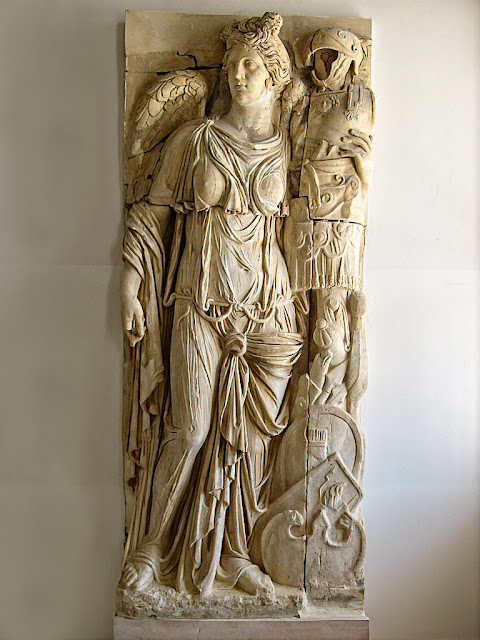
Despite the Roman association between Minerva and Athena and the frequent depiction of both goddesses with armor, unlike Athena, Minerva was not considered a war goddess in the Roman pantheon. The Romans had their own war goddess Bellona, originally an ancient Sabine goddess of war identified with Nerio, the consort of the war god Mars, and later with the Greek war goddess Enyo.  Bellona's main attribute is the military helmet that was worn on her head much like Athena.  Bellona  is often depcicted holding a sword, spear, or shield, and brandishing a torch or whip as she rides into battle in a four-horse chariot.  Bellona had a temple near the Theatre of Marcellus dedicated in 296 BCE near the Circus Flaminius by Appius Claudius Caecus, during the war with the Etruscans and Samnites. The Roman Campus Martius area, in which Bellona’s temple was situated, had extraterritorial status. Ambassadors from foreign states, who were not allowed to enter the city proper, stayed...

Etruscan panoply of the late 5th to early 4th century BCE

Image
This panoply comprises a matching ensemble of helmet, cuirass, and greave (shin guard), which are rare Etruscan works exemplifying the finest qualities of the form and decoration that characterize the greatest armors made in Etruria during the Classical period. In addition to exhibiting originality of design and exceptional workmanship, this ensemble occupies an important place in the historical development of Etruscan armor. It includes one of the finest Etruscan cuirasses known to survive and a helmet that has no parallels in the Ancient World. Very few Etruscan panoplies appear to have ever included anatomical cuirasses, and among the few specimen known to remain, many are extensively damaged or restored, unlike this example. The helmet, with its delicate embossed, chased, and engraved ornament, and its striking bronze and silver appliqués, is one of the most luxurious examples of a type found only in Etruria, and by far the best preserved representative of this exclusive group. It ...

Mars: The Roman God of War

Image
Mars was one of the more important gods of the Roman pantheon. Numerous temples, shrines, and altars were dedicated to him in Rome and throughout the Empire. As the god of war, he had many of the same attributes as the Greek god Ares, but he was also closely associated with the imperial cult, since the emperor's power and popularity depended heavily on the army and its military successes. Mars was therefore often depicted on monuments celebrating imperial victories, notably on triumphal arches, a distinctively Roman type of public building. This fragment presumably comes from one such monument, perhaps even from the now lost Portico of Septimius Severus in Rome. Mars is represented in the canonical guise of an older, bearded man wearing a Corinthian helmet tipped back on his head. - The Metropolitan Museum of Art Image: Mars fragment possibly from the Portico of Septimius Severus courtesy of the Metropolitan Museum of Art Colossal statue of Mars found in the forum of Nerva...

Mycenae at War

Image
Mycenae at War The military nature of the Mycenaean Greeks is evident from the numerous weapons unearthed, the use of warrior and combat representations in contemporary art, and the preserved Greek Linear B records. The Mycenaeans invested in the development of military infrastructure, with military production and logistics being supervised directly from the palatial centers. According to the Linear B records in the palace of Pylos, every rural community (the damos) was obliged to supply a certain number of men who had to serve in the army. Similar service was also performed by the aristocracy. Mycenaean armies were initially based on heavy infantry, equipped with spears, large shields and in some occasion armor. Later in the 13th century BC, Mycenaean warfare underwent major changes both in tactics and weaponry and armed units became more uniform and flexible, while weapons became smaller and lighter. The spear remained the main weapon among Mycenaean warriors, whil...

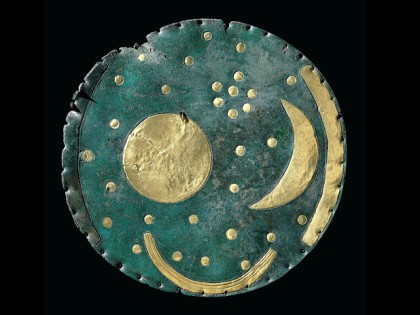
Turbulent times. Archaeology in Germany. War, art and migration since the Stone Age. Through January 6, 2019 at the Martin-Gropius-Bau Museum in Berlin, Germany

Image
Turbulent times. Archaeology in Germany. War, art and migration since the Stone Age.  Through January 6, 2019 at the Martin-Gropius-Bau Museum in Berlin, Germany.  Sky disc.  The oldest sky image of Europe found in 1999 from looted graves at the Mittelberg, Saxony-Anhalt.  Courtesy of the State Office of historic preservation and archaeology of Saxony-Anhalt.  Photo by Juraj Lipták. An arrowhead firmly lodged in the skull of an ancient fallen warrior, a voluptuous woman’s form carved from ivory and the mask of a Roman river god are among more than 1,000 major archaeological discoveries being brought together for the first time. Artifacts show how strongly progress was linked to the movement of people, goods and ideas into and across Europe.