Posts

Showing posts with the label vase

Creative art at the birth of democracy
Image
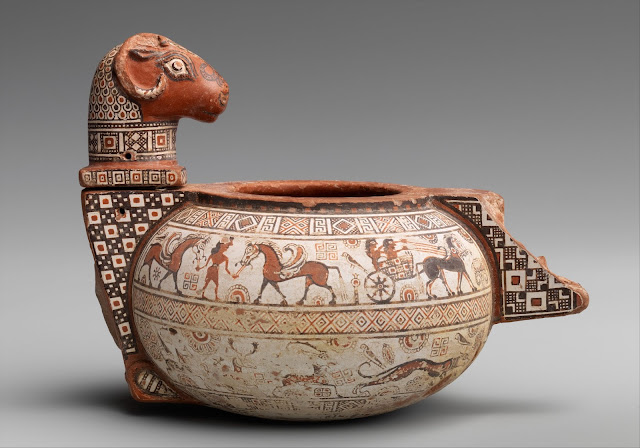
Terracotta cosmetic vase 4th quarter of the 6th century B.C.E. Archaic Period East Greek at the Metropolitan Museum of Art in New York On one side of the upper frieze of this exquisite vase, a youth holds two winged horses and two youths drive a chariot. Real and imaginary animals circulate on the other frieze areas between carefully drawn geometric patterns. The ram's-head cover may have served as a handle for a cosmetic applicator. In this period, there was huge economic development in Greece, and also in its overseas colonies which experienced a growth in commerce and manufacturing. There was a great improvement in the living standards of the population. Some studies estimate that the average size of the Greek household, in the period from 800 BC to 300 BCE, increased five times, which indicates a large increase in the average income of the population. In the second half of the 6th century BCE, Athens fell under the tyranny of Peisistratos and then of his sons Hip...

Canosa vase, Greek, 3rd century BCE Terracotta with white slip said to have been discovered near Canosa di Puglia, Italy at the Isabella Stewart Gardner Museum in Boston

Image
Canosa vase, Greek, 3rd century BCE Terracotta with white slip said to have been discovered near Canosa di Puglia, Italy at the Isabella Stewart Gardner Museum in Boston, MA. A type of Apulian vase, Canosa vases were produced exclusively for funerary use between 350 and 300 BCE. Their distinguishing feature is their three-dimensional decorations depicting Nike, chariots, battle scenes, naiskoi and winged female figures painted i n a variety of water-soluble pigments (blue, red/pink, yellow, pale purple, brown) on a white background. Preferred vessel forms are the volute-krater, cantharus, oinochoe, and askos. The main find locations of such vessels are Canosa (after which the vases are now named), Arpi and Ordona. Image: Canosa vase, Greek, 3rd century BCE Terracotta with white slip said to have been discovered near Canosa di Puglia, Italy at the Isabella Stewart Gardner Museum in Boston, MA. This vase was originally purchased from a Naples antiquities dealer for 150 lire on...