Posts

Showing posts with the label tragedy

Achilles' ambush of Troilus

Image
All Greek and Etruscan metal rings with engraved bezels ultimately derive from Egyptian and Phoenician cartouche-shaped rings. The cartouche-shaped ring was especially popular in Etruria in the later 500s B.C., where immigrant Greek goldsmiths from Ionia introduced it. This example features an intricate scene of two men approaching a fountain where water gushes into a vessel from a lion's head spout. Behind the fountain, a man squats as if hiding, holding a sword. These details identify the scene as a standard depiction of the ambush of Troilos (Troilus), prince of Troy, by the Greek hero Achilles during the Trojan War. On this ring, however, a strange dog-headed creature, who is not part of the Troilos myth, sits atop the fountain. The creature may actually be jackal-headed and thus meant to recall the Egyptian god Anubis harking back to the origin of such rings from Egypt. Prophecies retold in the Iliad link the fate of Troilos, one of the sons of King Priam (or Apollo in some ve...

Megarian Bowls

Image
Relief-decorated pottery with scenes from epic poetry and from Classical Greek tragedy became more popular than painted pottery during the Hellenistic period. The name Megarian was first given to this type of mold-made relief bowl in the late nineteenth century, because some of the first known examples were said to have come from the city of Megara. It has since been demonstrated that bowls of this type, which were produced at a number of different centers, originated in Athens in the third quarter of the third century B.C.E. - Metropolitan Museum of Art Unlike earlier, wheelmade wares with surfaces decorated only with slip, paint, and glaze, these bowls were made in stamp-decorated molds that added decoration in relief. This method of manufacture gave the vessels an embossed effect that may have been intended to imitate metalwork. The vessels were thrown on a potter's wheel while inside the mold in order to produce a smooth and even inner surface while allowing the outside to pick...

Ancient theater in Greece and Rome

Image
Nearly every Greek and Roman city of note had an open-air theater consisting of the orchestra, the flat dancing floor of the chorus, and the theatron, the actual structure of the theater building. Vase paintings indicate the stage stood about three feet high with a flight of steps in the center. The actors entered from either side and from a central door in the skene, which also housed the ekkyklema, a wheeled platform with sets of scenes. A mechane, or crane, located at the right end of the stage, was used to hoist gods and heroes through the air onto the stage.   Theatrical performances were usually part of a seasonal festival and were accompanied by processions, sacrifices in the theater, parades, and competitions between playwrights. Almost all Greek tragedies were based on heroic myths although the dialogue between actor and chorus sometimes served an instructional purpose and reflected current debate in the public assembly. "Unlike the Greek tragedy, the comic performanc...

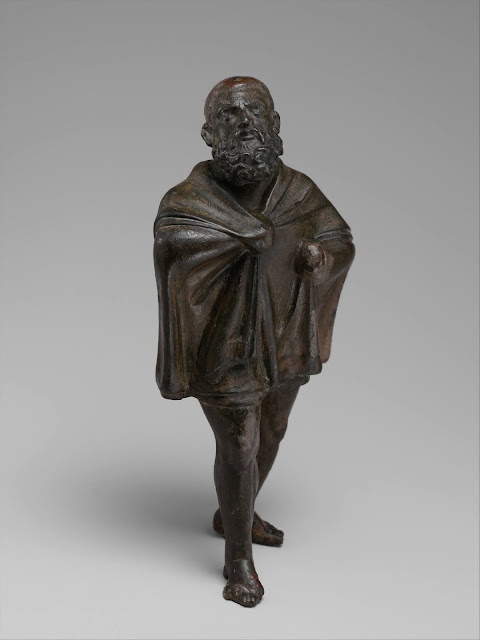
Bronze statuette of a draped man thought to be an actor 1st century BCE - 1st century CE

Image
This impressive statuette shows a mature, bearded man who stands purposefully and looks upward. The cloak that covers his torso also conceals his arms, bent forward over his chest. Proposed identifications have linked him with the theater, specifically as an actor declaiming a text rather than playing a role. - Metropolitan Museum of Art Roman theater began to develop following the devastation of a widespread plague in 364 BCE. Roman citizens began including theatrical presentations as a supplement to the Lectisternium ceremonies, religious propitiatory meals, in a stronger effort to pacify the gods. In the years following the establishment of these practices, actors began adapting these dances and games into performances by acting out texts set to music and simultaneous movement. As the era of the Roman Republic progressed, citizens began including professionally performed drama in the eclectic offerings of the ludi (celebrations of public holidays) held throughout each year—the large...