Posts

Showing posts with the label theater

Ancient theater in Greece and Rome

Image
Nearly every Greek and Roman city of note had an open-air theater consisting of the orchestra, the flat dancing floor of the chorus, and the theatron, the actual structure of the theater building. Vase paintings indicate the stage stood about three feet high with a flight of steps in the center. The actors entered from either side and from a central door in the skene, which also housed the ekkyklema, a wheeled platform with sets of scenes. A mechane, or crane, located at the right end of the stage, was used to hoist gods and heroes through the air onto the stage.   Theatrical performances were usually part of a seasonal festival and were accompanied by processions, sacrifices in the theater, parades, and competitions between playwrights. Almost all Greek tragedies were based on heroic myths although the dialogue between actor and chorus sometimes served an instructional purpose and reflected current debate in the public assembly. "Unlike the Greek tragedy, the comic performanc...
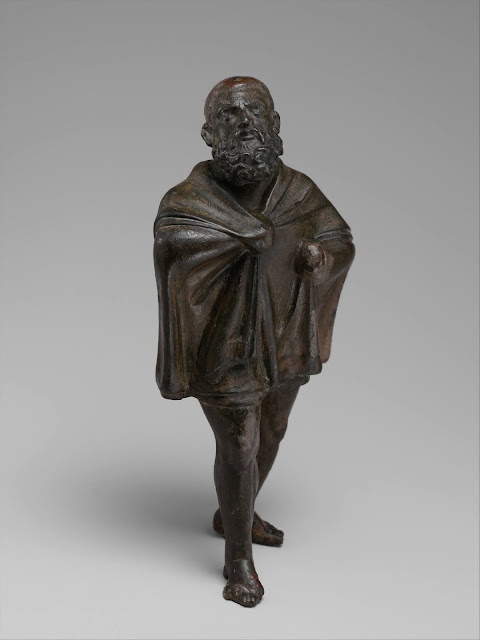
Bronze statuette of a draped man thought to be an actor 1st century BCE - 1st century CE

Image
This impressive statuette shows a mature, bearded man who stands purposefully and looks upward. The cloak that covers his torso also conceals his arms, bent forward over his chest. Proposed identifications have linked him with the theater, specifically as an actor declaiming a text rather than playing a role. - Metropolitan Museum of Art Roman theater began to develop following the devastation of a widespread plague in 364 BCE. Roman citizens began including theatrical presentations as a supplement to the Lectisternium ceremonies, religious propitiatory meals, in a stronger effort to pacify the gods. In the years following the establishment of these practices, actors began adapting these dances and games into performances by acting out texts set to music and simultaneous movement. As the era of the Roman Republic progressed, citizens began including professionally performed drama in the eclectic offerings of the ludi (celebrations of public holidays) held throughout each year—the large...

"Ancient Theater and the Cinema" through April 5, 2020 at the Museum of Fine Arts in St. Petersburg, Florida

Image
"Ancient Theater and the Cinema" through April 5, 2020 at the Museum of Fine Arts in St. Petersburg, Florida. Ancient Theater and the Cinema is the first exhibition to combine ancient objects with imagery of ancient Greek theater and modern movie stills inspired by Greek plays and mythology. The dialogue between ancient and contemporary images displays the continuity of Greek theater across nearly two and a half millennia, demonstrating its enduring legacy and profound influence. Theatrical performances were widely popular in ancient Greece. Theater was an Athenian invention and Athenian playwrights were celebrities far beyond Athens. A key feature of an ancient Greek city-state (polis) was a theater, at which tragic and comic plays were staged during multi-day festivals. The performances developed from choral song and dance sacred to Dionysus, the god of wine and the theater. This exhibition includes ancient ceramics and Greek sculpture as well as Tampa collec...