Posts

Showing posts with the label silver

The Getae: The noblest and the just of the Thracian tribes (according to Herodotus)

Image
Every time I read something about the Getae, I envision the skull wearing savage warriors depicted in the opening battle scenes of the Starz series "Spartacus." But according to Herodotus, the Getae were "the noblest as well as the most just of all the Thracian tribes."  When Lysimachus tried to subdue the Getae he was defeated by them. The Getae king, Dromichaetes, took him prisoner but he treated him well and convinced Lysimachus there is more to gain as an ally than as an enemy of the Getae and released him. According to Diodorus, Dromichaetes entertained Lysimachus at his palace at Helis, where food was served on gold and silver plates. The discovery of the celebrated tomb at Sveshtari (1982) suggests that Helis, the capital of the Getae, was located perhaps in its vicinity, where remains of a large antique city are found along with dozens of other Thracian mound tombs. The Getae were several Thracian-related tribes that once inhabited the regions to either side...
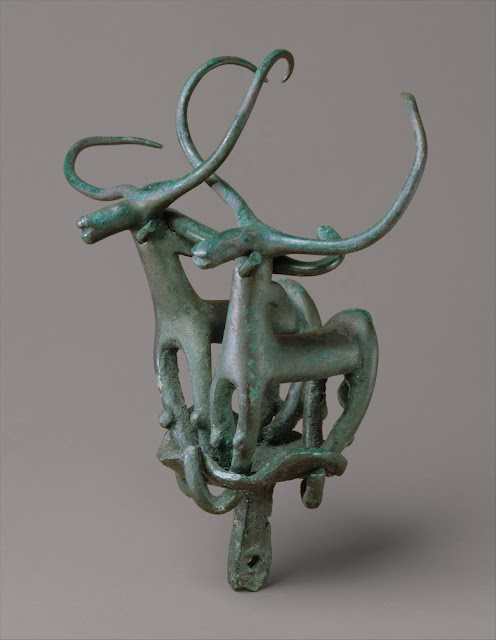
The Storm God of the Hatti then Hittite

Image
During the early Bronze Age the Hatti, who were neither Semitic nor Indo-European, inhabited central Anatolia. They were actually distinct from the Hittite but as the Hittite expanded beginning about 2000 BCE, the Hatti were gradually absorbed into the Hittite political and social order.  The Hatti were organized in monarchical city-states. These states were ruled as theocratic kingdoms or principalities. Hatti regions of Anatolia came to be influenced by mighty Mesopotamian polities, in the form the Akkadian Empire (24th-22nd century BCE) and the succeeding Old Assyrian Empire (21st-18th century BCE), both of which set up trading colonies called karum, located throughout eastern and central Anatolia. During the first centuries of the 2nd millennium BCE, an Assyrian trade colony existed in the city of Hattush, and several Assyrian inscriptions mention the existence of local rulers (kings) of Hattush, also referring to their relations with other city-states in the region. Fortunatel...

The Galloway Hoard Exhibit through September 12, 2021 at the National Museum of Scotland

Image
Discovered by a metal detectorist in Dumfries and Galloway, Scotland in 2014, the Galloway Hoard, buried around 900 CE, contains over 100 diverse objects, from silver, gold and jewelled treasures to rarely surviving textiles, including wool, linen and Scotland’s earliest examples of silk.   It is thought that the hoard was buried some time in the mid-ninth or tenth century, though it is not known why it was buried. The hoard consists of a variety of gold and silver objects including armbands, a silver pectoral cross, brooches, ingots, and what is possibly the largest silver Carolingian pot ever discovered. The pot was one of the older items in the hoard and may have been more than 100 years old by the time it was deposited. It is made of a silver alloy and was found wrapped in the remains of a cloth, with its lid still in place. It contained a collection of silver Anglo-Saxon disc brooches, an Irish silver brooch, Byzantine silk from the area around Constantinople, a gold ingo...

Waterfowl in Greco-Roman art

Image
Ducks, geese, and swans were often depicted on serving ware in both Greek and Roman households. Although fish was a more common protein source than ducks and geese, even the humiliores occasionally enjoyed poultry.  Following his triumph, Caesar sponsored a public feast for 260,000 of the poorer people of Rome, offering them ducks and geese as well as seafood and game.   But waterfowl as art was used to appeal to Greek and Roman intellect as well as to their stomachs.  In addition to their inclusion in myth such as  the legendary transformation of Zeus into a swan to seduce Leda, these species appeared multiple times in popular works of Aesop and Aristophanes as they were deemed "characterful" enough to lend themselves to literary purposes.  In his play "The Birds", Aristophanes points out that a goose could act as an agent of Eros when used as a competitive gift exchanged in the homosexual courtship between an erastês and his young erômenos. Some scholars,...

Silver plate possibly depicting the debate between Myth and Science

Image
Two seated philosophers, labeled Ptolemy and Hermes, engage in a spirited discussion on this fragmentary plate. A woman stands behind each man, gesturing and partaking in the exchange. The woman on the left is identified as Skepsis. Above the two seated men, an unidentified enthroned man is partially preserved. The scene on this plate has been interpreted as an allegory of the debate between Myth and Science: Ptolemy, the founder of the Alexandrian school of scientific thought, debating Hermes Trismegistos, a deity supporting the side of myth. - J. Paul Getty Museum Hermes Trismegistus, "Hermes the Thrice-Greatest" or Mercurius ter Maximus in Latin, is a legendary Hellenistic figure that originated as a syncretic combination of the Greek god of interpretive communication, Hermes, and the Egyptian god of wisdom, Thoth. He is the purported author of the Hermetica, a widely diverse series of ancient and medieval texts that lay the basis of various philosophical systems known as ...

Etruscan chariots

Image
Silver panel, perhaps from a parade chariot or piece of furniture, overlaid with electrum and decorated in repoussé relief with two riders, perhaps taking part in a horse-race, with a fallen comrade below, Etruscan, 540-520 BCE, found in the Castel San Mariano near the city of Perugia. Perguia, first called Perusia in the ancient sources, was one of the 12 confederate cities of Etruria.  The league was mostly an economic and religious league, or a loose confederation, similar to the Greek states.  The historical Etruscans had achieved a state system of society, with only remnants of the chiefdom and tribal forms used by surrounding Italics. The government was viewed as being a central authority, ruling over all tribal and clan organizations and wielding the power of life and death. The gorgon was revered as an ancient symbol of that power, and frequently appeared as a motif in Etruscan decoration. The individual referred to as a "fallen comrade" in this Archaic period relief ...

The Mildenhall Treasure

Image
The Mildenhall Treasure is a large hoard of 34 masterpieces of Roman silver tableware from the fourth century CE, and by far the most valuable Roman objects artistically and by weight of bullion in Britain. It was found at West Row, near Mildenhall, Suffolk, in 1942.  The treasure consists of silver tableware of types current in the 4th century, and was probably concealed at some time in that century. Most of the objects are comparatively large, and all are of very high-quality workmanship. The hoard consists of two large serving platters, two small decorated serving plates, a deep fluted bowl, a set of four large decorated bowls, two small decorated bowls, two small pedestalled dishes, a deep flanged bowl with a deep, domed cover, five small round ladles with dolphin-shaped handles, and eight long-handled spoons (cochlearia).   The Great Dish (also known as the Oceanus Dish or as the Neptune Dish, from the face of a sea-god at its centre), which was worked by chasing fro...

The Esquiline Treasure

Image
The Esquiline Treasure is an ancient Roman silver treasure that was found in 1793 on the Esquiline Hill in Rome. The hoard is considered an important example of late antique silver work from the 4th century CE, probably about 380 for the major pieces. Since 1866, 57 objects, representing the great majority of the treasure, have been in the British Museum. Two of the most important objects in the treasure are the ornate silver-gilt engraved boxes known as the Projecta Casket and the Muse Casket. The treasure was part of the belongings of a wealthy Roman household of high social status. The collection includes 8 plates (4 circular and 4 rectangular), a fluted dish, a ewer inscribed for "Pelegrina", a flask with embossed scenes, an amphora, 6 sets of horse trappings, with furniture fittings including 4 Tyche figures representing the 4 main cities of the Roman Empire: Rome, Constantinople, Antioch and Alexandria, two hands clenching bannisters, and an assortment of jewelry. The ...