Posts

Showing posts with the label ritual

Golden Mummies of Egypt through July 11, 2021 at the North Carolina Museum of Art in Raleigh, North Carolina

Image
This exhibition uses mummies from the collections of the Manchester Museum (England) to allow visitors to examine life for the wealthy in multicultural Roman Egypt, where diverse Egyptian, Roman, and Greek communities and cultural influences were blended. The exhibition journey traces expectations for the afterlife and introduces cultural constructions of identity, strikingly demonstrated by haunting painted panel portraits. The practices of preservation and decoration of the body, and the transformation of the deceased into a god, are explored by the mummies on display. Eight gilded mummies  and more than 100 related objects are presented in the display, including papyri, jewelry, ceramics, and artworks depicting deities that connect the daily lives of these Greco-Roman Egyptians to the religious world of the gods in a series of lavishly illustrated thematic sections covering the period from 300 BCE to 200 CE. The youngest of the preserved individuals is a 2 or 3 year-old child wr...

The secret of the rattling kantharos

Image
One of just a handful of “rattling cups” that survive from the fifth and fourth centuries BCE, this elegant black-glazed wine cup from the second half of the 4th century BCE is dedicated to Kastor and Polydeukes (Castor and Pollux), the twin sons of Zeus known as the Dioscouri, who protected sailors, horseman, and chariot racers. Since each brother split his time between Mt. Olympus and Hades, they were often represented by stars, depicted here beneath the cup’s rim.  The cup's ritual purpose is further indicated by a wreath, garlands, and bucrania  bucrania (skulls of sacrificial bulls) decorating the cup’s body. But, perhaps the most intriguing aspect of the vessel is that lifting and swirling the cup as if drinking or making a libation (liquid offering) during a ceremony produces a rattling noise.  It was assumed the sound was made by loose pellets moving inside the rim but curators at the J. Paul Getty Museum were puzzled by the fact that sometimes they could hear two...

Mourning Women, South Italian (Apulian, Canosan), 300-275 BCE Terracotta

Image
Statues of Mourning Women, South Italian (Apulian, Canosan), 300-275 BCE Terracotta, now in the collections of the J. Paul Getty Museum, Villa venue, Pacific Palisades, California This group of mourning women, often understood as female figures in prayer (orantes), was likely produced in the area of Canosa in south-eastern Italy. Although there are considerable differences in terms of clothing, poses and hairstyles, the four statues seem to depict a type of youthful female figure, probably envisioned as one of the mourners who expressed their grief during funerary ceremonies. The group was intended to be placed around a funerary couch (kline), and was probably produced for a fairly prestigious client who, in the context of Romanization in the area, aspired to underscore his economic prosperity, personal identity, and native traditions. The figures were made not with molds, as has been previously conjectured, but rather through a modeling process over a fairly thick conical structure. W...

Etruscan funerary banquet figurines

Image
"The banquet was one of the most popular and consistent funerary motifs in ancient Etruria. The earliest banquet scenes depict people sitting, whereas later representations show banqueters reclining on couches. The deceased is either depicted at a meal or ancestor figures are shown welcoming the newly deceased to the banquet. The characterization of the deceased at a meal is a funerary theme that also finds expression in the earlier tomb groups of the Villanovan period." - Anthony S. Tuck, The Etruscan Seated Banquet: Villanovan Ritual and Etruscan Iconography One of the earliest representations of a seated banquet was found in the Tomb of the Five Chairs at Cerveteri. A terracota figure was originally placed on each of five rock-carved thrones in a side chamber of the cruciform tomb.  Two stone tables were placed in front of the chairs  and classicist F. Prayon further describes the setting as including a large basket, libation table, and a rectangular base used for two addi...

Priestly attire from Roman Period Egypt 1st century CE

Image
Consisting of a wig with short, tight curls and a distinctive gilded sidelock, this priestly headdress made of cartonnage, said to have been purchased by Howard Carter and thought to have originated from Qau el-Kebir,  may have been found (and once worn) with a faux leopard-skin robe like the accompanying example. In all likelihood, a man serving as a sem-priest or Iunmutef-priest donned the headdress and cloak before carrying out a ritual that revivified a mummified body so that the deceased could live eternally. Priests of Iunmutef were documented from the 5th dynasty (around 2350 BCE) clear up to the Greco-Roman period.  Iunmutef is a manifestation of Horus in his capacity as the “loving son” of Osiris. In this quality he appears in numerous temple scenes and in the royal tombs as a ritual provider of the ruler, whom he enlivens, deifies and renews through the opening of the mouth ritual and as a representative of a rightful ruler in various regeneration and transformation ...

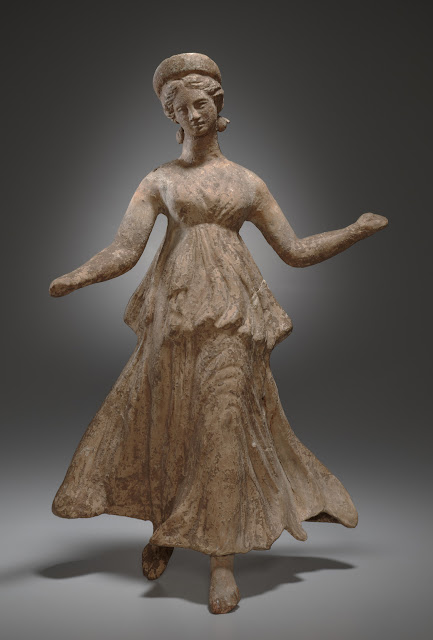
Sights and Sounds of Ancient Ritual. Through March 3, 2019 at the Yale University Art Gallery.

Image
Sights and Sounds of Ancient Ritual. Through March 3, 2019 at the Yale University Art Gallery. Terracotta statuette of a dancing woman. Greek from Myrina in Asia Minor. 2nd century BCE. Image courtesy of the Yale University Art Gallery. “In the ancient world, religious rituals were multisensory experiences, filled with vibrantly colored representations of supernatural beings, resonant musical sounds, billowing clouds of incense, and the taste of food and drink. Sights and Sounds of Ancient Ritual considers the ways in which these rituals appealed to the senses throug h objects that would have drawn worshippers into closer proximity to divine forces. The exhibition brings together works from the Yale University Art Gallery and the Yale Babylonian Collection at the Yale Peabody Museum of Natural History that span three millennia—from approximately 1500 B.C.E. to 1500 C.E.—and represent diverse traditions, including those of ancient Greece and Rome, Western Europe, Egypt, West...

Maya, Hidden Worlds Revealed. Through May 27, 2019 at the Natural History Museum of Utah in Salt Lake City, Utah.

Image
Maya, Hidden Worlds Revealed. Through May 27, 2019 at the Natural History Museum of Utah in Salt Lake City, Utah. A Bloodletting Bowl captures the moments prior to a Maya bloodletting ritual. Image courtesy of the Natural History Museum of Utah in Salt Lake City, Utah. Maya explores the fascinating social, natural, and spiritual realms of the ancient Maya through the eyes of powerful kings and queens and the lesser-known people who were the backbone of Maya society. The exhibit features immersive environments, authentic artifacts, and hands-on activities that tell the story of the  ancient Maya and their modern descendants.