Posts

Showing posts with the label religion

Disability and the politics of "Divine Disfavor" in the Greco-Roman world
Image
I was reading Classical Wisdom's newsletter in preparation for this weekend's virtual symposium and found their article "Hephaestus:The Humane God" particularly interesting. Although most of us think of Hephaestus as the divine metalworker that forged magical armor and weapons like the shield of Achilles, Sean Kelly pointed out that he was also the only god in the Greek pantheon (and Roman under the name Vulcan) who suffered from a physical impairment.  Hephaestus attempted to intervene in a quarrel between  Zeus and Hera, and an enraged Zeus  cast him from Mount Olympus, injuring his legs.  Thereafter he was the subject of derision because of his lameness although he was respected for his smithing skills. He forged Hermes' winged helmet and sandals, the Aegis breastplate, Aphrodite's famed girdle, Agamemnon's staff of office, Achilles' armour, Diomedes' cuirass, Heracles' bronze clappers, Helios' chariot, the shoulder of Pelops, and even E...

The Empire's Physician: Prosperity, Plague, and Healing in Ancient Rome

Image
The Institute for the Study of the Ancient World at New York University is sponsoring the virtual exhibit "The Empire's Physician: Prosperity, Plague, and Healing in Ancient Rome" (ancient medicine and health as seen through the eyes of Galen). Their exhibit can be explored here:   https://galen.nyu.yourcultureconnect.com/e/home Image: Votive relief depicting Asclepius healing a patient in her sleep, with Hygieia standing behind the god. Greek, ca. 400–350 BCE. Marble. Temple of Asclepius (Asclepieion), Piraeus, near Athens. H. 42 cm; W. 79 cm. Archaeological Museum of Piraeus: MP 405. Photo: Sites & Photos / Art Resource, NY.  

The Transformation of Pharaonic deities to household gods in Roman Egypt

Image
The iconography and style of depictions of Horus and other traditional Egyptian deities were influenced by Hellenistic and, later, Roman traditions of representation, often combining trappings of power in ways that are striking to modern observers. "Roman period depictions of  the falcon-headed Horus have been  found  in  a  variety  of   materials  throughout  the  empire,  from  Egypt  to  Oxfordshire.  Usually  dressed  in  Roman  military costume, falcon-headed Horus is sometimes depicted on horseback, but more often standing, while seated figures are rare. Although smaller figures may have been dedicatory, larger stone and metal sculptures were probably objects of  public or private devotion." - Polychromy in Roman Egypt: A study of a limestone sculpture of the Egyptian god Horus by Joanne Dyer, Elisabeth R. O"Connell, and Antony Simpson. Sir Harold Bell observes, "...a new reli...

The Storm God of the Hatti then Hittite

Image
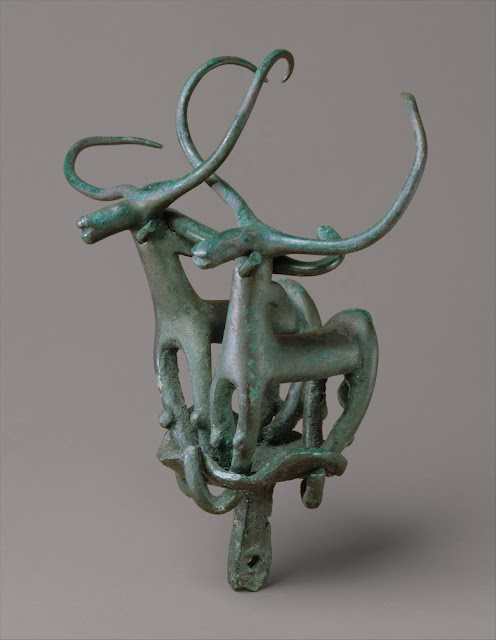
During the early Bronze Age the Hatti, who were neither Semitic nor Indo-European, inhabited central Anatolia. They were actually distinct from the Hittite but as the Hittite expanded beginning about 2000 BCE, the Hatti were gradually absorbed into the Hittite political and social order.  The Hatti were organized in monarchical city-states. These states were ruled as theocratic kingdoms or principalities. Hatti regions of Anatolia came to be influenced by mighty Mesopotamian polities, in the form the Akkadian Empire (24th-22nd century BCE) and the succeeding Old Assyrian Empire (21st-18th century BCE), both of which set up trading colonies called karum, located throughout eastern and central Anatolia. During the first centuries of the 2nd millennium BCE, an Assyrian trade colony existed in the city of Hattush, and several Assyrian inscriptions mention the existence of local rulers (kings) of Hattush, also referring to their relations with other city-states in the region. Fortunatel...

The horse: A perfect gift to a Persian (or Parthian)

Image
"For a nomadic people like the Persians, the horse had a significant practical and symbolic purpose and the importance of horses among the Iranian nobility is evidenced by the fact that many of them bore names compounded with the Old Persian word aspa – ‘horse’, observes Lloyd Llewellyn-Jones, Senior Lecturer in Ancient History at the University of Edinburgh.  "Several of Darius I’s inscriptions note that Persia was a land containing both good men and good horses (DZe §1; DPd §2) and Herodotus famously states that Persian fathers were intent on teaching their sons ‘to ride, to draw the bow, and to speak the truth’ (1. 136; see also Strabo 15. 3.18). The premium Persian horses were bred in the alfalfa-rich plains of Media, and it was here that the main royal stud farms were located (Polybius 10.70). Most prized of all were those steeds bred on the plains of Nisaea near Ecbatana and Bisitun, and Nisaean horses became celebrated for their magnificence, fine proportions, and swif...

The transformative shrew in Greco-Roman mythology

Image
When I saw this carefully detailed bronze sculpture of a common shrew from Egypt's Greco-Roman Period, I wondered why the ancients thought this creature worthy of such expense. Although this sculpture is part of the collections of the Cleveland Museum of Art, the Metropolitan Museum of Art also has a similar, though less detailed example from the same period as does the Museum of Fine Arts in Budapest.   According to The Met, the ancient Egyptians named the shrew, "the voracious", because of its feeding habits. In ancient Egyptian mythology, the shrew represented the blind aspect of the solar deity, “the one with no eyes in his face” (Mechenti-n-irti in old Egyptian) that was complemented by the ichneumon, “the one whose eyes (the Sun and the Moon) are in his face” (Mechenti-irti in old Egyptian), a creature with very keen eyesight. This god with the dual nature was revered in Letopolis as one of the aspects of Horus, who, as myth has it, was blind at birth.  According to...

From Etruscan Lasa to Roman Lare

Image
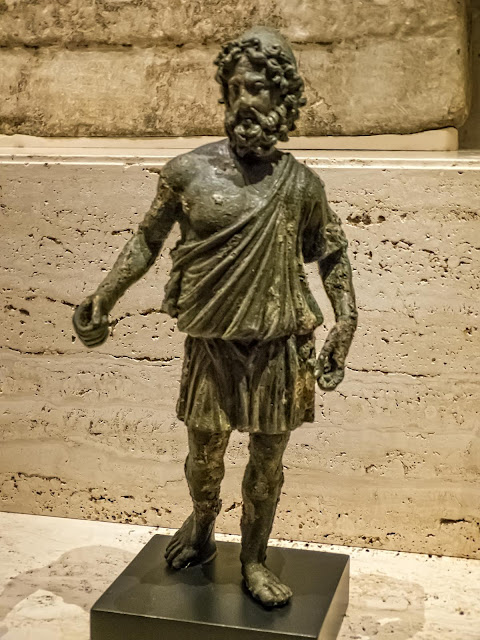
Although art historians are not certain whether a Lasa was a major or minor Etruscan deity, it is thought the domain and purpose of the lasa morphed into a being known as a Lar to the Romans. Lares are thought to have been hero-ancestors, guardians of the hearth, fields, boundaries, or fruitfulness, or an amalgamation of these. Roman writers sometimes conflated the Lares with domestic Penates but the Lares had much broader domains. Roadways, seaways, agriculture, livestock, towns, cities, the state, and its military were all under the protection of their particular Lar or Lares. Those who protected local neighborhoods (vici) were housed in the crossroad shrines (Compitalia), which served as a focus for the religious, social, and political lives of their local, overwhelmingly plebeian communities. Their cult officials included freedmen and slaves, otherwise excluded by status or property qualifications from most administrative and religious offices. Despite official bans on non-Christia...

Golden Mummies of Egypt through July 11, 2021 at the North Carolina Museum of Art in Raleigh, North Carolina

Image
This exhibition uses mummies from the collections of the Manchester Museum (England) to allow visitors to examine life for the wealthy in multicultural Roman Egypt, where diverse Egyptian, Roman, and Greek communities and cultural influences were blended. The exhibition journey traces expectations for the afterlife and introduces cultural constructions of identity, strikingly demonstrated by haunting painted panel portraits. The practices of preservation and decoration of the body, and the transformation of the deceased into a god, are explored by the mummies on display. Eight gilded mummies  and more than 100 related objects are presented in the display, including papyri, jewelry, ceramics, and artworks depicting deities that connect the daily lives of these Greco-Roman Egyptians to the religious world of the gods in a series of lavishly illustrated thematic sections covering the period from 300 BCE to 200 CE. The youngest of the preserved individuals is a 2 or 3 year-old child wr...