Posts

Showing posts with the label ram

Creative art at the birth of democracy
Image
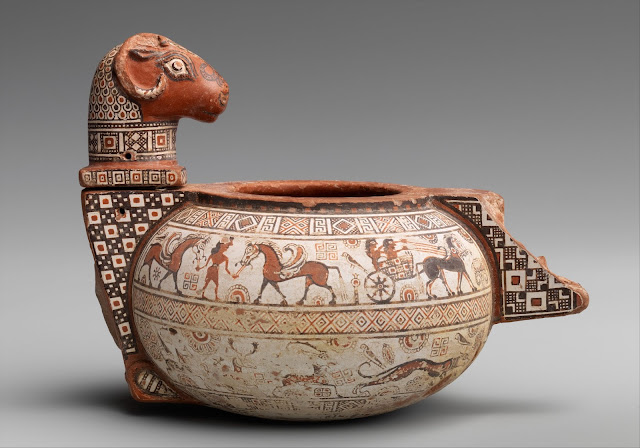
Terracotta cosmetic vase 4th quarter of the 6th century B.C.E. Archaic Period East Greek at the Metropolitan Museum of Art in New York On one side of the upper frieze of this exquisite vase, a youth holds two winged horses and two youths drive a chariot. Real and imaginary animals circulate on the other frieze areas between carefully drawn geometric patterns. The ram's-head cover may have served as a handle for a cosmetic applicator. In this period, there was huge economic development in Greece, and also in its overseas colonies which experienced a growth in commerce and manufacturing. There was a great improvement in the living standards of the population. Some studies estimate that the average size of the Greek household, in the period from 800 BC to 300 BCE, increased five times, which indicates a large increase in the average income of the population. In the second half of the 6th century BCE, Athens fell under the tyranny of Peisistratos and then of his sons Hip...
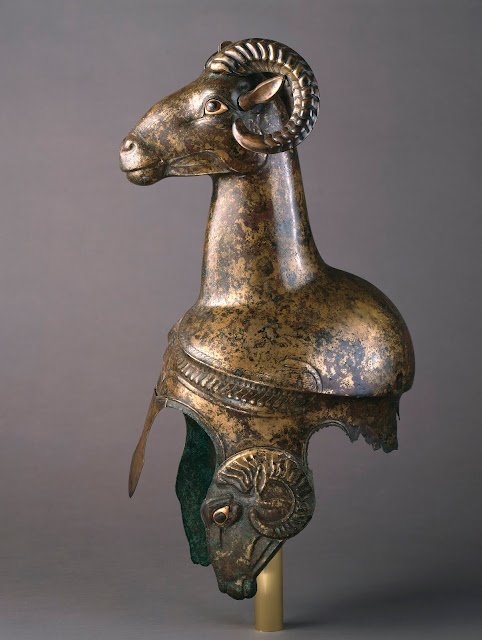
Archaic period Greek helmet with ram's head, 525-500 BCE at the Saint Louis Art Museum in Saint Louis, Missouri

Image
Archaic period Greek helmet with ram's head, 525-500 BCE at the Saint Louis Art Museum in Saint Louis, Missouri. This bronze Archaic Period helmet with a ram's head was excavated in Metaponto (ancient Metapontum) in the southern region of Italy known as Magna Graecia. The size of its decorative element indicates it was probably worn for ceremonial purposes rather than in actual combat. It was made by hammering a single sheet  of bronze, which makes it extremely light and unsuitable as actual armor. Additional decoration was added using a series of common metalworking techniques such as repoussée, punching, tracing, and engraving. The ram’s head on top, whose horns, ears, and eyes have been restored, is mirrored by the attached ram’s head cheek pieces. The selection of the ram to adorn a military-style helmet is fitting since the animals have a double-layered skull which helps protect them from injury. Image courtesy of the museum.