Posts

Showing posts with the label pre-Columbian

The Tiwanaku (Tiahuanacu) Empire

Image
The Tiwanaku (Tiahuanacu) Empire was a Pre-Columbian polity in western Bolivia based in the southern Lake Titicaca Basin.  Its capital, Tiwanaku, was founded around 110 CE during the Late Formative Period, when there were a number of growing settlements in the southern Lake Titicaca Basin. Between 450 and 550 CE, other large settlements were abandoned, leaving Tiwanaku as the pre-eminent center in the region.  Beginning around 600 CE its population grew rapidly, probably due to a massive immigration from the surrounding countryside, and large parts of the city were built or remodeled. Tiwanaku was a multi-cultural "hospitality state" that brought people together to build large monuments, perhaps as part of large religious festivals. This may have been the central dynamic that attracted people from hundreds of kilometers away, who may have traveled there as part of llama caravans to trade, make offerings, and honor the gods. Tiwanaku grew into the Andes' most important pil...

Greek, Roman, Egyptian, and Pre-Columbian art at the Chrysler Museum of Art in Norfolk, Virginia

Image
Greek, Roman, Egyptian, and Pre-Columbian art at the Chrysler Museum of Art in Norfolk, Virginia. Founded in 1933, this American museum offers a diverse display of ancient art, nestled within its total collection of 30,000 objects. The Chrysler's collection of Mesoamerican ceramics and sculptures represent several major pre-Columbian cultures. Citizens and heroes of ancient Greece and Rome endure through works of art created in  bronze, stone, and ceramics. Ancient Egypt is represented by displays of jewelry, ceramics, funerary art, and sculpture while the museum's Asian collection include objects from Japan, India, and China, with ceramics representing every major Chinese dynasty. Image: Basalt Head from Egypt's Greco-Roman period 200-400 CE courtesy of the Chrysler Museum of Art.

Ancient Art of Greece, Rome, Egypt, Asia and pre-Columbian America at the Indianapolis Museum of Art in Indianapolis, Indiana

Image
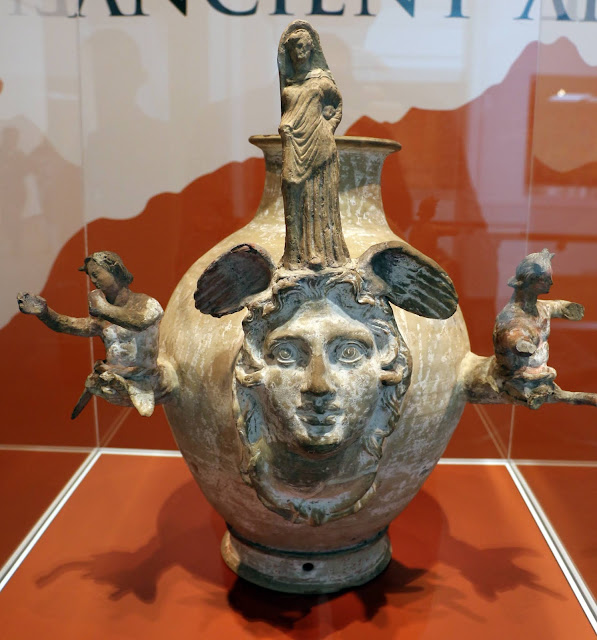
Ancient Art of Greece, Rome, Egypt, Asia and pre-Columbian America at the Indianapolis Museum of Art in Indianapolis, Indiana. Although not well publicized, in fact, you can't even find a reference to antiquities on their website, the antiquities at the Indianapolis Museum of Art are high quality, well conserved pieces dating back over 5,000 years. Objects include funerary art, ceramics, sculpture, jewelry, and utilitarian items . Image: Canosan vessel featuring a protome of Medusa from Apulia, southern Italy 3rd to 2nd century BCE. Canosa, sometimes referred to as Canusium, was an important center for pottery production. Although initially an ally of the Samnites, Canosa became a Roman ally in 318 BCE. It protected the fleeing remnants of the Roman army within its walls after the catastrophic Roman defeat at Cannae during the Second Punic War. Although its pottery is said to be distinctive because of its water soluble paint, I find it interesting because of the three di...

Ancient Art at the Fleming Museum on the campus of the University of Vermont in Burlington, Vermont.

Image
Ancient Art at the Fleming Museum on the campus of the University of Vermont in Burlington, Vermont. With Near Eastern, Egyptian, Mediterranean, and prehistoric Vermont objects, the Ancient Art and Archaeology collection encompasses broad geographic regions and historical periods. Highlights include a 3,000-year-old Assyrian bas-relief from the palace of Assurnasirpal II, Sumerian cuneiform tablets, Greek pottery, Coptic textiles , and more than 400 Egyptian objects, including a late Dynastic mummy and coffin. The Fleming Museum's Pre-Columbian collection spans nearly 3,000 years. Most notable are the Museum's ceramics, which range from elegant jars and bowls to striking human and animal effigies. The collection also contains wonderful examples of Pre-Columbian textiles and ceremonial stone carvings. Image: Late dynastic mummy with gilded mummy mask. Image courtesy of the Fleming Museum.

Antiquities and Pre-Columbian Art at the New Orleans Museum of Art in New Orleans, Louisiana

Image
Antiquities and Pre-Columbian Art at the New Orleans Museum of Art in New Orleans, Louisiana. Paintings, drawings and prints, and decorative arts including Greek ceramics survey the development of Western Civilization from the pre-Christian era to the present. A unique Arts of the Americas collection showcases the cultural heritage of North, Central and South America from the pre-Columbian period through the Spanish Colonial era. This collection is especially rich in objects from the great Mayan culture of Mexico and Central America, and in painting and sculpture from Cuzco, the fabulous Spanish capital of Peru. Image: Articulated terracotta figure from the Vera Cruz culture of Vera Cruz, Mexico 700-900 CE. Image courtesy of the New Orleans Museum of Art.

Roman epigraphy, pre-Columbian ceramics and even an Egyptian mummy. Ongoing at The Carmo Archaeological Museum in Lisbon, Portugal

Image
Roman epigraphy, pre-Columbian ceramics and even an Egyptian mummy.  Ongoing at The Carmo Archaeological Museum in Lisbon, Portugal.  Peruvian Mummy at the Carmo Archaeological Museum in Lisbon, Portugal.  Image courtesy of Trip Advisor. Founded in 1864 by the Association of Portuguese Archaeologists (1863) in the ruins of the old Carmo church in Lisbon, this museum houses an eclectic collection of Roman epigraphy, pre-Columbian ceramics and mummies, an Egyptian sarcophagus and mummy, plus a vast array of objects recovered from the excavation of Castro de Vila Nova de S. Pedro (CalcolĂ­tico c. 3500 BC) , in Azambuja. Related links: https://en.wikipedia.org/wiki/Carmo_Convent_(Lisbon) https://en.wikipedia.org/wiki/Castro_of_Vila_Nova_de_S%C3%A3o_Pedro