Posts

Showing posts with the label mythology

Bellerophon: Heroic Hubris

Image
Bellerophon is a hero of Greek mythology considered to be one of the greatest slayers of monsters, alongside Cadmus and Perseus, before the days of Heracles. His greatest feat was killing the Chimera, a monster that Homer depicted with a lion's head, a goat's body, and a serpent's tail: "her breath came out in terrible blasts of burning flame." Bellerophon, is said to have been born in Corinth and was the son of the mortal Eurynome and either her husband Glaucus, king or Corinth, or Poseidon. Bellerophon was exiled after murdering his brother or another ruler of the Corinthians and was sent to Proetus, king in Tiryns, a Mycenaean stronghold of the Argolid. Proetus cleansed Bellerophon of his crime but when Proetus' wife took a fancy to Bellerophon ans was rejected, she accused the young man of ravishing her. Proetus dared not satisfy his anger by killing a guest (who is protected by xenia), so he sent Bellerophon to King Iobates his father-in-law, i...

Death of a hero: Meleager in ancient Roman art

Image
Meleager was a Calydonian prince as the son of Althaea and the vintner, King Oeneus, although in some versions of the myth, the god Ares. Like a number of mythological heroes, Meleager was fated to die young by the Moirai (the Fates) who predicted he would only live until a piece of wood, burning in the family hearth, was consumed by fire. Overhearing them, his mother, Althaea, immediately doused the hearth and hid wood. When Meleager grew to manhood, his father, King Oeneus, ordered Meleager to gather up heroes from all over Greece to hunt the Calydonian Boar that had been terrorizing the area and rooting up the vinyards needed for the production of his father's wines. The boar was actually sent as a punishment by Artemis after King Oenus neglected to honor Artemis at a festival he held to honor other gods. In addition to the heroes his father named, Meleager also asked Atalanta, a fierce hunter who had been abandoned as an infant and raised by a bear, to participate as well. ...

Roman-era mosaics in the Adana Archaeology Museum in Adana, Turkey

Image
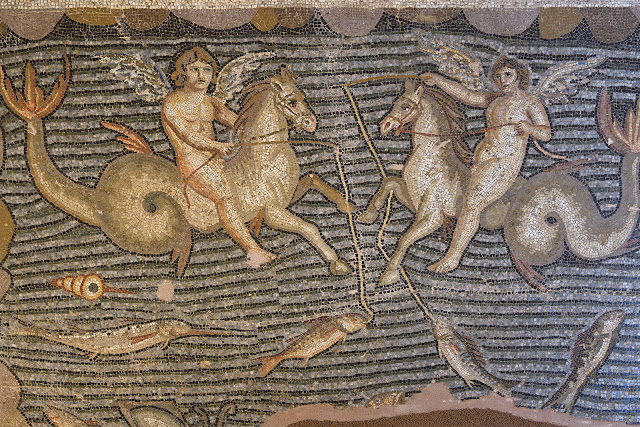
Roman-era mosaics in the Adana Archaeology Museum in Adana, Turkey.  Newly opened galleries at the Adana Museum now house an astonishing collection of Roman-era mosaics.  The mosaics depict an array of themes from classical mythology including Orpheus, Thetys, Artemis, and Erotes, as well as early Christian portrayals of the "Peaceful Kingdom" and Noah's Ark.  The museum has constructed elevated walkways in the new gallery space so visitors can view the expansive mosaics, many that once adorned church floors, more easily. The museum also has many objects from the Hittite period as well as artifacts from the Neolithic, Bronze Age, Iron Age, Archaic, Roman, Byzantine, and Ottoman eras.  Roman objects include sarcophagi, jugs, catapult shots, inscriptions, architectural elements, glassware, ceramics and jewellery. All images cc by courtesy of Dick Osseman:

Ancient Worlds. Greeks, Etruscans and Romans Ongoing at the Altes Museum in Berlin, Germany.

Image
Ancient Worlds. Greeks, Etruscans and Romans Ongoing at the Altes Museum in Berlin, Germany. The Greek hero Meleager Roman copy of Greek original in the Altes Museum in Berlin, Germany.  Image by Richard Mortel courtesy of Wikimedia Commons. The new exhibition on the main floor of the Altes Museum starts with the 'Age of Heroes', from 1000 to 700 BCE. Statues of warriors and helmets stand alongside images of griffins and lions that are distinctly Eastern in character. Right from the outset, the visitor's gaze is drawn towards the next rooms containing archaic temples and tomb monuments dating from the 6th century BCE. The section 'Life and Death in Athens', meanwhile, sheds light on all facets of everyday life in the capital of classical antiquity. Related link: https://www.smb.museum/en/museums-institutions/altes-museum/about-the-collections/collections.html

Dangerous Beauty: Medusa in Classical Art: Through January 2019 at the Metropolitan Museum of Art, New York City

Image
Dangerous Beauty: Medusa in Classical Art: Through January 2019 at the Metropolitan Museum of Art, New York City - This heavy metal ornament, decorated with the head of Medusa and inlays of silver and copper, probably comes from a currus triumphalis (ceremonial chariot) used in processions rather than a lightweight racing chariot.  Roman.  1st - 2nd century CE.  Image courtesy of the Metropolitan Museum of Art in New York City, New York. Beginning in the fifth century B.C., Medusa, the snaky-haired Gorgon whose gaze turned men to stone, became increasingly anthropomorphic and feminine, undergoing a visual transformation from grotesque to beautiful. A similar shift in representations of other mythical female half-human beings, such as sphinxes, sirens, and the sea monster Scylla, took place at the same time. Featuring 60 artworks, primarily from The Met collection, this exhibition explores how the beautification of these terrifying figures manifested the idealizing...