Posts

Showing posts with the label muse

The Muses

Image
 According to Pausanias, who wrote in the later second century CE, there were originally three Muses, worshipped on Mount Helicon in Boeotia: Aoide ("song" or "tune"), Melete ("practice" or "occasion"), and Mneme ("memory").  The earliest known records of the Muses come from Boeotia and some ancient authorities point to Thrace as the origin of this myth.   Writing in the first century BCE, Diodorus Siculus claims Homer and Hesiod state there are actually nine Muses, though.  According to Hesiod's account (c. 600 BCE), generally followed by most writers of antiquity, the Nine Muses were the nine daughters of Zeus and Mnemosyne (i.e., "Memory" personified), which represented personifications of knowledge and the arts, especially poetry, literature, dance and music.  Ironically, Hesiod says the Muses brought to people forgetfulness, that is, the forgetfulness of pain and the cessation of obligations, though. For poet and ...

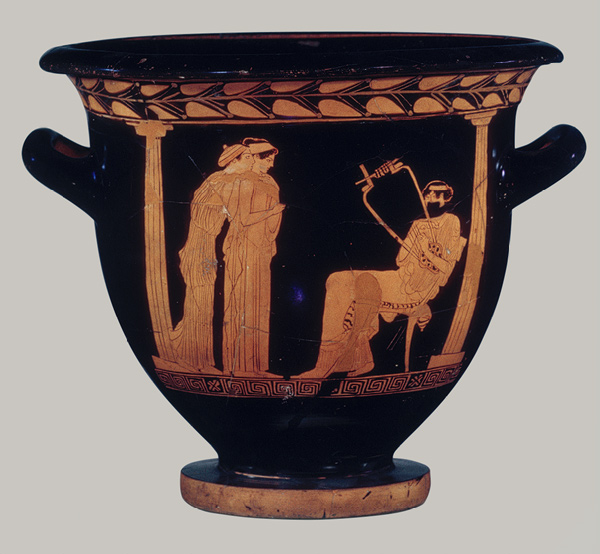
The Esquiline Treasure

Image
The Esquiline Treasure is an ancient Roman silver treasure that was found in 1793 on the Esquiline Hill in Rome. The hoard is considered an important example of late antique silver work from the 4th century CE, probably about 380 for the major pieces. Since 1866, 57 objects, representing the great majority of the treasure, have been in the British Museum. Two of the most important objects in the treasure are the ornate silver-gilt engraved boxes known as the Projecta Casket and the Muse Casket. The treasure was part of the belongings of a wealthy Roman household of high social status. The collection includes 8 plates (4 circular and 4 rectangular), a fluted dish, a ewer inscribed for "Pelegrina", a flask with embossed scenes, an amphora, 6 sets of horse trappings, with furniture fittings including 4 Tyche figures representing the 4 main cities of the Roman Empire: Rome, Constantinople, Antioch and Alexandria, two hands clenching bannisters, and an assortment of jewelry. The ...

For the love of Sappho

Image
In antiquity Sappho's poetry was highly admired, and several ancient sources refer to her as the "tenth Muse". The earliest surviving poem to do so is a third-century BCE epigram by Dioscorides. She was sometimes also referred to as "The Poetess", just as Homer was "The Poet".  The scholars of Alexandria included Sappho in the canon of nine lyric poets. According to Aelian, the Athenian lawmaker and poet Solon asked to be taught a song by Sappho "so that I may learn it and then die". This story may well be apocryphal, especially as Ammianus Marcellinus tells a similar story about Socrates and a song of Stesichorus, but it is indicative of how highly Sappho's poetry was considered in the ancient world. Sappho's poetry also influenced other ancient authors. In Greek, the Hellenistic poet Nossis was described by Marilyn B. Skinner as an imitator of Sappho, and Kathryn Gutzwiller argues that Nossis explicitly positioned herself as an inhe...

Muse (Terpsichore) late 4th-mid 2nd Century BCE, Paros Marble, at the Michael C. Carlos Museum at Emory University in Atlanta, Georgia

Image
The scale and style of this extraordinarily sensitive figure recall decorative sculpture found in grander private homes in Hellenistic Greece, such as the Houses of the Five Statues or of the Diadoumenos on Delos. Her identity is not certain. She shares much with goddesses such as Aphrodite (love), Artemis (hunting), and Themis (established law). However, an attribute made perhaps either of stone, wood, or ivory and now missing, was once dowelled into the top of the tree-stump at her left. This is likely to have been a lyre, identifying the figure as one of the nine Muses, daughters of Zeus and Mnemosyne (memory). It may be Terpsichore, the Muse of Dance whose name means "she who rejoices in the dance". The softness of the facial features, whose elements flow into one another, was achieved by carving the head separately, to guarantee the very finest marble. This may also at times have enabled division of the carving between master craftsman (head) and workshop (body), but her...