Posts

Showing posts with the label mummy mask

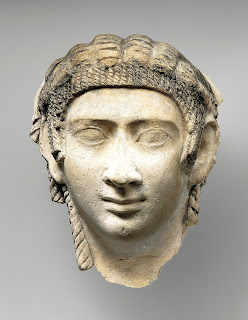
Mummy mask of a woman with corkscrew locks and bang, 50–150 CE, Roman Period Egypt
Image
Plaster Romano-Egyptian mummy masks of the 1st - 2nd century CE appear to be individualized, much like the famous mummy portraits of the Faiyum region. But, in fact, most were made in a mold.  Distinguishing details were added while the plaster was still moist with a spatula or knife. Ears were added separately and, sometimes, eyes were inlaid then the mask painted or gilded. "This woman's waved hairstyle is based on Roman court fashion, but three hanging corkscrew curls behind the ears and a short fringe of curls over the forehead and in front of the ears seem to reflect a local style. Toward the back of her head, above her ears, are traces of a smooth area that once represented a pillow. In general earlier Roman-period masks such as this one show the deceased as if reclining on a bier with the head on a pillow, while later masks have the head raised as if the deceased is rising from the bier. The underneath edge of this example is flat where it is meant to be attached to a b...

Mummy masks - An Egyptian (and Roman!) tradition

Image
 In 2016, I had the opportunity to photograph some of the collections of the Neues Museum in Berlin, Germany. Their collection of Egyptian mummy masks included some of the most meticulously conserved examples I have encountered in my travels.  TourEgypt's comprehensive article on mummy masks does an excellent job of explaining the evolution of this form of funerary art.  An excerpt: Funerary masks had more than one purpose. They were a part of the elaborate precautions taken by the ancient Egyptians to preserve the body after death. The protection of the head was of primary concern during this process. Thus, a face covering helped preserve the head, as well as providing a permanent substitute, in an idealized form which presented the deceased in the likeness of an immortal being, in case of physical damage. Those of means were provided with both a mask with gilt flesh tones and blue wigs, both associated with the glittering flesh and the lapis lazuli hair of the sun god. ...

Egyptian collection of the Penn Museum

Image
Yesterday I finished editing and uploading the last of my images of artifacts in the Egyptian gallery of the University of Pennsylvania's Museum of Archaeology and Anthropology (Penn Museum) to Wikimedia Commons. Next I'll be working on uploading my images of their Greco-Roman collection. Here are some of my favorites from their Egyptian collection: https://commons.wikimedia.org/wiki/Category:Egyptian_antiquities_in_the_University_of_Pennsylvania_Museum Head of King Osorkon II of Egypt excavated at Tunis 874-850 BCE Black Granite Head of a colossal statue of Ramesses II King of Egypt from Abydos 1290-1224 BCE New Kingdom Dynasty 19 Head of a colossal statue of Ramesses II King of Egypt from Abydos 1290-1224 BCE New Kingdom Dynasty 19 Closeup of Bronze statue of a cat with gold leaf Dynasty 22 Egypt 945-712 BCE Basalt Baboon Egypt Dynasty 20 1182-1151 BCE Statue of Ramesses III Limestone Egypt 1187-1156 BCE (Reign of Ramesses III, Dynasty 20) Ka statue of the Royal Acquaintanc...

Late 2nd century CE painted lime plaster mummy mask of a male with inset glass eyes at the Royal Ontaraio Museum in Toronto, Ontario, Canada

Image
The social structure in Aegyptus under the Romans was based on a system of social hierarchy that revolved around ethnicity and place of residence. Other than Roman citizens, a Greek citizen of one of the Greek cities had the highest status, and a rural Egyptian would be in the lowest class. Gaining citizenship and moving up in the ranks was very difficult and there were not many available options for ascendancy. One of the routes that many followed to ascend to a higher social class, as in other provinces of the Empire, was through enlistment in the army. Although only Roman citizens could serve in the legions, many Greeks found their way in. The native Egyptians could join the auxiliary forces and attain citizenship upon discharge.  The Augustan period in Egypt saw the creation of urban communities with “Hellenic” landowning elites. These landowning elites were put in a position of privilege and power and had more self-administration than the Egyptian population. The Romans looked...

Ancient Egypt: Ancient Culture Modern Technology now open at the Boonshoft Museum in Dayton Ohio

Image
Ancient Egypt: Ancient Culture Modern Technology now open at the Boonshoft Museum in Dayton Ohio. This interactive exhibit features CT scans and a 3D printed skull of a female mummy named Nesiur originally excavated in 1922 at El Badari by the Metropolitan Museum of Art. The museum presented the mummy to J. Morton Howell, American Consul General to Egypt from 1920 to 1927. Howell, originally from Dayton, Ohio donated the mummy  along with his Egyptian artifact collection to the city in 1926. His collection included sculptures, funerary art, a beautiful gilded cartonnage mummy mask and Nesiur, a woman who lived during the 25th dynasty about 700 BCE. Images: Facial Reconstruction and 3D printed skull of Nesiur, a woman of the 25th dynasty of Egypt and a gilded cartonnage mummy mask at the Boonshoft Museum in Dayton, Ohio courtesy of the museum.

Gilded cartonnage of a Romano-Egyptian woman and man, possibly from Hawara, Egypt, 1st century CE on display at the Brooklyn Museum in Brooklyn, New York

Image
Gilded cartonnage of a Romano-Egyptian woman and man, possibly from Hawara, Egypt, 1st century CE on display at the Brooklyn Museum in Brooklyn, New York. This gilded mummy mask of a woman, thought to be from Hawara, Egypt, and a man were created in the 1st century CE during Egypt's Roman period. It is created of linen, gilded gesso, glass, and faience. Hawara is an archaeological south of the site of Crocodilopolis, its Gree k name, or Arsinoe, its Ptolemaic Period name, at the entrance to the depression of the Fayum oasis. The first excavations at the site were made by Karl Lepsius, in 1843. William Flinders Petrie excavated at Hawara, beginning in 1888, finding papyri of the 1st and 2nd centuries CE, and, north of the pyramid, a vast necropolis where, in 1911, he found 146 portraits on coffins dating to the Roman period now known as Fayum portraits. Some of the mummies discovered in Hawara, though, were covered with a cartonnage mask rather than a painted portrait. Carton...

Ancient Egypt at the Museo Egizio in Turin, Italy.

Image
Ancient Egypt at the Museo Egizio in Turin, Italy. The Egyptian antique collection of the Egyptian Museum, one of the largest in the world, includes about 40,000 artifacts, most of which comes from the purchase of the Bernardino Drovetti collection in 1824 and from the excavations conducted by Ernesto Schiaparelli in Egypt from 1903 to 1920. Thematic exhibits include the parity of women in ancient Egypt. In a room dedicated to  Merit, a woman who lived around 3,400 years ago during Egypt’s New Kingdom period are boxes that contained her toiletries and other possessions painted with images of a confident woman side by side with her architect husband, Kha, giving offerings to the gods and greeting visitors.The variety of expensive goods she was buried with—a large wig made of human hair, loaves of bread, jewelry, toiletries, clothing—attests to her importance. In the same room is a white limestone statue of a woman — Nefertari — and her husband, Pendua. They are the same size, sa...

Ancient Art of the Mediterranean Basin. Ongoing. At the Legion of Honor Museum in San Francisco, California.

Image
Ancient Art of the Mediterranean Basin. Ongoing. At the Legion of Honor Museum in San Francisco, California.  Late Ptolemaic period gilded cartonnage mummy mask and pectoral. 150-50 BCE. Image courtesy of Wikimedia Commons user Fastily. Ancient art objects on view at the Legion feature a wide gamut of sculptures, figurines, vessels, jewelry, and carved reliefs made of diverse materials, such as marble and other stones, bronze, gold, ivory, terracotta, wood, and glass from Egypt, the Near East, Greece, and Rome. Notable works include an Assyrian stone re lief and carved ivories from the ancient site of Nimrud, an Achaemenid Persian wall relief from the palace of Darius in Persepolis, Egyptian mummies, coffins, and a 4,000-year-old carved wood figure of Seneb, the Egyptian royal scribe, as well as classical marble sculptures and painted vases.