Posts

Showing posts with the label mirror

Usil: Etruscan God of the Sun
Image
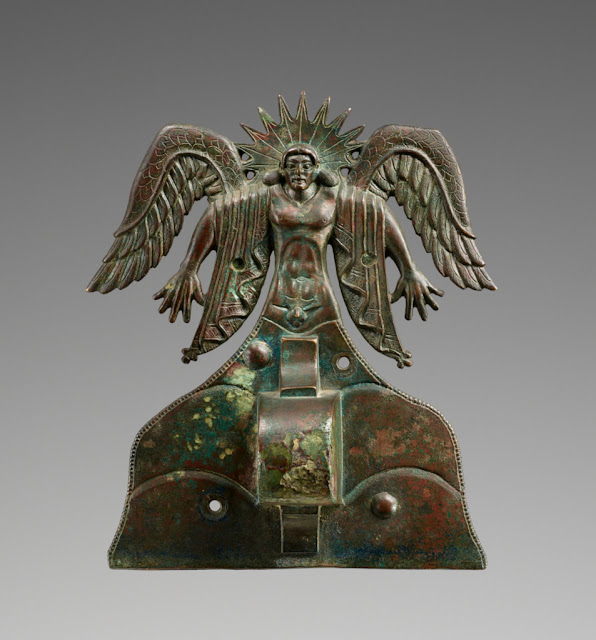
Usil, the Etruscan god of the sun, is equated with the Greek and Roman Helios/Sol Invictus. Appliques depicting the god usually depict the deity with spread wings and a nimbus of rays surrounding his head which is also adorned with a diadem.  On such a plaque obtained by the J. Paul Getty Museum, the figure merges into a broad plate decorated with undulating lines, suggesting the sea from which the sun emerges at daybreak and sinks at dusk.  "Ornamental reliefs such as this functioned as fittings on funeral carts and chariots, which often accompanied the burials of Etruria’s equestrian elite. Probably affixed to the sides of the vehicle, the winged god reflects the imagery of a celestial divinity driving the chariot of the sun across the sky, which was common in Greek and later Etruscan art. The earliest Usil plaque, in the Vatican Museums, was reportedly found at Roma Vecchia between 1760 and 1775 and was illustrated by Francesco Piranesi in 1778. In 1845, four similar plaque...

Calchas and the prophecies of the Iliad

Image
Despite the addition of a head of Serapis, recut and restored in the 18th century CE, the overall scene of a relief at the J. Paul Getty Museum portrays Calchas, the Argive soothsayer to whom Apollo had given the gift of prophecy. In Homer’s Iliad (II.300-30), the seer foretold that the Trojan War would last for nine years after observing a snake devour a mother sparrow and her eight chicks. The eclectic style of the relief combines the form of a late Classical Attic stele with landscape elements drawn from the Hellenistic repertoire. It was discovered in 1774 at Roma Vecchia in the Villa dei Sette Bassi, which belonged to the senatorial family of C. Bellicus Calpurnius Apolaustus. Such a panel may have decorated a library assembled by a cultured patron well versed in Greek literature. On the underside is a Latinized Greek inscription that reads XEANTHE—likely a version of Xanthe, the former name for Troy.   It was Calchas who prophesied that in order to gain a favourable wind...

The Anthropological Implications of Laconian Art

Image
When scholars seek to show the role of Spartan austerity in the evolution of artistic production, they often limit themselves to objects of luxury and high prestige, supposedly condemned by the egalitarian civic ideology of the homoioi.  This raises the question, then,  of who among Spartan citizens actually produced the art.  Did Spartan citizens participate or was the art produced by the "perioikoi," a group of residents, sometimes referred to as mercenaries, living within the body of Lacedaemonians but not equal to Spartiates and yet distinct from the oppressed helots. Classicist Conrad M. Stibbe thinks we should also consider a third possibility, that Laconian art production was not a privilege of one social class or another but rather a branch of artistic industry open to all inhabitants of Laconia, whether free, less free, or unfree. Stibbe poses that archaic Sparta of the seventh and sixth centuries BCE was an open society in which artists of all kinds could freely...

Gifts with subtle messages

Image
The British Museum points out although mirrors, such as these early Greek examples dating to the 4th century BCE, were usually owned by women, they were often a gift from male lovers and often depicted scenes of abduction and male dominance to reflect the subordinate place women held in society.  Here we see Herakles attempting to abduct the nymph Auge from Corinth about 330-300 BCE, an Amazon fighting a bearded Greek from a tomb in Elis, about 350 BCE (some think it may be Dionysos, though, in a short tunic, high boots, and nebris fighting a giant in a Phyrgian helmet), Nike sacrificing a bull from Megara, about 350 BCE, and the abduction of Ganymede.  Three of the four mirrors represent male dominance.  The sacrifice scene celebrates male achievement as the victory represented by Nike may refer to an athletic contest or victorious battle.  The scene also decorated the Temple of Athena Nike at Athens. I photographed the first three mirrors at the British Museum a...

The First Mirrors

Image
The earliest manufactured mirrors were pieces of polished stone such as obsidian, a naturally occurring volcanic glass. Examples of obsidian mirrors found in Anatolia (modern-day Turkey) have been dated to around 6000 BCE. Mirrors of polished copper were crafted in Mesopotamia beginning around 4000 BCE, and in ancient Egypt from around 3000 BCE. Polished stone mirrors from Central and South America date from around 2000 BCE onwards. Some of the earliest examples of Bronze Age copper mirrors were produced by the Qijia culture (2200 BCE-1600 BCE)  distributed around the upper Yellow River region of Gansu (centered in Lanzhou) and eastern Qinghai, China. Glass began to be used for mirrors in the 1st century CE, with the development of soda-lime glass and glass blowing. The Roman scholar Pliny the Elder claims that artisans in Sidon (modern-day Lebanon) were producing glass mirrors coated with lead or gold leaf in the back. The metal provided good reflectivity, and the glass provide...

Roman mirror featuring a woodland scene with Artemis at the Art Institute of Chicago, Illinois

Image
Roman mirror featuring a woodland scene with Artemis at the Art Institute of Chicago, Illinois. Artemis (Roman Diana), or a Roman lady with divine fantasies, after her bath in a rustic, woodland setting, is the subject of the tondo in relief on the back of this Roman hand mirror. Her cloak is draped over the rocks on which she sits, and she holds the end wrapped around a small hand mirror in her raised left hand, a divine celebration of the uses of the mirror in a Roman household. The landscape in front of her, to the right, recalls the paintings and reliefs from houses around the Bay of Naples before the eruption of Mount Vesuvius in 79 CE. The quiver of the goddess leans against the base of a garlanded altar with a small herm on top. A second terminal figure, Priapis, the god of gardens and fertility, tilts back while facing to the right on the ledge at the right. The bovine skull in the right foreground suggests the sacrifice after a successful hunt.  Brass repoussé once atta...

Bronze mirror from the Peloponnesos circa 460 BCE

Image
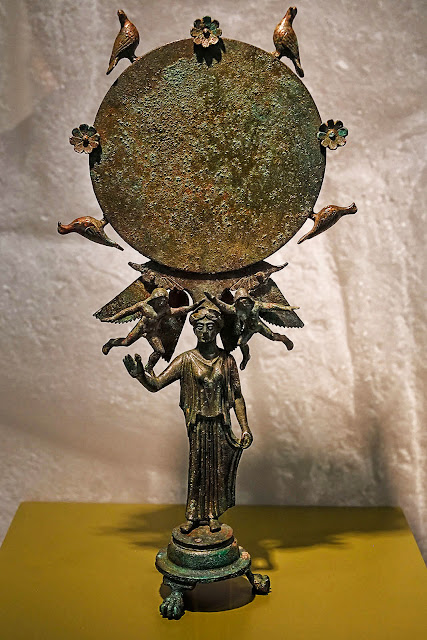
Bronze mirror from the Peloponnesos circa 460 BCE (Inv 566) Surrounded by flowers and pigeons, this mirror features a handle depicting Aphrodite accompanied by two Erotes. It is part of the permanent collection of the Allard Pierson Museum in Amsterdam courtesy of Wikimedia Commons contributor Dick Osseman. Bronze mirror with Aphrodite handle at the Allard Pierson Museum in Amsterdam courtesy of Dick Osseman. Closeup of  Bronze mirror with Aphrodite handle at the Allard Pierson Museum in Amsterdam courtesy of Dick Osseman.