Posts

Showing posts with the label lion

Iron Age III gold cuirass fragments from Northwestern Iran, 8th-7th centuries BCE
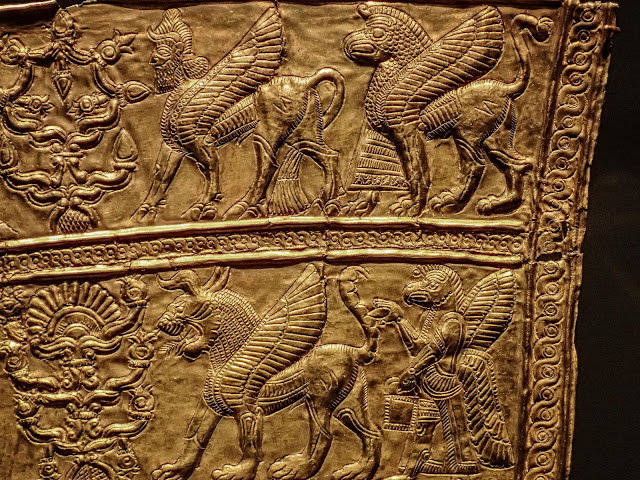
Image
In 2015, I had the opportunity to photograph artifacts in the Smithsonian's Sackler Gallery of Asian Art.  In it, I found this spectacular fragment of a gold breastplate dating to the Iron Age III period. Other fragments of this breastplate are today in the Cincinnati Art Museum and in the Royal Ontario Museum in Toronto. Fragments from a second gold breastplate found in the burial mound near the village of Ziwiye are in the Metropolitan Museum of Art and in the National Museum in Teheran. "This is a fragment from the lower part of a much larger pectoral, or breastplate, made of sheet metal and embellished with figures and ornament arranged in horizontal bands. A breastplate shielded the chest from arrows or other weapons. The decoration on this example consists of mythical guardian creatures, whose images were believed to provide magical protection for the wearer." "A pectoral made of thin sheet gold, like this one, would have been attached to a sturdier material, p...

The David Plates plus one

Image
In 628–29 CE the Byzantine emperor Herakleios (also spelled Heraclius) (r. 610–41) successfully ended a long, costly war with Persia and regained Jerusalem, Egypt, and other Byzantine territory. Silver stamps dating to 613–29/30 on the reverse of these masterpieces place their manufacture in Herakleios’s reign. The biblical figures on the plates wear the costume of the early Byzantine court, suggesting to the viewer that, like Saul and David, the Byzantine emperor was a ruler chosen by God. Elaborate dishes used for display at banquets were common in the late Roman and early Byzantine world; generally decorated with classical themes, these objects conveyed wealth, social status, and learning. This set of silver plates may be the earliest surviving example of the use of biblical scenes for such displays. Their intended arrangement may have closely followed the biblical order of the events, and their display may have conformed to the shape of a Christogram, or monogram for the name of Ch...

Pre-Achaemenid art: Neo-Assyrian or Median?

Image
The Medes were an ancient Iranian people who spoke the Median language and who inhabited an area known as Media between western and northern Iran. Around the 11th century BCE, they occupied the mountainous region of northwestern Iran and the eastern region of Mesopotamia located around Hamadan (Ecbatana). Herodotus reports the Medes played a determining role in the fall of the Assyrian Empire and "could" have  formed an empire at the beginning of the 7th century BCE that lasted until the 550s BCE. It was originally thought they competed with the kingsoms of Lydia and Babylonia for hegemony.  However, the Medes left no written account of their history.  Archaeologists have had to rely upon foreign sources such as the Assyrians, Babylonians and Greeks for Median history, instead, as well as a few Iranian archaeological sites, which are believed to have been occupied by Medes. Some scholars have gone so far as to suggest a Median kingdom as a political entity never existed a...

Pottery askos in the form of a lion preparing to spring, Etruscan, 340-300 BCE at the British Museum

Image
An askos was a vessel used to dispense small quantitites of liquids such as oil. They were used most commonly for refilling oil lamps. The original meaning of askos was wineskin. This example, thought to have been made in Chiusi, Italy has a base of irregular outline that has been cut away inside so as to leave only a narrow support, has a glazed black, and is decorated with a wavy pattern. The motif of the lion drawing back and snarling was popular in the art of both Etruria and southern Italy in the second half of the 4th century BC. It is frequently found on Greek vases and is also common in Etruscan funerary sculpture, particularly in Tuscania and Vulci, and most notably on the frieze of the Tomba François itself where this askos was probably found. All the examples pre-suppose an opponent: one is rarely shown. Buranelli suggests that the opponent may originally have been Herakles, and that the lion is the Nemean lion, shown at the moment before the hero seizes it. In support of ...

Battle of Centaurs and Wild Beasts, a mosaic made for the dining room of Hadrian's Villa, 120-130 CE at the Staatliche Museum in Berlin, Germany

Image
Battle of Centaurs and Wild Beasts, a mosaic made for the dining room of Hadrian's Villa, 120-130 CE at the Staatliche Museum in Berlin, Germany. This centaur mosaic was found in the 18th century on the site of the sprawling, luxurious villa complex near Tivoli that once belonged to the Roman emperor Hadrian. The mosaic was found in situ along with other smaller ones that bore depictions of landscapes, animals and masks. The re latively small central panel (emblema) formed part of the floor decoration for the dining room (triclinium) in the main palace. The various individual scenes of these mosaic pictures bear depictions of wild, inhospitable landscapes that deliberately contrast with idyllic ones featuring animals living in harmony with each other. The dangers of the wild are portrayed in this mosaic in the dramatic struggle between great cats and a pair of centaurs, mythological creatures with the head, arms, and torso of a man and the body and legs of a horse. On a rocky o...

Bronze fountain statuette of Cybele on a cart drawn by lions, Roman, 2nd half of 2nd century C.E. at the Metropolitan Museum of Art in New York City

Image
Bronze fountain statuette of Cybele on a cart drawn by lions, Roman, 2nd half of 2nd century C.E. at the Metropolitan Museum of Art in New York City. This bronze fountain ornament represents the cult image of the goddess Cybele enthroned on a cart drawn by two lions. Spouts formerly projecting from the open mouths of the lions. The original cart, harness, and thr one no longer survive. The rear left wheel is a 19th century restoration. Originally a Phrygian Mother Goddess, the cult was adopted and adapted by Greek colonists of Asia Minor and spread to mainland Greece and its more distant western colonies around the 6th century B.C.E. Rites included the presence of a divine Phrygian castrate shepherd-consort Attis, who was probably a Greek invention, and was represented by members of a eunuch mendicant priesthood. Rome officially adopted her cult during the Second Punic War (218 to 201 B.C.E.), after dire prodigies, including a meteor shower, a failed harvest and famine, seemed to w...