Posts

Showing posts with the label leopard

Spotted cats: Mythological beasts of both the Old World and the New
Image
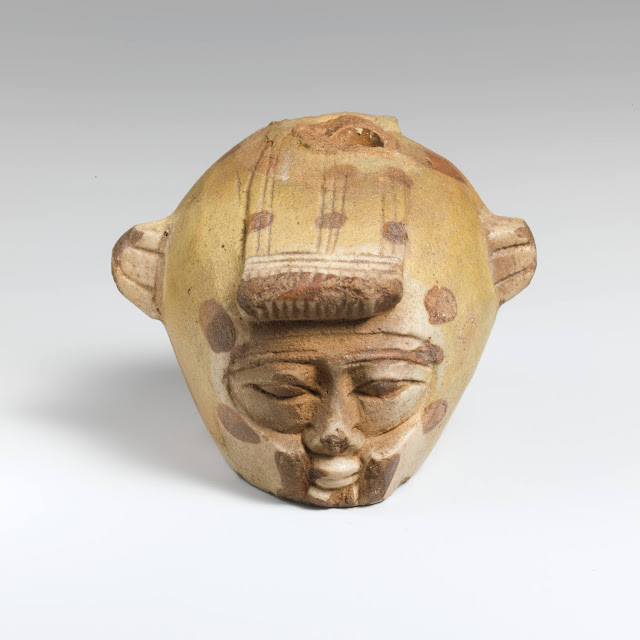
This unusual vase shows a human head of which all but the area of the eyes, nose, and mouth is enclosed in the head of an animal. The softness of the pelt is indicated by the way in which it tightly fits the human head. The small ears and spots are further animal attributes. It is difficult to identify the figure. It may possibly be a very Egyptianized interpretation of Herakles wearing the lion skin. - Metropolitan Museum of Art This vessel caught my attention because it reminded me very much of ancient pre-Columbian American art.  All major Mesoamerican civilizations prominently featured a jaguar god, and for many, such as the Olmec, the jaguar was an important part of shamanism. The jaguar's formidable size, reputation as a predator, and its evolved capacities to survive in the jungle made it an animal to be revered. The Olmec and the Maya witnessed this animal's habits, adopting the jaguar as an authoritative and martial symbol, and incorporated the animal into their mythol...

Priestly attire from Roman Period Egypt 1st century CE

Image
Consisting of a wig with short, tight curls and a distinctive gilded sidelock, this priestly headdress made of cartonnage, said to have been purchased by Howard Carter and thought to have originated from Qau el-Kebir,  may have been found (and once worn) with a faux leopard-skin robe like the accompanying example. In all likelihood, a man serving as a sem-priest or Iunmutef-priest donned the headdress and cloak before carrying out a ritual that revivified a mummified body so that the deceased could live eternally. Priests of Iunmutef were documented from the 5th dynasty (around 2350 BCE) clear up to the Greco-Roman period.  Iunmutef is a manifestation of Horus in his capacity as the “loving son” of Osiris. In this quality he appears in numerous temple scenes and in the royal tombs as a ritual provider of the ruler, whom he enlivens, deifies and renews through the opening of the mouth ritual and as a representative of a rightful ruler in various regeneration and transformation ...

Battle of Centaurs and Wild Beasts, a mosaic made for the dining room of Hadrian's Villa, 120-130 CE at the Staatliche Museum in Berlin, Germany

Image
Battle of Centaurs and Wild Beasts, a mosaic made for the dining room of Hadrian's Villa, 120-130 CE at the Staatliche Museum in Berlin, Germany. This centaur mosaic was found in the 18th century on the site of the sprawling, luxurious villa complex near Tivoli that once belonged to the Roman emperor Hadrian. The mosaic was found in situ along with other smaller ones that bore depictions of landscapes, animals and masks. The re latively small central panel (emblema) formed part of the floor decoration for the dining room (triclinium) in the main palace. The various individual scenes of these mosaic pictures bear depictions of wild, inhospitable landscapes that deliberately contrast with idyllic ones featuring animals living in harmony with each other. The dangers of the wild are portrayed in this mosaic in the dramatic struggle between great cats and a pair of centaurs, mythological creatures with the head, arms, and torso of a man and the body and legs of a horse. On a rocky o...