Posts

Showing posts with the label jewelry

Ancient Amber

Image
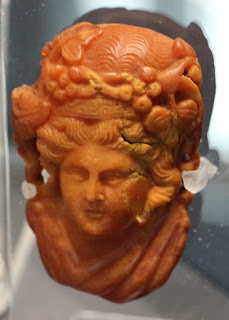
Despite fanciful descriptions by some ancient sources like Nicias (470-415 BCE) that amber "is a liquid produced by the rays of the sun, and that these rays, at the moment of the sun's setting, striking with the greatest force upon the surface of the soil, leave upon it an unctuous sweat, which is carried off by the tides of the Ocean, and thrown up upon the shores of Germany", Roman naturalist Pliny the Elder cited sources who were well aware of amber's actual origin from tree resin. In Book 37, section XI of Natural History, Pliny wrote: "Amber is produced from a marrow discharged by trees belonging to the pine genus, like gum from the cherry, and resin from the ordinary pine. It is a liquid at first, which issues forth in considerable quantities, and is gradually hardened [...] Our forefathers, too, were of opinion that it is the juice of a tree, and for this reason gave it the name of "succinum" and one great proof that it is the produce of a tree o...

Mycenaean gold "seal" rings with Minoan-style iconography

Image
When the so-called "Griffin Warrior" was discovered near the Palace of Nestor in Pylos, the young man who died around 1500 BCE was buried with some 2,000 objects, including silver cups, beads made of precious stones, ivory combs, a sword and four intricately decorated solid gold rings. Archaeologists Shari Stocker and Jack Davis from the University of Cincinnati that excavated the warrior's burial think these grave goods provided evidence that Mycenaean culture recognized and appreciated Minoan culture more than previously believed, especially the gold rings. Made of multiple sheets of gold, the rings depict detailed scenes including bull leaping and iconography such as sun symbols and mythological genii creatures from Minoan mythology.   Originally the rings were thought to have probably been crafted on Crete where they were used to seal documents or indicate ownership of goods or other objects and pillaged in warfare. But, after extensive study, Stocker and Davis have e...

Forgeries of ancient engraved gems

Image
The J. Paul Getty Museum has some spectacular ancient engraved gems in their collections and I have featured a number of them in my posts.  But, during the pandemic one of their curators, Kenneth Lapatin, researched one gem in their collection with a portrait of Marc Antony engraved upon it, and discovered, unfortunately, it was not ancient at all but a 19th century forgery produced by Giovanni Calandrelli for Prince Stanislas Poniatowski, nephew and heir to the King of Poland and Lithuania, and one of the richest men in Europe. Alerted by a friend, the late Gertrud Platz from the Berlin Antikensammlung, who had  just published a study of Giovanni Calandrelli, Lapatin learned she had recently examined a plaster impression that was made of one of Calandrelli's forgeries featuring a portrait of Marc Antony.  Platz suspected the Getty gem was the same work.  So Lapatin sent an impression of the Getty gem to her and they were found to be virtually identical. "There are t...

Cypriot gold spiral earrings: Local fashion or the result of Achaemenid influence?

Image
According to the Metropolitan Museum of Art, spirals with ornate animal-head terminals are frequently found in Cypriot tombs of the Classical period. Terracotta and limestone votive statues illustrate that from the Archaic through the Classical period it was customary for Cypriot men and women to wear such ornaments in large holes pierced through their earlobes. When I saw these earrings, I wondered if this Cypriot practice of making large holes in their earlobes to accommodate these ornaments was a local fashion or adopted as a result of Persian rule beginning in 545 BCE, especially since most examples I have seen  are dated between the late 6th century to the 5th century BCE. I managed to find images of Achaemenid bracelets similarly made of gold tubing but each example of similar earrings I found in my research were all labeled Cypriot. Since the Cypriots were ruled by the Assyrians and even the Egyptians for a short time, I researched the jewelry of those cultures as well but f...

Etruscan jewelry

Image
 The tomb group represents one of the richest and most impressive sets of Etruscan jewelry ever found. It comprises a splendid gold and glass pendant necklace, a pair of gold and rock-crystal disk earrings, a gold dress fastener (fibula) decorated with a sphinx, a pair of plain gold fibulae, a gold dress pin, and five finger rings. Two of the rings have engraved scarabs that revolve on a swivel bezel. One is decorated with embossed satyr heads, and the other two have decorated gold bezels. Very little jewelry from the Villanovan Era, an Early Iron Age culture dating c. 900 BCE – 700 BCE, has been discovered in modern times. The Villanovan Etruscans seem to have left few items of luxury, and thus appear modest. Yet extant Villanovan jewelry confirms that in Etruria great effort was placed in the production of decorative arts. Trade networks with the Greeks and the ancient Near East, particularly the Assyrians,  Phoenicians, and Egyptians, brought techniques such as granulation ...

Painted portrait shroud from a Romano-Egyptian female

Image
 Linen Shroud of a Woman Wearing a Fringed Tunic, 170–200 CE, said to be from Fayum at the Metropolitan Museum of Art in New York. This round-faced Romano-Egyptian woman wears a fine tunic with narrow clavi (stripes) and a mantle draped over her arms.  She must have been extremely wealthy as she wears a great deal of jewelry including earrings, three necklaces, six twisted gold bracelets, and three rings.  Curators are surprised by what appears to be red socks on her feet as there has been no recovery of socks in the archaeological record from this period. She apparently still practices Egyptian religion as she is flanked on either side by Egyptian deities including Anubis.  The Met curators point out that she seems to step forward from a light gray rectangle. This form could be interpreted as a doorway, a late reminiscence of the so-called False Doors of pharaonic Egypt, elaborate niches through which the dead were believed to communicate with the living.  Imag...

Securing valuables in the ancient world

Image
Security of possessions has been a primary concern since humans began accumulating anything of value. Locks were invented to address this issue about 6,000 years ago as evidenced by examples discovered in the ruins of Nineveh, the capital of ancient Assyria.  Locks evolved in ancient Egypt to a wooden pin lock consisting of a  bolt, door fixture or attachment, and key. When the key was inserted, pins within the fixture were lifted out of drilled holes within the bolt, allowing it to move. When the key was removed, the pins fell part-way into the bolt, preventing movement.  This design evolved further into a warded lock, a type of lock that uses a set of obstructions, or wards, to prevent the lock from opening unless the correct key is inserted. The correct key has notches or slots corresponding to the obstructions in the lock, allowing it to rotate freely inside the lock. Warded locks were used in both Rome and ancient China. The Romans were the first to introduce steel w...

Byzantine Temple Pendants

Image
Temple pendants are thought to have hung near the temple or cheek, suspended from the wearer’s hair or headdress. The pendant’s hollow interior probably held a piece of perfumed cloth. A small stick would have been used to guide the cloth in and out of the pendant. When Kievan Rus, a powerful new state to the north of the Byzantine Empire, accepted Christianity as its official religion in 988, the aristocracy also adopted the manners and dress of the Byzantine court. Local artists soon produced their own versions of Constatinopolitan fashions. Temple pendants of precious metals worked in cloisonné enamel or niello are local variants of the more intricately detailed works made for the Byzantine court. As in Byzantium, temple pendants may have been worn next to the face by both the men and the women of Rus. The works in the Metropolitan Museum of Art were perhaps buried by their owners when the Mongol armies under Batu Khan sacked Kiev in 1240. In her paper "Temple Pendants' in ...