Posts

Showing posts with the label horse tack

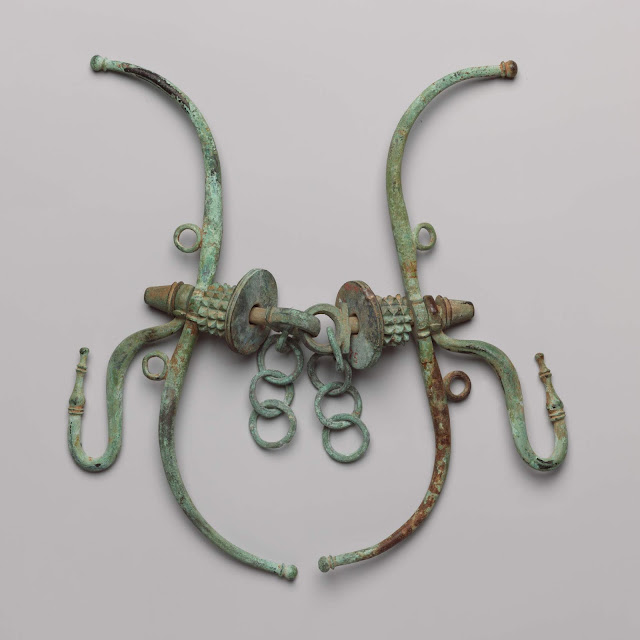
The bit that controlled the mighty Bucephalus
Image
There is evidence of the use of bits to control horses, located in two sites of the Botai culture in ancient Kazakhstan, dated about 3500–3000 BCE.  Nose rings appear on the equids portrayed on the Standard of Ur, circa 2600–2400 BCE. To date, the earliest known artistic evidence of use of some form of bitless bridle comes in illustrations of Synian (Syrian?) horseman, dated approximately 1400 BCE.  Metal bits came into use between 1300 and 1200 BCE, originally made of bronze.   The need for control of horses in warfare drove extensive innovation in bit design, producing a variety of prototypes and styles over the centuries. This bit is of a distinctive type attested in Northern Greece and used for horses that are ridden rather than driven. Its most noteworthy occurrence is on the mount of Alexander of Macedon in the famous Alexander mosaic from the Casa del Fauno in Pompeii and now in the Archaeological Museum, Naples. Bronze bit, Greek, 4th-3rd century BCE at...

Engraved horse pectoral from Roman Carnuntum, 1st century CE, at the Carnuntum Roman Museum in Petronell-Carnuntum, Austria.

Image
Engraved horse pectoral from Roman Carnuntum, 1st century CE, at the Carnuntum Roman Museum in Petronell-Carnuntum, Austria. Carnuntum was a Roman legionary fortress (castrum legionarium) and headquarters of the Pannonian fleet from 50 CE. After the 1st century, it was capital of Pannonia Superior and grew to a city of 50,000 inhabitants. Its impressive remains are situated on the Danube in Lower Austria halfway between Vienna and Bratislava in the Carnuntum Archaeological Park. Carnuntum first appears in Roman history when Tiberius made it his base of operations in his campaigns against Maroboduus, a Romanized king of the Germanic Suebi in 6 CE. In 14 CE the town was selected as the garrison of Legio XV Apollinaris. From the 1st century BCE onward, most cavalry members came from provinces outside Italy and allied states and were classified as auxilia. Most Roman military awards were reserved for Roman citizens but auxilia cavalrymen received horse trappings for battlefi...