Posts

Showing posts with the label history

Machu Picchu and the Golden Empires of Peru to open October 16 at the Boca Raton Museum of Art

Image
Machu Picchu and the Golden Empires of Peru featuring 192 Artifacts, Including the "most-impressive collection of Andean gold ever to travel the world", is coming to the Boca Raton Museum of Art, Boca Raton, Florida, October 16, 2021.  Artifacts in the exhibition are on loan from Museo Larco in Lima, Peru, and Museo de Sitio Manuel Chávez Ballón, in Aguas Calientes, Peru. Objects that belonged to noble Andean lords, include a fully intact gold attire of a Chimú Emperor that dates to 1300 CE.  Said to be rivaled only by Ancient Egypt in longevity and by the Roman Empire in engineering, Andean societies dominated a substantial segment of South America for over 3,000 years until the fall of the Incan Empire in the 16th century CE.  Guests will be taken to the mysterious city in the sky, Machu Picchu, built and abandoned within a century. They will continue on a journey through the vast expanse of Andean history, traveling alongside the mythical hero Ai Apaec, and discoverin...

The Muses

Image
 According to Pausanias, who wrote in the later second century CE, there were originally three Muses, worshipped on Mount Helicon in Boeotia: Aoide ("song" or "tune"), Melete ("practice" or "occasion"), and Mneme ("memory").  The earliest known records of the Muses come from Boeotia and some ancient authorities point to Thrace as the origin of this myth.   Writing in the first century BCE, Diodorus Siculus claims Homer and Hesiod state there are actually nine Muses, though.  According to Hesiod's account (c. 600 BCE), generally followed by most writers of antiquity, the Nine Muses were the nine daughters of Zeus and Mnemosyne (i.e., "Memory" personified), which represented personifications of knowledge and the arts, especially poetry, literature, dance and music.  Ironically, Hesiod says the Muses brought to people forgetfulness, that is, the forgetfulness of pain and the cessation of obligations, though. For poet and ...

Roman Ivories: An Inherited Art

Image
Humans have ornamentally carved ivory since prehistoric times. Very fine detail can be achieved, and as the material, unlike precious metals, has no bullion value and usually cannot easily be recycled, the survival rate for ivory pieces in the archaeological record is much higher than for those in other materials. Ivory objects were not crafted exclusively from the tusks of elephants but from a number of species including hippopotami, walrus, narwhale, sperm whale, elk, and even wart hogs. Worked ivory has been found from the earliest periods of Egyptian history, including both the Predynastic and Early Dynastic periods. Most were made of hippopotamus tusks, however, as elephants had disappeared from Egypt by the historical period. Elephant ivory was imported from Nubia, though, as well as Asia, since populatiions of elephants and hippopotami survived in western Asia into the Late Bronze Age. As hippopotami in Egypt decreased, imported elephant ivory became the most used source, re...

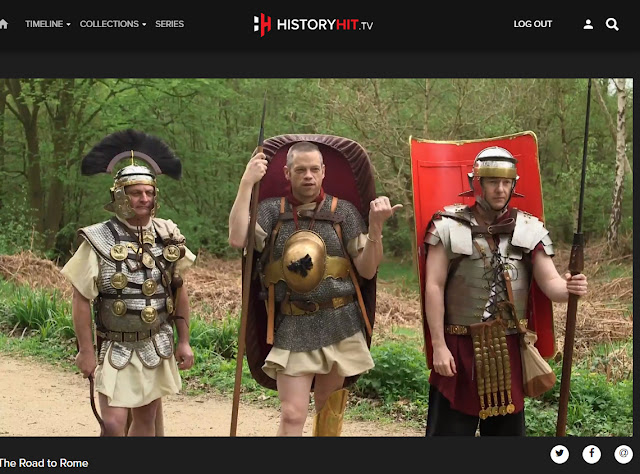
Road to Rome a new documentary on HistoryHit

Image
"The Road to Rome" is a documentary narrated by Sir Ian McKellen that follows the journey of three historical fiction authors (L to R),   Anthony Riches ,  Ben Kane,  and Russell Whitfield, as they walk from Naples to Rome dressed as Roman soldiers to raise money for charity. HistoryHit, a subscription streaming service, is available on Apple TV, Apple App Store for iPhone and iPad, Google Play Store for Android devices and Amazon Fire TV.