Posts

Showing posts with the label gorgon

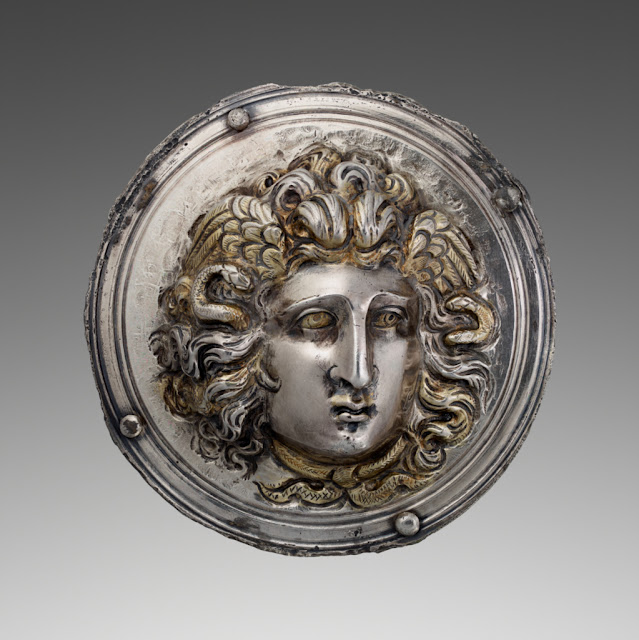
The beautification of Medusa
Image
While ancient Greek vase-painters and relief carvers of the Archaic Period imagined Medusa and her two immortal sisters as having monstrous form that is both male and female, human and animal, with  round faces, wide eyes, beards, and gaping mouths with extended tongues and gnashing, sharp teeth, sculptors and vase-painters of the fifth century BCE began to envisage her as being beautiful as well as terrifying and she loses the frightful teeth and beard but retains her wild hair and her uncompromising riveting gaze. In an ode written in 490 BCE, Pindar already speaks of "fair-cheeked Medusa".  Art historians attribute this to the emergence of a new artistic emphasis on the ideal form that codified standards of perfection and beauty. In fact, the depiction of a snake-haired Medusa does not become widespread until much later in the 1st century BCE, further perpetuated by the Roman poet Ovid in his Metamorphoses (4.794–803), who explains that Medusa was originally a beautiful ma...

Etruscan chariots

Image
Silver panel, perhaps from a parade chariot or piece of furniture, overlaid with electrum and decorated in repoussé relief with two riders, perhaps taking part in a horse-race, with a fallen comrade below, Etruscan, 540-520 BCE, found in the Castel San Mariano near the city of Perugia. Perguia, first called Perusia in the ancient sources, was one of the 12 confederate cities of Etruria.  The league was mostly an economic and religious league, or a loose confederation, similar to the Greek states.  The historical Etruscans had achieved a state system of society, with only remnants of the chiefdom and tribal forms used by surrounding Italics. The government was viewed as being a central authority, ruling over all tribal and clan organizations and wielding the power of life and death. The gorgon was revered as an ancient symbol of that power, and frequently appeared as a motif in Etruscan decoration. The individual referred to as a "fallen comrade" in this Archaic period relief ...

The widespread myth of winged horses

Image
According to Greek myth, the immortal winged horse Pegasus and his brother Chrysaor were born from the blood issuing from Medusa's neck as Perseus was beheading her.  In another version, when Perseus beheaded Medusa, the winged horses were born of the Earth, fed by the Gorgon's blood. A variation of this story holds that they were formed from the mingling of Medusa's blood, pain and sea foam, implying that Poseidon was involved in their creation. The last version bears resemblance to Hesiod's account of the birth of Aphrodite from the foam created when Uranus's severed genitals were cast into the sea by Cronus. Pegasus was captured and raised by the hero Bellerophon who engaged in fighting off monsters. The hero competed with the gods and this angered Zeus, who struck down the horse, turning Pegasus into the beast of burden who carried lightning bolts at Zeus's palace.  Everywhere the winged horse struck his hoof to the earth, an inspiring water spring burst for...

Archaeological Museum of Corfu, Greece

Image
Archaeological Museum of Corfu, Greece.  The Archaeological Museum of Corfu, Greece constructed between 1962 and 1965 houses archaeological finds from the ancient city of Corfu, from the region of Cassiope and the district of Thesprotia.  These include the oldest stone pediment in Greece from the Artemis Temple of Corfu dated between 590-580 BCE, the Lion of Menecrates dated to the end of the 7th century BCE , hoplite armor and weapons, funerary monuments, votive statuettes of Artemis, ceramics, reliefs, and portrait sculpture including a Roman copy of a 3rd century BCE portrait head of Thycydides. Gorgon pediment from the Temple of Artemis 590-580 BCE hoplite armor Archaic period votive plaque Portrait head of Thucydides, Roman copy of 3rd century BCE Greek original  Images courtesy of the museum and Wikimedia Commons contributors Dr. K, and Zde 

Dangerous Beauty: Medusa in Classical Art: Through January 2019 at the Metropolitan Museum of Art, New York City

Image
Dangerous Beauty: Medusa in Classical Art: Through January 2019 at the Metropolitan Museum of Art, New York City - This heavy metal ornament, decorated with the head of Medusa and inlays of silver and copper, probably comes from a currus triumphalis (ceremonial chariot) used in processions rather than a lightweight racing chariot.  Roman.  1st - 2nd century CE.  Image courtesy of the Metropolitan Museum of Art in New York City, New York. Beginning in the fifth century B.C., Medusa, the snaky-haired Gorgon whose gaze turned men to stone, became increasingly anthropomorphic and feminine, undergoing a visual transformation from grotesque to beautiful. A similar shift in representations of other mythical female half-human beings, such as sphinxes, sirens, and the sea monster Scylla, took place at the same time. Featuring 60 artworks, primarily from The Met collection, this exhibition explores how the beautification of these terrifying figures manifested the idealizing...