Posts

Showing posts with the label gold

The Getae: The noblest and the just of the Thracian tribes (according to Herodotus)

Image
Every time I read something about the Getae, I envision the skull wearing savage warriors depicted in the opening battle scenes of the Starz series "Spartacus." But according to Herodotus, the Getae were "the noblest as well as the most just of all the Thracian tribes."  When Lysimachus tried to subdue the Getae he was defeated by them. The Getae king, Dromichaetes, took him prisoner but he treated him well and convinced Lysimachus there is more to gain as an ally than as an enemy of the Getae and released him. According to Diodorus, Dromichaetes entertained Lysimachus at his palace at Helis, where food was served on gold and silver plates. The discovery of the celebrated tomb at Sveshtari (1982) suggests that Helis, the capital of the Getae, was located perhaps in its vicinity, where remains of a large antique city are found along with dozens of other Thracian mound tombs. The Getae were several Thracian-related tribes that once inhabited the regions to either side...

Sarmatians: Descendants of the Amazons?

Image
Herodotus (4.110–117) tells us some Amazons were captured in battle by Greeks in Pontus (northern Turkey) near the river Thermodon, and the captives were loaded into three boats. They overcame their captors while at sea, but were not able sailors. The boats were blown north to the Maeotian Lake (the Sea of Azov) onto the shore of Scythia near the cliff region (today's southeastern Crimea). After encountering the Scythians and learning the Scythian language, the Amazons agreed to marry Scythian men, but only on the condition that they move away from Scythia and not be required to follow the customs of Scythian women. Hippocrates described these warlike women. "Their women, so long as they are virgins, ride, shoot, throw the javelin while mounted, and fight with their enemies. They do not lay aside their virginity until they have killed three of their enemies, and they do not marry before they have performed the traditional sacred rites. A woman who takes to herself a husband no...

Mycenaean gold "seal" rings with Minoan-style iconography

Image
When the so-called "Griffin Warrior" was discovered near the Palace of Nestor in Pylos, the young man who died around 1500 BCE was buried with some 2,000 objects, including silver cups, beads made of precious stones, ivory combs, a sword and four intricately decorated solid gold rings. Archaeologists Shari Stocker and Jack Davis from the University of Cincinnati that excavated the warrior's burial think these grave goods provided evidence that Mycenaean culture recognized and appreciated Minoan culture more than previously believed, especially the gold rings. Made of multiple sheets of gold, the rings depict detailed scenes including bull leaping and iconography such as sun symbols and mythological genii creatures from Minoan mythology.   Originally the rings were thought to have probably been crafted on Crete where they were used to seal documents or indicate ownership of goods or other objects and pillaged in warfare. But, after extensive study, Stocker and Davis have e...

The Galloway Hoard Exhibit through September 12, 2021 at the National Museum of Scotland

Image
Discovered by a metal detectorist in Dumfries and Galloway, Scotland in 2014, the Galloway Hoard, buried around 900 CE, contains over 100 diverse objects, from silver, gold and jewelled treasures to rarely surviving textiles, including wool, linen and Scotland’s earliest examples of silk.   It is thought that the hoard was buried some time in the mid-ninth or tenth century, though it is not known why it was buried. The hoard consists of a variety of gold and silver objects including armbands, a silver pectoral cross, brooches, ingots, and what is possibly the largest silver Carolingian pot ever discovered. The pot was one of the older items in the hoard and may have been more than 100 years old by the time it was deposited. It is made of a silver alloy and was found wrapped in the remains of a cloth, with its lid still in place. It contained a collection of silver Anglo-Saxon disc brooches, an Irish silver brooch, Byzantine silk from the area around Constantinople, a gold ingo...

Machu Picchu and the Golden Empires of Peru to open October 16 at the Boca Raton Museum of Art

Image
Machu Picchu and the Golden Empires of Peru featuring 192 Artifacts, Including the "most-impressive collection of Andean gold ever to travel the world", is coming to the Boca Raton Museum of Art, Boca Raton, Florida, October 16, 2021.  Artifacts in the exhibition are on loan from Museo Larco in Lima, Peru, and Museo de Sitio Manuel Chávez Ballón, in Aguas Calientes, Peru. Objects that belonged to noble Andean lords, include a fully intact gold attire of a Chimú Emperor that dates to 1300 CE.  Said to be rivaled only by Ancient Egypt in longevity and by the Roman Empire in engineering, Andean societies dominated a substantial segment of South America for over 3,000 years until the fall of the Incan Empire in the 16th century CE.  Guests will be taken to the mysterious city in the sky, Machu Picchu, built and abandoned within a century. They will continue on a journey through the vast expanse of Andean history, traveling alongside the mythical hero Ai Apaec, and discoverin...

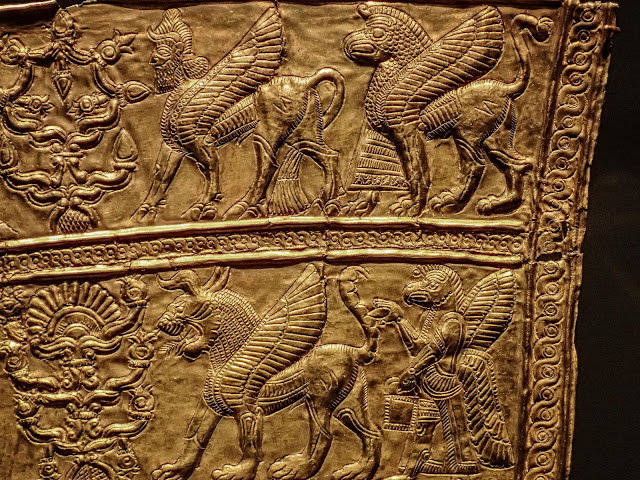
Iron Age III gold cuirass fragments from Northwestern Iran, 8th-7th centuries BCE

Image
In 2015, I had the opportunity to photograph artifacts in the Smithsonian's Sackler Gallery of Asian Art.  In it, I found this spectacular fragment of a gold breastplate dating to the Iron Age III period. Other fragments of this breastplate are today in the Cincinnati Art Museum and in the Royal Ontario Museum in Toronto. Fragments from a second gold breastplate found in the burial mound near the village of Ziwiye are in the Metropolitan Museum of Art and in the National Museum in Teheran. "This is a fragment from the lower part of a much larger pectoral, or breastplate, made of sheet metal and embellished with figures and ornament arranged in horizontal bands. A breastplate shielded the chest from arrows or other weapons. The decoration on this example consists of mythical guardian creatures, whose images were believed to provide magical protection for the wearer." "A pectoral made of thin sheet gold, like this one, would have been attached to a sturdier material, p...