Posts

Showing posts with the label god

Pompeii Walk - 1st 30 minutes

Image
The first 30 minutes of a 5 hour Pompeii walk video that I enjoyed immensely. Although I wasn't controlling the video camera, I was able to grab some screen shots that with a little editing with Topaz Sharpen AI, On1 Effects, and Photoshop's sky replacement feature (In summer Naples skies are usually empty and that makes for boring images!) I felt like I was revisiting the site and didn't even have to suffer any jet lag! Enhanced screen captures: House of the Mariner Tablinum screen capture from Pompeii Walk video courtesy of POMPEII ARCHAEOLOGICAL PARK Mosaic fragments from the House of Trittolemo Pompeii Walk video courtesy of POMPEII ARCHAEOLOGICAL PARK Mosaic fragments from the House of Trittolemo Pompeii Walk video courtesy of POMPEII ARCHAEOLOGICAL PARK Apollo statue in Temple of Apollo Pompeii screen capture from Pompeii Walk video courtesy of POMPEII ARCHAEOLOGICAL PARK Apollo statue in Temple of Apollo Pompeii screen capture from Pompeii Walk video courtesy of POMP...
Disability and the politics of "Divine Disfavor" in the Greco-Roman world

Image
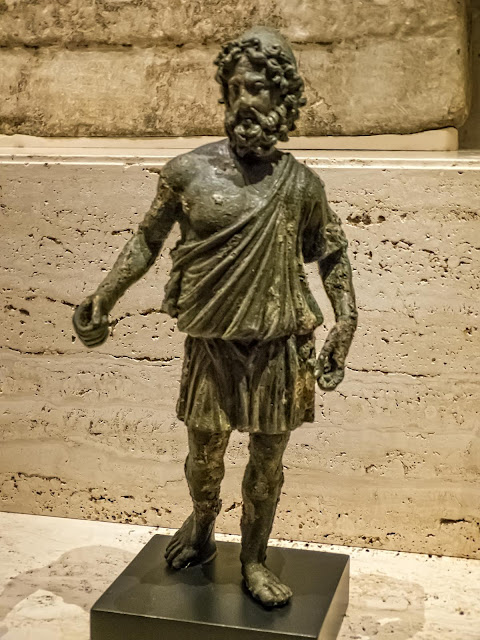
I was reading Classical Wisdom's newsletter in preparation for this weekend's virtual symposium and found their article "Hephaestus:The Humane God" particularly interesting. Although most of us think of Hephaestus as the divine metalworker that forged magical armor and weapons like the shield of Achilles, Sean Kelly pointed out that he was also the only god in the Greek pantheon (and Roman under the name Vulcan) who suffered from a physical impairment.  Hephaestus attempted to intervene in a quarrel between  Zeus and Hera, and an enraged Zeus  cast him from Mount Olympus, injuring his legs.  Thereafter he was the subject of derision because of his lameness although he was respected for his smithing skills. He forged Hermes' winged helmet and sandals, the Aegis breastplate, Aphrodite's famed girdle, Agamemnon's staff of office, Achilles' armour, Diomedes' cuirass, Heracles' bronze clappers, Helios' chariot, the shoulder of Pelops, and even E...

The Empire's Physician: Prosperity, Plague, and Healing in Ancient Rome

Image
The Institute for the Study of the Ancient World at New York University is sponsoring the virtual exhibit "The Empire's Physician: Prosperity, Plague, and Healing in Ancient Rome" (ancient medicine and health as seen through the eyes of Galen). Their exhibit can be explored here:   https://galen.nyu.yourcultureconnect.com/e/home Image: Votive relief depicting Asclepius healing a patient in her sleep, with Hygieia standing behind the god. Greek, ca. 400–350 BCE. Marble. Temple of Asclepius (Asclepieion), Piraeus, near Athens. H. 42 cm; W. 79 cm. Archaeological Museum of Piraeus: MP 405. Photo: Sites & Photos / Art Resource, NY.  

Demon God Protector of Egypt at the NY Carlsberg Glyptotek in Copenhagen, Denmark, May 20 - October 31, 2021

Image
Say the words ‘Egyptian gods’ and it is usually the sun god Ra, Anubis god of the dead or the goddess Isis that spring to mind. These gods were closely associated with the Pharaoh and the upper echelons of Egyptian society. But in ancient Egypt, it was the demon gods that were inextricably linked to the everyday life of Egyptians. The most important of these was Bes, who provided protection against all manner of ills and ailments in ancient Egypt. “The exhibition isn’t just a story about the popular, multifaceted deity Bes, whom very few people today know. Bes provides a unique insight into how the people in general lived, and into the thought and faith of ancient Egypt”, says the Egyptologist and exhibition curator Tine Bagh. “Throughout history, humankind has sought safety and security. In today’s Denmark we have a welfare system to look after us. In ancient Egypt they had Bes.” Bes is easily recognisable. He has short, stumpy legs, his tongue pokes out of his mouth, his beard resemb...

Gigantes

Image
In Greek and Roman Mythology, the Giants, also called Gigantes, were a race of great strength and aggression, though not necessarily of great size. They were known for the Gigantomachy (Gigantomachia), their battle with the Olympian gods for supremacy of the cosmos. Historically, the myth of the Gigantomachy (not to be confused with the Titanomachy) may reflect the "triumph" of the new imported gods of the invading Greek speaking peoples from the north (c. 2000 BCE) over the old gods of the existing peoples of the Greek peninsula. For the Greeks, the Gigantomachy represented a victory for order over chaos—the victory of the divine order and rationalism of the Olympian gods over the discord and excessive violence of the earth-born chthonic Giants. More specifically, for sixth and fifth century BCE Greeks, it represented a victory for civilization over barbarism.  Archaic and Classical representations show Gigantes as man-sized hoplites (heavily armed ancient Greek foot soldier...