Posts

Showing posts with the label goat

Pre-Achaemenid art: Neo-Assyrian or Median?

Image
The Medes were an ancient Iranian people who spoke the Median language and who inhabited an area known as Media between western and northern Iran. Around the 11th century BCE, they occupied the mountainous region of northwestern Iran and the eastern region of Mesopotamia located around Hamadan (Ecbatana). Herodotus reports the Medes played a determining role in the fall of the Assyrian Empire and "could" have  formed an empire at the beginning of the 7th century BCE that lasted until the 550s BCE. It was originally thought they competed with the kingsoms of Lydia and Babylonia for hegemony.  However, the Medes left no written account of their history.  Archaeologists have had to rely upon foreign sources such as the Assyrians, Babylonians and Greeks for Median history, instead, as well as a few Iranian archaeological sites, which are believed to have been occupied by Medes. Some scholars have gone so far as to suggest a Median kingdom as a political entity never existed a...

Pan: Purveyor of Music and Panic

Image
In Greek mythology, Syrinx was a forest Nymph. In her attempt to escape the affection of the god Pan (god of the wild, shephers, and flocks with the hindquarters, legs and horns of a goat), she was transformed into a water-reed or calamos (cane-reed). Then, Pan cut several reeds, placed them in parallel one next to the other, and bound them together to make a melodic musical instrument. Ancient Greeks called this instrument Syrinx, in honour of the Muse, and Pandean, or Pan-pipes or Pan-flute, after Pan. The Syrinx, a predominantly pastoral instrument for the Greeks, was adopted by the Etruscans who played it at their festivals and banquets called it a fistula. The Romans adopted both Pan, whose Roman counterpart was Faunus, father or Bona Dea, and the Syrinx from the Greeks and the Etruscans, and they too played it at their banquets, festivals, as well as in religious and funeral processions. Despite Homer's account of the chaste nature of Odysseus' wife Penelope in "The ...

Neo-Assyrian ivory of a rearing goat from ancient Nimrud at the Metropolitan Museum of Art

Image
 In this fragmentary, openwork plaque, a rearing goat balances its forelegs on the intertwining tendrils of a stylized plant, nibbling on the leaves at the top. This piece was found in a large storeroom at Fort Shalmaneser, a royal building at Nimrud that was probably used to store booty and tribute collected by the Assyrians while on military campaign. A rectangular tenon preserved below the lower edge suggests that it may have been fitted into a frame, likely as part of a piece of furniture. The goat’s large eye, which bears traces of blue paste into which a colored glass or semiprecious stone inlay would have been set, is emphasized by incisions along the brow, as are its snout, ears, beard, mane, and ribs. The preserved fragment of vegetation emerging from behind the goat’s lower back suggests that the stylized plant depicted between its legs continued upwards and framed the goat in a vegetal landscape. While the goat’s large, heavy body and energetic pose are characteristic o...

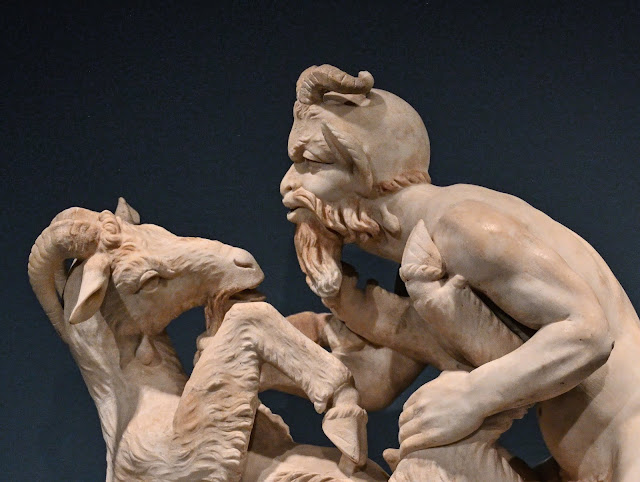
A goat and satyr "Buried by Vesuvius" at the Getty Villa until October 28, 2019

Image
A goat and satyr "Buried by Vesuvius" at the Getty Villa until October 28, 2019. The marble sculpture of the woodland god Pan having intercourse with a she-goat was discovered in the Villa dei Papiri in 1752. It immediately became notorious and was long off-limits, viewable only in the vaults of the royal palace at Portici by special permission of the king. Explicit imagery was common in antiquity. S ome modern commentators have interpreted this sculpture as evidence of the Romans’ reverence for the generative power of sex. Others have seen it as a satire on the bestial nature of all men. As many of the sculptures in the villa seem to have been grouped thematically, it is tempting to link this work with busts found nearby such as the Macedonian king Demetrios Poliorketes, often depicted with horns, like Pan, and famously dissolute. The satyr and goat were found on the south side of the rectangular peristyle on March 1, 1752. Image: Closeup of Satyr and goat found...