Posts

Showing posts with the label funerary art

Red-figured fish plates of the 5th century BCE

Image
Throughout my travels to various museums around the world I have often encountered red-figured fish plates. First developed in Athens, these beautifully detailed serving pieces became especially popular in South Italy and Sicily in the 400s BCE. I stumbled across this excellent video about them and learned that fish plates produced in Magna Graecia were usually more colorful with white accents and the fish are portrayed with their bellies facing inwards towards the small central depression that is thought to have contained dipping sauce like garum. Fish on plates produced in Athens are painted with their bellies facing outwards. I thought this is quite a peculiar style difference.  There also seems to be disagreement among scholars as to whether these plates were actually used in everyday life or produced for funerary purposes only, as almost all of the 1,000 examples that have been recovered came from ancient burials. Art historian Lucas Livingston points out that many of the reco...
Ancient Amber

Image
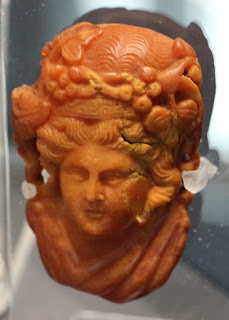
Despite fanciful descriptions by some ancient sources like Nicias (470-415 BCE) that amber "is a liquid produced by the rays of the sun, and that these rays, at the moment of the sun's setting, striking with the greatest force upon the surface of the soil, leave upon it an unctuous sweat, which is carried off by the tides of the Ocean, and thrown up upon the shores of Germany", Roman naturalist Pliny the Elder cited sources who were well aware of amber's actual origin from tree resin. In Book 37, section XI of Natural History, Pliny wrote: "Amber is produced from a marrow discharged by trees belonging to the pine genus, like gum from the cherry, and resin from the ordinary pine. It is a liquid at first, which issues forth in considerable quantities, and is gradually hardened [...] Our forefathers, too, were of opinion that it is the juice of a tree, and for this reason gave it the name of "succinum" and one great proof that it is the produce of a tree o...

Mycenaean gold "seal" rings with Minoan-style iconography

Image
When the so-called "Griffin Warrior" was discovered near the Palace of Nestor in Pylos, the young man who died around 1500 BCE was buried with some 2,000 objects, including silver cups, beads made of precious stones, ivory combs, a sword and four intricately decorated solid gold rings. Archaeologists Shari Stocker and Jack Davis from the University of Cincinnati that excavated the warrior's burial think these grave goods provided evidence that Mycenaean culture recognized and appreciated Minoan culture more than previously believed, especially the gold rings. Made of multiple sheets of gold, the rings depict detailed scenes including bull leaping and iconography such as sun symbols and mythological genii creatures from Minoan mythology.   Originally the rings were thought to have probably been crafted on Crete where they were used to seal documents or indicate ownership of goods or other objects and pillaged in warfare. But, after extensive study, Stocker and Davis have e...

Golden Mummies of Egypt through July 11, 2021 at the North Carolina Museum of Art in Raleigh, North Carolina

Image
This exhibition uses mummies from the collections of the Manchester Museum (England) to allow visitors to examine life for the wealthy in multicultural Roman Egypt, where diverse Egyptian, Roman, and Greek communities and cultural influences were blended. The exhibition journey traces expectations for the afterlife and introduces cultural constructions of identity, strikingly demonstrated by haunting painted panel portraits. The practices of preservation and decoration of the body, and the transformation of the deceased into a god, are explored by the mummies on display. Eight gilded mummies  and more than 100 related objects are presented in the display, including papyri, jewelry, ceramics, and artworks depicting deities that connect the daily lives of these Greco-Roman Egyptians to the religious world of the gods in a series of lavishly illustrated thematic sections covering the period from 300 BCE to 200 CE. The youngest of the preserved individuals is a 2 or 3 year-old child wr...

Apotropaic infant rattles

Image
Baby rattles go back at least 2500 years. Ancient rattles were made of various materials, including clay, wood, bronze, dried heads of poppy flowers, and pebbles. One of the oldest infant rattles in central Europe was found in Poland  in a grave of a baby who was a member of the early Iron Age Lusatian culture (1300 BCE – 500 BCE).  That hollow clay rattle was shaped like a pillow and was filled with little balls. It was found next to a tiny urn containing the cremated remains of the baby.   Children in ancient Greece and Rome would have been amused by mold-made rattles like those pictured here. In his Politics, Aristotle observed  that young children should be given a rattle (particularly one designed by Archytas) to keep them quiet.  Greek mold-produced terracottas began to appear in the archaeological record around the 7th-century BCE. These figures were formed by pressing wet clay into a two‑part mold to form a small sculpture in the round that can be s...

Mourning Women, South Italian (Apulian, Canosan), 300-275 BCE Terracotta

Image
Statues of Mourning Women, South Italian (Apulian, Canosan), 300-275 BCE Terracotta, now in the collections of the J. Paul Getty Museum, Villa venue, Pacific Palisades, California This group of mourning women, often understood as female figures in prayer (orantes), was likely produced in the area of Canosa in south-eastern Italy. Although there are considerable differences in terms of clothing, poses and hairstyles, the four statues seem to depict a type of youthful female figure, probably envisioned as one of the mourners who expressed their grief during funerary ceremonies. The group was intended to be placed around a funerary couch (kline), and was probably produced for a fairly prestigious client who, in the context of Romanization in the area, aspired to underscore his economic prosperity, personal identity, and native traditions. The figures were made not with molds, as has been previously conjectured, but rather through a modeling process over a fairly thick conical structure. W...

Archaic Period Horse Sculptures

Image
Horses, with or without riders, were favorite subjects for Boeotian artisans. The figurines were frequently left as burial offerings in graves. Horses were a sign of wealth for the Greeks of this period, and the terracotta horses were probably left to symbolize and to reinforce the high status of the deceased. Thousands of clay figurines like this one survive from the Archaic period (600 to 480 BCE). "Horses played a central role in the great civic festivals in the ancient world, such as the Panathenaic Games in Athens and the Olympic games at Olympos, where they took part in chariot races and single horse races. The horse’s long affiliation with gods and heroes in Greek mythology no doubt also fostered a special respect and admiration for this remarkable creature in the minds of “ordinary” Greeks. In Homer’s Iliad, horses drive the chariots of the heroes and are praised for their swiftness and beautiful coats. They are often depicted as having special relationships with their own...

"Colors of the Romans: Mosaics from the Capitoline Collections" opens at the Centrale Montemartini in Rome

Image
The “Colors of the Romans” exhibition at Centrale Montemartini, one of Rome’s great museums, hopes to attract tourists to the Italian capital through this lesser-known but varied selection of mosaics. The exhibition is divided into four sections.  The first showcases the history and mosaic techniques. The works chosen represent all types of mosaic floors and wall decorations, allowing to illustrate through the techniques, materials, colors, decorative motifs, the stylistic evolution and the transformation of mosaic art over time.  The second explores living and dwelling in Rome between the end of the Republican age and the late ancient age: luxury residences and domestic contexts.  The route follows a chronological criterion, passing from the oldest examples - such as the large polychrome mosaic with coffered, discovered at the Villa Casali al Celio - to the more recent ones, up to the fourth century CE, the period to which the mosaic belongs with a seasonal bust, perhaps...

Usil: Etruscan God of the Sun

Image
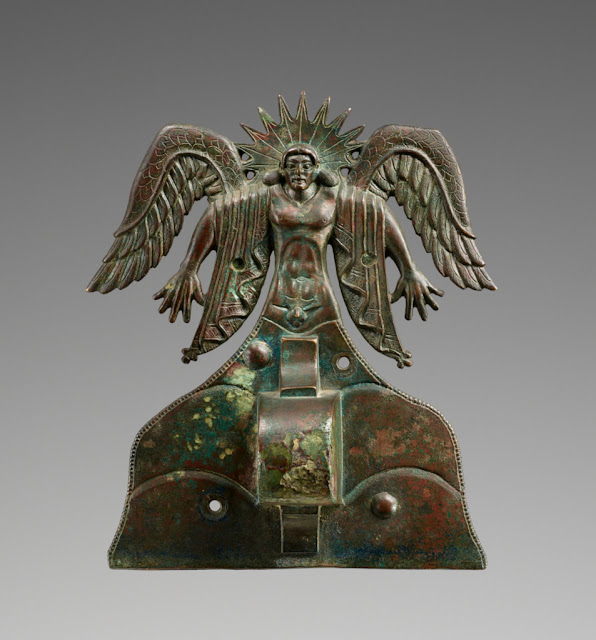
Usil, the Etruscan god of the sun, is equated with the Greek and Roman Helios/Sol Invictus. Appliques depicting the god usually depict the deity with spread wings and a nimbus of rays surrounding his head which is also adorned with a diadem.  On such a plaque obtained by the J. Paul Getty Museum, the figure merges into a broad plate decorated with undulating lines, suggesting the sea from which the sun emerges at daybreak and sinks at dusk.  "Ornamental reliefs such as this functioned as fittings on funeral carts and chariots, which often accompanied the burials of Etruria’s equestrian elite. Probably affixed to the sides of the vehicle, the winged god reflects the imagery of a celestial divinity driving the chariot of the sun across the sky, which was common in Greek and later Etruscan art. The earliest Usil plaque, in the Vatican Museums, was reportedly found at Roma Vecchia between 1760 and 1775 and was illustrated by Francesco Piranesi in 1778. In 1845, four similar plaque...