Posts

Showing posts with the label exhibit

Pompeii's Regio V: Vibrant gladiator frescos and proof of October eruption date

Image
This fresco of gladiatorial combat, unearthed in Pompeii in 2019, was found in a basement room of a building that scholars think was a tavern frequented by gladiators in the city.  The tavern was found not far from the gladiators' barracks in Regio V. The wounded Thraex, bleeding profusely from injuries on his wrist and chest, raises a finger to indicate his submission and request for mercy. The victorious Murmillo, wearing a plumed, wide-brimmed helmet with visor, holds aloft his large rectangular shield in his left hand while gripping his short sword in his right. For historians, probably the most significant find from Regio V was unearthed in 2018.  Excavators uncovered an inscription proving the city was destroyed after October 17, 79 CE instead of August 24 as previously thought.  The August date had been suspect for some time as a number of the 1,150 victims recovered from the ruins were discovered wearing heavier clothing than the light summer clothes typical of Au...

The Painters of Pompeii: Roman Frescoes from the National Archaeological Museum, Naples

Image
The Painters of Pompeii: Roman Frescoes from the National Archaeological Museum, Naples will open June 26, 2021 at the Oklahoma City Museum of Art.  It will be on display until October 17, 2021. Tickets will be available on a timed entry basis with limited capacity to ensure adequate social distancing.  Although masks are encouraged, they are not required for fully vaccinated visitors.  Eighty artifacts and artworks from Pompeii and Herculaneum will be presented. During the exhibition, the museum plans to host a series of lectures in the Noble Theater with several of the most renowned scholars in the field of Ancient Roman Art and History.  Topics include the rediscovery of Pompeii, Food & Wine in Pompeii, Roman Painting, and Powerful Elite Women in Imperial Rome. The exhibit notice says its appearance at the Oklahoma City Museum of Art will be its only US presentation. Image: Polyphemus hears of the arrival of Galatea (or Hercules and Omphale), ancient Roman fre...

Glorious Victories. Between Myth and History through February 2021 at the National Archaeological Museum in Athens, Greece

Image
In celebration of th 2500-year anniversary of the Battle of Thermopylae and the Naval Battle of Salamis, this exhibit presents 105 ancient works along with a model of an Athenian trireme of the 5th century BCE, assembled from the National Archaeological Museum of Athens and the archaeological museums of Astros, Thebes, and Olympia, as well as the Konstantinos Kotsanas Museum of Ancient Greek Technology.  A Roman copy of a 5th century BCE Greek bust of Themistocles has also been contributed by the Archaeological Museum of Ostia. Displays show the military attire of the Greek hoplites and Persian warriors and votive offerings made in the large sanctuaries of antiquity following the battles, including the helmet of Miltiades, the arrowheads from the battlefield of Thermopylae, and fragments of vases with traces of fire from the burning of Athens by the Persians. Figures of gods and mythical heroes are used to represent  the subsequent legends developed over later centuries that r...

Philoctetes and compassion for Hercules on the Pyre

Image
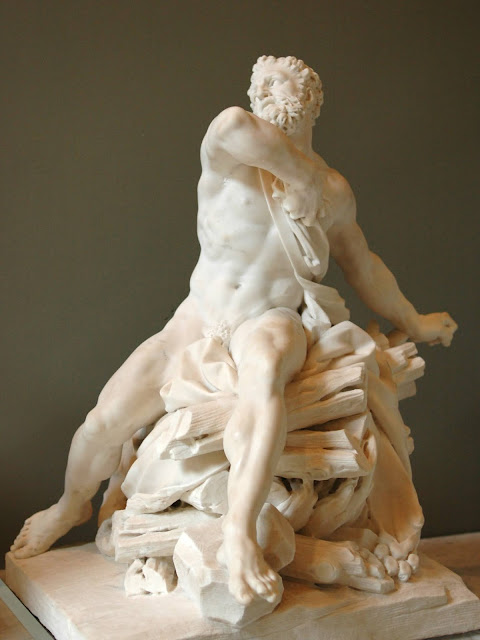
According to the most common legend of Hercules' death, no one but Hercules' friend Philoctetes,  son of King Poeas of the city of Meliboea in Thessaly, would light his funeral pyre. For his compassion, Philoctetes  received Hercules' bow and arrows. Later, Philoctetes as one of the many eligible Greeks who competed for the hand of Helen, the Spartan princess, was required to participate in the Trojan War to reclaim Helen for Menelaus when she was stolen away by Paris.  On his way to the Trojan War, Philoctetes was bitten by a snake that Hera sent to molest him as punishment for his service to Hercules. The wound festered and began to smell so his Greek companions stranded Philoctetes on the island of Lemnos. When the Greeks reached Troy, Helenus, the prophetic son of King Priam, revealed under torture that one of the conditions for the Greeks to win the war was that they needed the bow and arrows of Hercules as some of the arrows were those dipped in the poison bloo...

At the Feet of the Gods: The art of footwear in ancient Rome, epic film and contemporary fashion" through April 19, 2020 at the Pitti Palace in Florence, Italy

Image
At the Feet of the Gods: The art of footwear in ancient Rome, epic film and contemporary fashion" through April 19, 2020 at the Pitti Palace in Florence, Italy. This exhibit features 80 works from sculptures and decorative urns to sandals ancient and new, many on loan from international museums. In ancient times, shoes acted as a sort of "identity card" for their owner. They could reveal a great deal of information about the wea rer—such as their sex, profession or economic status. The prehistoric forerunners of the sandal date back as far as 10,000 years. This exhibit brings together massive feet in marble and bronze, the remnants of destroyed statues of gods and other delicate footwear on pottery dating back to the 5th century BCE. On one vase, Eros, the Greek god of love, helps a virgin change into the skin-exposing sandals she will wear as a bride. On an Etruscan urn, a nude courtesan laces up sandals whose nailed soles left impressions on carpets spelling, ...

Freedman by John Quincy Adams Ward at the Pennsylvania Academy of the Fine Arts

Image
Freedman by John Quincy Adams Ward at the Pennsylvania Academy of the Fine Arts.  Ward, who received his artistic training in the United States, was a revitalizing force in American sculpture during the third quarter of the nineteenth century, being one of the first native sculptors to reject European Neoclassicism for a more naturalistic style. A popular work available in multiple castings, "Freedman" was first exhibited at the Penn sylvania Academy in 1863 and remained there until the artist presented it in 1866. Several bronze casts of the piece exist in other collections. The sculpture may be viewed as both a commemoration of the Emancipation Proclamation and an expression of Ward's own abolitionist sentiments. However, Ward dresses his freedman in the classical style. Recent scholarship has noted its relationship to the Greek torso Belvedere, and indeed Ward's appreciation and study of classical sculpture is well documented. From a historical perspective, how...

Pythagoreans celebrate the sunrise by Fyodor Bronnikov, 1869

Image
Pythagoreans celebrate the sunrise by Fyodor Bronnikov, 1869. The political and religious teachings of Pythagoras of Samos were well known in Magna Graecia and influenced the philosophies of Plato, Aristotle, and, through them, Western philosophy . Around 530 BCE, he travelled to Croton, in what is now southern Italy, where he founded a school in which initiates were sworn to secrecy and lived a communal, ascetic lifestyle. The teaching most securely identified with Pythagoras is metempsychosis, or the "transmigration of souls", which holds that every soul is immortal and, upon death, enters into a new body. He may have also devised the doctrine of musica universalis, which holds that the planets move according to mathematical equations and thus resonate to produce an inaudible symphony of music. Pythagoras's followers eventually came into conflict with supporters of democracy and Pythagorean meeting houses were burned. Pythagoras may have been killed during this pers...

The Falling Gladiator by American artist William Rimmer at the Metropolitan Museum of Art in New York City

Image
The Falling Gladiator by American artist William Rimmer at the Metropolitan Museum of Art in New York City. Although not ancient, this sculpture of a falling gladiator exquisitely reflects the anguish experienced by ancient warriors whose lives depended on not only their martial skills but their ability to impress the often-jaded Roman crowds in amphitheaters across the empire. It's sculptor, William Rimmer, was an American artist or iginally born in Liverpool, England before his father, a French refugee, immigrated to Nova Scotia. His father was a shoemaker and Rimmer learned his father's trade. At fifteen he also became a draughtsman and sign-painter. Rimmer eventually moved to Randolph, Massachusetts where he studied medicine and supplemented his income by carving busts from blocks of granite. He originally crafted his Falling Gladiator, like many of his other works, in clay without models or preliminary sketches, in 1861. Because of the medium he used, few of his works ...