Posts

Showing posts with the label excavation

The Visigoths: ECCESVINTHUS REX OFFERET

Image
The Visigoths were an early Germanic people who, along with the Ostrogoths, constituted the two major political entities of the Goths within the Roman Empire in Late Antiquity, or what is known as the Migration Period. The Visigoths emerged from earlier Gothic groups, including a large group of Thervingi, who had moved into the Roman Empire beginning in 376 CE and had played a major role in defeating the Romans at the Battle of Adrianople in 378 CE. Relations between the Romans and the Visigoths were variable, alternately warring with one another and making treaties when convenient. Under their first leader, Alaric I, they invaded Italy and sacked Rome in August 410 CE. Afterwards, they began settling down, first in southern Gaul and eventually in Hispania, where they founded the Visigothic Kingdom and maintained a presence from the 5th to the 8th centuries CE. The Visigoths were never called Visigoths, only Goths, until Cassiodorus used the term, when referring to their loss against C...

Sutton Hoo gold shoulder clasp

Image
Finally had a chance to watch "The Dig", about the discovery of the Sutton Hoo ship burial on Netflix last night.  I enjoyed it (despite what some critics said) and read up on it a little this morning.  I didn't realize scholars believe Rædwald of East Anglia is the most likely person to have been buried in the ship.   Rædwald was the son of Tytila of East Anglia and a member of the Wuffingas dynasty (named after his grandfather, Wuffa), who were the first kings of the East Angles. Details about Rædwald's reign are scarce, primarily because the Viking invasions of the 9th century destroyed the monasteries in East Anglia where many documents would have been kept. Rædwald reigned from about 599 CE until his death around 624 CE, initially under the overlordship of Æthelberht of Kent. In 616 CE at the decisive  Battle of the River Idle, Rædwald's army was split into three formations, led by Rædwald, Rægenhere, and Edwin. With more experienced fighters, Æthelfrith at...

Remnants of Caligula's Horti Lamiani now on display

Image
During the four years that Caligula occupied the Roman throne, his favorite hideaway was an imperial pleasure garden called Horti Lamiani. The vast residential compound spread out on the Esquiline Hill, one of the seven hills on which the city was originally built, in the area around the current Piazza Vittorio Emanuele II. There, just on the edge of the city, villas, shrines and banquet halls were set in carefully constructed “natural” landscapes. An early version of a wildlife park, the Horti Lamiani featured orchards, fountains, terraces, a bath house adorned with precious colored marble from all over the Mediterranean, and exotic animals, some of which were used, as in the Colosseum, for private circus games.  Now, relics from the Horti Lamiani have been recovered and put on display by archaeologists. The objects and structural remnants on display in the museum paint a vivid picture of wealth, power and opulence including elaborate mosaics and frescoes, a marble staircase, capi...

Early excavations at Herculaneum and Pompeii

Image
Last year after attending the "Buried by Vesuvius" exhibit at the Getty Villa and meeting a group from the Herculaneum Society, I joined the organization. This morning in their newsletter, they included this interesting image of Herculaneum's main street, the Decumano in the 1st century CE alongside a modern photograph of the street today: For years I was under the misconception that Herculaneum was the working port and Pompeii was the resort town but then learned that, in fact, it was just the opposite. Although Herculaneum was discovered first, it was covered by almost 100 feet of volcanic debris so only the "young and nimble" as it was described in an early report I read, were able to descend the deep tunnels to root out the beautiful sculptures and artifacts in demand from the royalty of Europe for their private collections. Pompeii, on the other hand, was only covered by about 11 feet of debris making it much more accessible to excavators in the 1...

The value of finding Roman seal stamps in archaeological excavations

Image
Yesterday when I was translating the excavations records for the House of Sallust, I read about one of the finds there, a stamp with ring on the back.  The stamp found had a vase inscribed on the bevel portion of the ring and the words A • COSS•LBAN probably the last owner of the house or one of the guests staying at the hospitium (the House of Sallust was converted into a hospitium (a Roman hotel) during the last decades before the eruption of Vesuvius). This morning while I was searching the collections of the Metropolitan Museum of Art, I found just such a stamp from the Villa at Boscoreale. Its ring is inscribed with a winged caduceus, the staff of Mercury, god of commerce.  Its letter inscription, L*HER*FLO, signifies Lucius Herennius Florus, the name of the owner of the villa at Boscoreale from which the Museum's Second Style frescoes come.  Of course, this is a little confusing since the frescoes are labeled as coming from the Villa of P. Fannius Synistor. ...

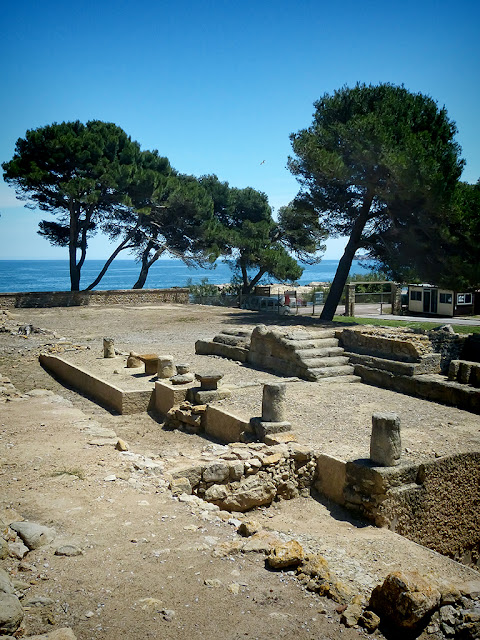
Antiquities from the excavations at Empúries onsite and in the Archaeological Museum of Catalonia in Barcelona, Spain

Image
Antiquities from the excavations at Empúries onsite and in the Archaeological Museum of Catalonia in Barcelona, Spain. Empúries was founded in 575 BCE by Greek colonists from Phocaea. After the invasion of Gaul from Iberia by Hannibal the Carthaginian general in 218 BCE, the city was occupied by the Romans (Latin: Emporiæ). After the conquest of Hispania by the Romans, Empúries remained an independent city-state. However, in t he civil war between Pompey and Julius Caesar, it opted for Pompey, and after his defeat it was stripped of its autonomy. A colonia of Roman veterans, named Emporiae, was established near Indika to control the region and a Roman mint operated there. A number of Roman mosaics have been preserved and sculptures of Asclepius, Demeter, Dionysos and possibly the Empress Livia have been recovered, too, as well as red-figured ceramics, oil lamps, articulated dolls, and coin hoards. Note: I had the wonderful opportunity to explore Empúries in 2013 taking the photogr...