Posts

Showing posts with the label engraved

Protesilaus: The first Greek to die in the Trojan War

Image
Protesilaus (also spelled Protesilaos) was one of the suitors of Helen of Troy sworn to defend the honor of Menelaus. He brought forty black ships with him to Troy, drawing his men from "flowering" Pyrasus, coastal Antron, and Pteleus, "deep in grass", in addition to his native Phylace in ancient Thessaly. Protesilaus was "the first man who dared to leap ashore when the Greek fleet touched the Troad", Pausanias recalled, quoting the author of the epic called The Cypria.  An oracle had prophesied that the first Greek to walk on the land after stepping off a ship in the Trojan War would be the first to die, and so, after killing four men, he was himself slain by Hector. (Alternate sources have him slain by either Aeneas, Euphorbus, Achates, or Cycnus.)  The gods had pity on his widow, Laodamia, daughter of Acastus, and brought him up from Hades to see her. She was at first overjoyed, thinking he had returned from Troy, but after the gods returned him to the ...
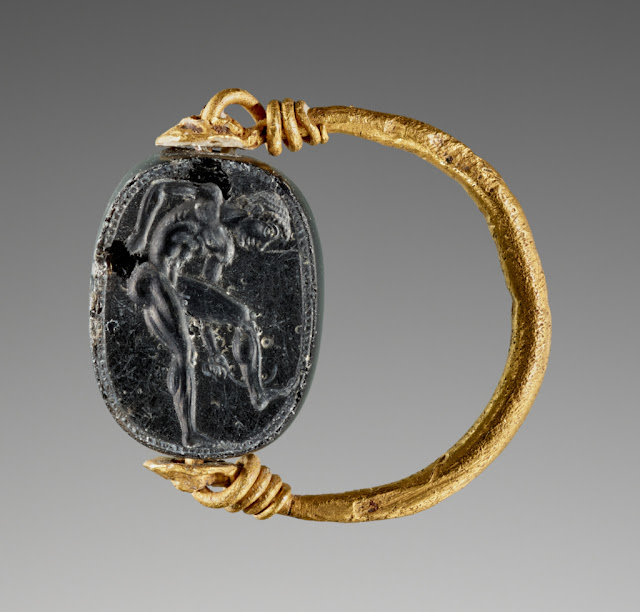
Roman athletics (as opposed to spectator sports)

Image
Depictions of athletes were popular on gems of the late 500s BCE and thereafter.  Not only Greek but Etruscan artisans produced these miniature works of art and the collection of these gems became popular among the Roman elite. As I've mentioned previously, both Julius Caesar and Pompey the Great collected them. One such artist, Epimenes, from the Cyclades, produced scenes of nude youths with meticulously defined musculature in complex twisted poses. His youths sported locks of hair radiating from the crown of the head with clusters of curls on the forehead. He adopted these features from innovations in sculpture and vase-painting at the time. "It is clear that some form of amateur athletics must have taken place simulta­neously with the real business at hand, which was, naturally enough from the bias of Republican Rome, training for war," observes classicist Donald White, University of Pennsylvania Museum of Archaeology and Anthropology. "Special ludi in­cluding spo...

Forgeries of ancient engraved gems

Image
The J. Paul Getty Museum has some spectacular ancient engraved gems in their collections and I have featured a number of them in my posts.  But, during the pandemic one of their curators, Kenneth Lapatin, researched one gem in their collection with a portrait of Marc Antony engraved upon it, and discovered, unfortunately, it was not ancient at all but a 19th century forgery produced by Giovanni Calandrelli for Prince Stanislas Poniatowski, nephew and heir to the King of Poland and Lithuania, and one of the richest men in Europe. Alerted by a friend, the late Gertrud Platz from the Berlin Antikensammlung, who had  just published a study of Giovanni Calandrelli, Lapatin learned she had recently examined a plaster impression that was made of one of Calandrelli's forgeries featuring a portrait of Marc Antony.  Platz suspected the Getty gem was the same work.  So Lapatin sent an impression of the Getty gem to her and they were found to be virtually identical. "There are t...

Centaur battling a Giant?

Image
Centaurs are popular on Archaic and Classical Greek gems and are often shown fighting, armed with branches or stones as signs of their wild nature. Battles with Herakles or the Lapiths (a people of Thessaly, famous in Greek mythology for their defeat of the centaurs) appear often, but the exact scene on this gem is unclear. The two snakes seen below the centaur’s forelegs recall the standard depiction of giants in Greek art, which are typically shown with human bodies and snake-legs: although a battle between a centaur and giant would be extremely unusual and is not a specific feature of Greek myth, the subject is attested on a Roman glass paste intaglio, suggesting it might also be depicted here. Such motifs probably reflect the Late Classical and Hellenistic interest in fanciful scenes involving mythical creatures popular in painting and sculpture. A scaraboid is a simplified scarab, with a plain curved back and an intaglio design decorating the flat underside. The form gradually rep...