Posts

Showing posts with the label emperor

The Transformation of Pharaonic deities to household gods in Roman Egypt

Image
The iconography and style of depictions of Horus and other traditional Egyptian deities were influenced by Hellenistic and, later, Roman traditions of representation, often combining trappings of power in ways that are striking to modern observers. "Roman period depictions of  the falcon-headed Horus have been  found  in  a  variety  of   materials  throughout  the  empire,  from  Egypt  to  Oxfordshire.  Usually  dressed  in  Roman  military costume, falcon-headed Horus is sometimes depicted on horseback, but more often standing, while seated figures are rare. Although smaller figures may have been dedicatory, larger stone and metal sculptures were probably objects of  public or private devotion." - Polychromy in Roman Egypt: A study of a limestone sculpture of the Egyptian god Horus by Joanne Dyer, Elisabeth R. O"Connell, and Antony Simpson. Sir Harold Bell observes, "...a new reli...
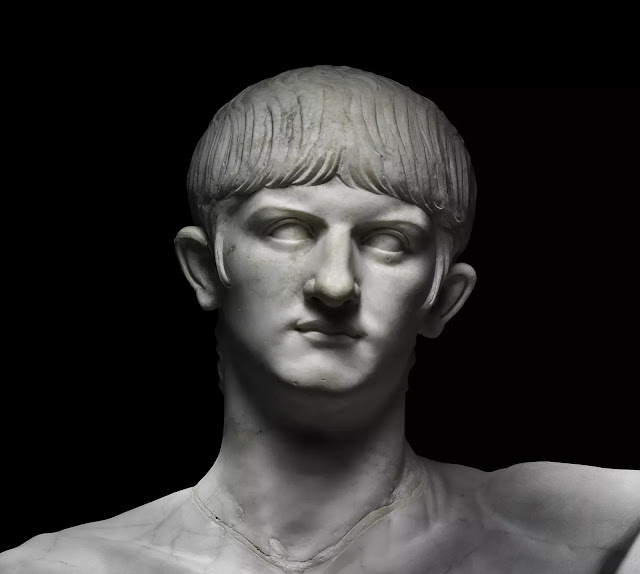
Nero: The Man Behind the Myth to open at the British Museum May 27, 2021

Image
An exhibition that will examine the misogynistic treatment of women under the reign of the emperor Nero is slated to open at the British Museum on May 27, 2021.  It will be on display until October 24, 2021. This "fresh look" at one of Rome's most notorious emperors will include more than 200 objects from the imperial palace in Rome to the streets of Pompeii that appear to contradict the traditional depiction of the “tyrant”, which is based on a “narrow range” of “brutally biased and partisan” sources. Part of the exhibition will also explore the role of imperial Roman women who were portrayed as adulterous and incestuous. Visitors will be able to see sculpture, manuscripts, objects destroyed in the 64 CE Great Fire of Rome, jewelry and even slave chains from Wales.  The Fenwick Hoard, a treasure discovered in 2014 beneath the floor of a shop in Colchester, will also be on display. Drawing on the latest research, this major exhibition questions the traditional narrative o...

The tragic boy emperor Philip II

Image
Philip II (Latin: Marcus Julius Severus Philippus; 237 – 249CE), also known as Philip the Younger, was the son and heir of the Roman Emperor Philip the Arab by his wife Marcia Otacilia Severa. When his father became emperor in 244, young Philip was appointed caesar at the age of only seven-years-old. In 247, he became consul, and was later elevated by his father to the rank of augustus and co-ruler.  Although ancient historians claim both Philip the Arab and his son were killed in battle by Decius.   Decius was a distinguished senator who had served as suffect consul in 232, had been governor of Moesia and Germania Inferior soon afterwards, served as governor of Hispania Tarraconensis between 235 and 238, and was urban prefect of Rome during the early reign of Emperor Philip the Arab. In 248 or 249 Decius was sent to quell the revolt of Pacatianus and his troops in Moesia and Pannonia, a rebellion seen by some modern historians as emerging Balkan separatism.  After t...

Mars, The Roman God of War

Image
Statue of the Roman emperor Hadrian as Mars, God of War, 117–125 CE, that I photographed at the Capitoline Museums, Rome, Italy In ancient Roman religion and myth, Mars was the god of war and also an agricultural guardian, a combination characteristic of early Rome. He was the son of Jupiter and Juno, and he was the most prominent of the military gods in the religion of the Roman army.  Under the influence of Greek culture, Mars was identified with the Greek god Ares, whose myths were reinterpreted in Roman literature and art under the name of Mars. But the character and dignity of Mars differed in fundamental ways from that of his Greek counterpart, who is often treated with contempt and revulsion in Greek literature. Mars' altar in the Campus Martius, the area of Rome that took its name from him, was supposed to have been dedicated by Numa, the peace-loving semi-legendary second king of Rome. Although the center of Mars's worship was originally located outside the sacred boun...

The David Plates plus one

Image
In 628–29 CE the Byzantine emperor Herakleios (also spelled Heraclius) (r. 610–41) successfully ended a long, costly war with Persia and regained Jerusalem, Egypt, and other Byzantine territory. Silver stamps dating to 613–29/30 on the reverse of these masterpieces place their manufacture in Herakleios’s reign. The biblical figures on the plates wear the costume of the early Byzantine court, suggesting to the viewer that, like Saul and David, the Byzantine emperor was a ruler chosen by God. Elaborate dishes used for display at banquets were common in the late Roman and early Byzantine world; generally decorated with classical themes, these objects conveyed wealth, social status, and learning. This set of silver plates may be the earliest surviving example of the use of biblical scenes for such displays. Their intended arrangement may have closely followed the biblical order of the events, and their display may have conformed to the shape of a Christogram, or monogram for the name of Ch...

Remnants of Caligula's Horti Lamiani now on display

Image
During the four years that Caligula occupied the Roman throne, his favorite hideaway was an imperial pleasure garden called Horti Lamiani. The vast residential compound spread out on the Esquiline Hill, one of the seven hills on which the city was originally built, in the area around the current Piazza Vittorio Emanuele II. There, just on the edge of the city, villas, shrines and banquet halls were set in carefully constructed “natural” landscapes. An early version of a wildlife park, the Horti Lamiani featured orchards, fountains, terraces, a bath house adorned with precious colored marble from all over the Mediterranean, and exotic animals, some of which were used, as in the Colosseum, for private circus games.  Now, relics from the Horti Lamiani have been recovered and put on display by archaeologists. The objects and structural remnants on display in the museum paint a vivid picture of wealth, power and opulence including elaborate mosaics and frescoes, a marble staircase, capi...

Cornice Block with Relief Showing the Baptism of Pharaoh (either Claudius or Nero), 41–68 CE, from the Temple of Harendotes on the island of Philae, Egypt, Roman Period at the Metropolitan Museum of Art

Image
This block originally formed part of a screen wall that connected the four front columns and the sidewalls of the temple of Harendotes ("Horus the Avenger") on the island of Philae. The relief represents the "Baptism of Pharaoh," a purification ritual that was part of Egyptian coronation ceremonies. The gods Horus (not preserved) and the ibis-headed Thoth, god of wisdom, pours water, represented by streams of the hieroglyphs ankh (life) and was (dominion), over the head of the king. The pharaoh whose head is partially preserved is a Claudian emperor, most probably either Claudius or Nero as defined in the strip of hieroglyphs along the top of the relief. As Pharaoh of Egypt, Nero adopted the royal titulary Autokrator Neron Heqaheqau Meryasetptah Tjemaahuikhasut Wernakhtubaqet Heqaheqau Setepennenu Merur ('Emperor Nero, Ruler of rulers, chosen by Ptah, beloved of Isis, the sturdy-armed one who struck the foreign lands, victorious for Egypt, ruler of rulers, chose...

The Arch of Galerius

Image
The Roman emperor Galerius commissioned the triple Arch of Galerius, built in 298-299 CE and dedicated in 303 CE,  as an element of the imperial precinct linked to his palace in Thessaloniki, Greece. Galerius served as Caesar during the tetrarchy of Diocletian and married Diocletian's daughter.  Entrusted with the care of the Illyrian provinces, he campaigned against Sarmatians and Goths along the Danube then was  dispatched to Egypt to fight the rebellious cities Busiris and Coptos. From there, Galerius was sent to command the eastern forces between Carrhae and Callinicum in Syria. Then, in about 295 CE, Narseh, son of the king Shapur I and the seventh emperor of the Sassanid Persian Empire, declared war on Rome and invaded western Armenia. Narseh then moved south into Roman Mesopotamia, where he inflicted a severe defeat on Galerius. Diocletian may or may not have been present at the battle, but presented himself soon afterwards at Antioch, where the official version of...

Gallienus, Third Century Reformer

Image
Born into a wealthy and traditional senatorial family, Gallienus was the son of Valerian and Mariniana. Valerian became Emperor on 22 October 253 CE and had the Roman senate elevate Gallienus to the ranks of Caesar and Augustus. Valerian divided the empire between him and his son, with Valerian ruling the east and his son the west. Gallienus defeated the usurper Ingenuus in 258 CE and destroyed an Alemanni army at Mediolanum in 259 CE. The defeat and capture of Valerian at Edessa in 260 CE by the Sasanian Empire threw the Roman Empire into the chaos of civil war. Control of the whole empire passed to Gallienus. He defeated the eastern usurpers Macrianus Major and Mussius Aemilianus in 261–262 CE but failed to stop the formation of the breakaway Gallic Empire under general Postumus. Aureolus, another usurper, proclaimed himself emperor in Mediolanum in 268 CE but was defeated outside the city by Gallienus and besieged inside. While the siege was ongoing, Gallienus was stabbed to death b...

Heraclius: The David of the Eastern Roman Empire?

Image
The year the Roman emperor Heraclius came to power, the empire was threatened on multiple frontiers. Heraclius immediately took charge of the Byzantine–Sasanian War of 602–628. The first battles of the campaign ended in defeat for the Byzantines. The Persian army fought their way to the Bosphorus but Constantinople was protected by impenetrable walls and a strong navy, and Heraclius was able to avoid total defeat. Soon after, he initiated reforms to rebuild and strengthen the military. Heraclius drove the Persians out of Asia Minor and pushed deep into their territory, defeating them decisively in 627 at the Battle of Nineveh. The Persian king Khosrow II was overthrown and executed by his son Kavad II, who soon sued for a peace treaty, agreeing to withdraw from all occupied territory.  The Eastern Roman empire thus regained Jerusalem, Egypt, and other Byzantine territory.  To celebrate his victory Heraclius ordered the production of a set of silver plates. Elaborate dishes us...

Claudius Imperator: Messalina, Agrippina and the Shadows of a Dynasty through October 27, 2019 at the Ara Pacis Museum in Rome, Italy.

Image
Claudius Imperator: Messalina, Agrippina and the Shadows of a Dynasty through October 27, 2019 at the Ara Pacis Museum in Rome, Italy. The story of Claudius's life and works, told in an innovative setting enriched with images and a sprinkling of audio and visual excerpts, lies at the heart of the exhibition, but other characters that pepper the narrative – introduced through valuable works of art - are the protagonists of installations that will help to make visitor’s experience even more engaging. Enhanced by the updated work of historians and archaeologists, the exhibition trail at the Ara Pacis Museum, reveals an image of Claudius that is a little different from the dark and unflattering impression of him provided by those who wrote about him in ancient times. What emerges is the sense of an emperor able to take care of his people, to champion useful economic reforms and great public works, who also introduced legislation that contributed to the administrative development of ...

Roma Universalis - the Severans, at the Colosseum in Rome, Italy through August 25, 2019

Image
Roma Universalis - the Severans, at the Colosseum in Rome, Italy through August 25, 2019.  A new exhibition at the Colosseum pays tribute to the Severans, Rome’s fourth and final dynasty which ruled from 193-235 CE.  Sculptures include portrait heads of Domna Julia, a young Geta, Heliogabulus, and the infamous Caracalla.  Artifacts include a tray-handle engraved with the triumph of Bacchus on loan from the Metropolitan Museum of Art, calyxes, cups and beakers from Germany and Tunisian earthenware.  Along the Forum, Romulus’s temple hosts 33 artifacts from the recent excavation of Eliogabalus’s Baths (between the Arches of Titus and Constantine).  A multimedia presentation entitled "Time's vortex" is also included in the admission ticket. Image: Marcus Aurelius through the Severans from the exhibition Roma Universalis.  Courtesy of Roma Universalis.